Remembering the Red Moulana
Remembering the Red Moulana
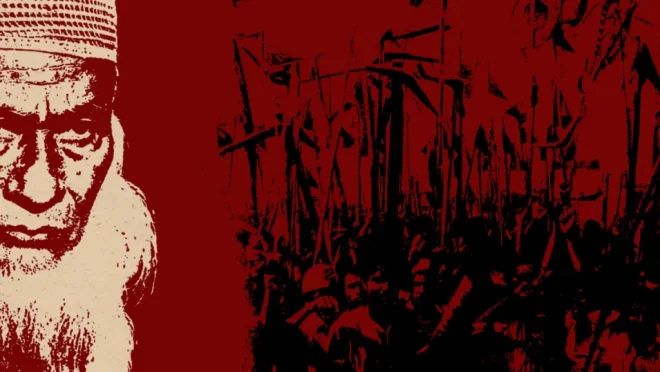
If one has to define politics in a word, that may be ‘compromise’. A pragmatic politician, not to mention a successful one, is always ready to cut deals for the perceived benefit of his constituency, moreover, for the benefit of his or her own standing as a so-called representative of that constituency.
However, the politician in question is nothing of that sort. Regarded as a “troublemaker” by Field Marshal Ayub Khan in his own diaries, Moulana Abdul Hamid Khan Bhashani was someone who could never get himself to sit patiently at the negotiating table.
“Talks between the oppressor and the oppressed never benefit the latter; it is always the oppressor who wins at the negotiating table… There should, therefore, be no discussion with a tyrant; the people are to realise their legitimate demands through mass movement.” – Moulana Abdul Hamid Khan Bhashani
This uncompromising characteristic is perfectly highlighted in the book written by the Editor-in-Chief of The New Age, Nurul Kabir, aptly naming his project The Red Moulana. Therefore, on the death anniversary of the Moulana, it is appropriate that we evaluate the Moulana’s life through the words of Nurul Kabir.
Becoming ‘Red’
As a Muslim born during the peak of colonial rule, it is no wonder that Abdul Hamid sought refuge in the emancipating principles of Islam wholeheartedly. His philosophy against aggression further developed greatly during his study at Deoband Darul Ulum, a birthplace of anti-colonial sentiment among educated Muslims in India.
The plight of the common man was something the Moulana could feel all too well. After becoming an orphan and living with his abusive uncle for a few years, he embraced the cold darkness known as British India.
“The so-called aristocracy of society struck my mind in childhood. I could never tolerate the idea of class distinction between human beings on the basis of the amount of land they own,” an uproar directly quoted by Nurul Kabir.
Reading some of the backstories of his childhood, it is no wonder that the Moulana would soon find commonalities with Marx himself and find the latter’s words regarding the pitfalls of capitalism quite convincing.
One of his teachers, Moulana Azad Sobhani, was a politician who may have introduced him to Marx. Indian mainstream politicians would call his teacher a communist openly. The Communist Party of India would even invite Sobhani to various political rallies to give speeches, such was the nature of idealistic politicians back then. Sobhani openly embraced communism, saying, “Yes, I am a communist, but with Allah.”
The anti-colonial and anti-imperialist spirit built within the walls of Darul Ulum paved the way for the Moulana to embrace the ‘Red’, and all his subsequent political decisions involved keeping the working class and the poor at the centre.
Becoming a National Leader
Bhashani would travel all over the districts of Bangladesh and lead the peasants to deter the oppressive social order one way or another. The problem proved to be so dominant that the British administration in Kolkata managed to get Bhashani legally ousted from many districts of Bengal. Kabir mentioned Pabna, Rajshahi, and Dinajpur.
In 1926, he fled to Assam. Here too, the ever-industrious Moulana arranged a historical conference for immigrant Bengali peasants at Bhashan Char, from where the people famously started to call him Bhashaner Moulana, which later turned into Moulana Bhashani. Nurul Kabir emphasises that it was notably the Assamese Hindus, a poorer class, who affectionately coined the term ‘Bhashani’ and started to call him a ‘Moulana’ (religious cleric).
Such was the Red One, who, despite having a long beard and his evergreen Islamic attire, could never be coined as a religious extremist. His work personified the essence of secular politics in East Pakistan, as he was one of the pioneers who separated from the Muslim League and formed the Awami Muslim League.
Amateur readers like us may not even know that it was he, not Sheikh Mujibur Rahman, who insisted that the word ‘Muslim’ be removed from the Awami Muslim League. He did so, much to the chagrin of a few party high commands, as the first president of the now Awami League.
The Moulana, who effectively led the consensus of Bengali politics for well over three decades, shaped the nationalistic nature of the Bangladeshi population. Some may argue it was he who straightforwardly demanded complete separation from West Pakistan if they did not fix their course towards a more equitable system.
Whether it was the British Raj, the Pakistani elite, or even the political hegemony of the post-71 Awami League, no administration felt fully comfortable sitting on their throne whenever the Moulana would walk the streets of the common man and echo their concerns.
Nurul Kabir fondly highlighted that the Moulana founded and left political parties and administrative roles many times. “He did so for the sole objective of paving the way for advancing genuine democratic causes,” writes Kabir.
In 1957, during the peak of the military regime of the Pakistani elite, Moulana Bhashani said “Assalamu Alaikum” to the current regime, meaning that it was time for them to leave, thereby wishing them well as they departed.
This famous sarcastic blessing echoed once more on 23rd November 1970. After the central government showed total indifference to the victims of a devastating cyclone in November 1970, Bhashani returned to Dhaka and, in a mammoth public rally on November 23, explicitly said “Assalamu Alaikum” to West Pakistan and effectively declared an independent East Pakistan.
The declining Bangladeshi historians will forever remain in debate over who actually declared independence conclusively. However, at a time when the general consensus was firmly against Pakistan, when there seemed to be no other way than independence, and when people’s conversations were filled with the word “mukti”, meaning emancipation, it was the Moulana who decisively could utter those words, just as he did in 1957, without any regard for how it may have sounded. To some “patriots” back in 1957, it sounded like treason, but not so much in 1970.
Contrasting everyone with the Moulana and his stances in 1957 and 1970 may be the best way to understand his politics. He was not afraid to utter any words of dissent so long as it meant serving his people. In 1957, when West Pakistan was joining a US-led defence pact without considering the East’s view, it was easy for him to say “goodbye” (Assalamu Alaikum), and in 1970, when the neglect reached its highest peak and the elite failed to revive the flood-ridden lands of his people, it was expected of him to utter similar words once again.
Such was the Moulana, ever defiant against power, ever vigilant against injustice, and forever ‘Red’, a giant beyond the eyes of the beholder.
The Red Moulana serves its purpose in introducing the newer generation to the person, the politician, and the idealist. A book worth much more than the price it is offered to us for and an easy read for someone looking to gain a proper understanding of how history truly takes its course.