1.4m jobs lost in decade despite 10% industrial growth: Study
Female manufacturing employment halves in 10 years
1.4m jobs lost in decade despite 10% industrial growth: Study
Female manufacturing employment halves in 10 years
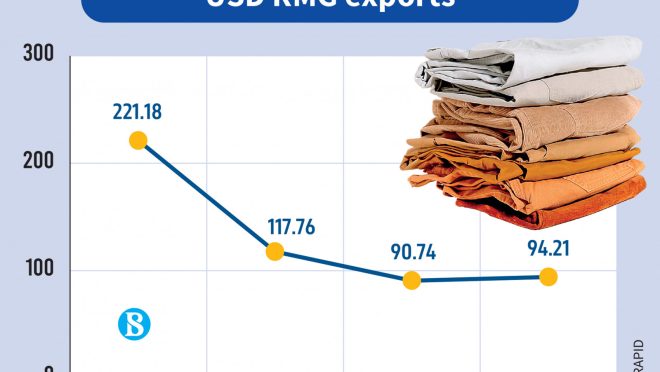
Bangladesh has experienced a decade of robust manufacturing expansion, yet employment in the sector has shrunk by 1.4 million, according to new findings from Research and Policy Integration for Development (RAPID).
The findings, presented by MA Razzaque, chairman of RAPID, at a seminar in Dhaka today (30 November), highlight a severe policy imbalance and a systemic failure of the education system to meet the demands of the labour market. Razzaque warned that if Bangladesh fails to adopt employment-centred policies for the coming decade, it risks a development “lost opportunity.”
RMG productivity surge reduces demand for workers
The readymade garment (RMG) industry – Bangladesh’s export backbone – illustrates the shift most starkly. In 2013, producing and exporting $1 million worth of garments required 220 workers. In 2024, the same volume of production needed just 94, largely due to automation and the adoption of advanced technologies.
Between 2010 and 2024, RMG exports jumped from $12.5 billion to $40 billion, yet employment stagnated at around four million workers.
“Youth unemployment is more than double the overall unemployment rate,” said Razzaque, who presented the keynote paper titled “Beyond Jobless Growth: Towards an Employment-Centred Policy Framework for Bangladesh Through a Post-Neoliberal Lens” at the seminar.
He argued that previous governments’ policy choices – focused narrowly on a single export sector – were responsible for the lack of broad-based job creation. “We have had growth over the past decade, but not employment, because policy was concentrated on a single sector. Other sectors were not prioritised,” he said.
Female employment in manufacturing halved
The report highlights a sharp decline in women’s participation in manufacturing. Female employment fell from 3.78 million in 2013 to 1.95 million in 2024, dropping from 40% of the sector’s workforce to just 24%. Male employment saw a slight rise during the same period.
Nearly four-fifths of Bangladesh’s unemployed population are young people, and in 2024, youth unemployment exceeded 8%, more than double the national average of 3.66%.
Education system failing job market needs
Speakers at the event identified Bangladesh’s education system as a major contributor to the employment crisis.
AKM Fahim Mashroor, CEO of bdjobs.com, said the number of annual graduates had surged from 3,00,000 fifteen years ago to 750,000 today – 4,50,000 of whom come from colleges under the National University.
“They are nothing but a factory for producing unemployed graduates,” he said, adding that nearly 70% of the curriculum taught under the National University is irrelevant to industry needs.
The criticism was echoed by Hossain Zillur Rahman, executive chairman of the Power and Participation Research Centre (PPRC), who said: “Access to education has expanded, but human capital is not being developed. Under the National University system, the lowest of the low-quality manpower is being produced.”
Md Sarwar Jahan Bhuiyan, secretary of the labour and employment ministry, added: “We are producing meaningless BA and MA graduates from the National University,” and called for restricting unskilled migration. He argued that remittance earnings would rise significantly if Bangladesh could send skilled workers abroad.
Labour market gaps and lost opportunities
The RAPID study shows that between 2016 and 2020, Bangladesh created about 1.2 million jobs per year – well short of the 2.2 million needed annually.
Agricultural output declined over the past decade, but employment in the sector increased, suggesting disguised unemployment in rural areas. Speakers said agriculture and overseas migration could serve as “low-hanging fruit” for job creation.
‘Trap of joyless resilience’
Two women entrepreneurs also presented their experiences, highlighting how they are creating jobs despite limited policy support. Their stories prompted Hossain Zillur to remark that “Bangladesh has fallen into the trap of joyless resilience,” urging policymakers to “free ourselves from this trap.”
Razzaque urged the government to prioritise employment creation in its upcoming Ninth Five-Year Plan. Failure to do so, he warned, could result in a missed development window.
New type of corruption’ under previous regime
Hossain Zillur characterised the previous Awami League government’s tenure in three phases, describing 2016-2022 as a period of “new type of corruption.”
“During these years, Bangladesh fell into the trap of a vicious triangle,” he said. “Growth was not employment-centred, equality was ignored, and governance served the vested interests of the corrupt and oligarchic groups,” he said.
The event was moderated by RAPID Executive Director Abu Eusuf, and featured contributions from Max Tuñón, ILO country director for Bangladesh; Sayema Haque Bidisha, pro-vice chancellor of the University of Dhaka; Kohinoor Yeasmin, CEO of Tarango; and Taslima Miji, managing director of Leatherina.