Pawmum Parban: From distant hills to the city of hope
For the first time, children from Bandarban’s Mro community have come to Dhaka to share their music, art and stories, bridging the hills and the city through a week-long cultural exchange
Pawmum Parban: From distant hills to the city of hope
For the first time, children from Bandarban’s Mro community have come to Dhaka to share their music, art and stories, bridging the hills and the city through a week-long cultural exchange
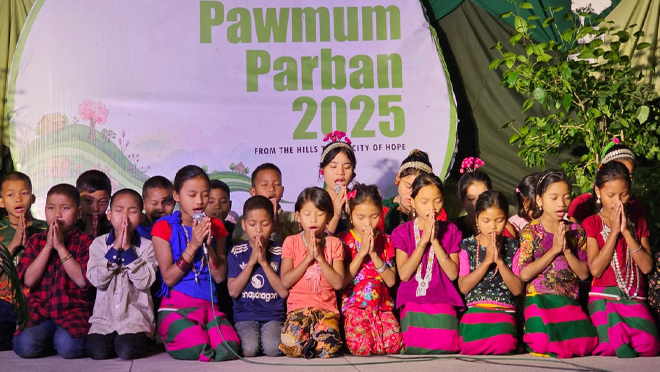
Picture a childhood spent entirely in the hills of Bandarban—far removed from city life, without ever performing ancestral music or dance beneath bright stage lights or through amplified sound. A life shaped by nature’s rhythms, untouched by the drone of traffic or the press of crowded streets.
Now, for the first time, children from the Mro community of Lama in Bandarban have travelled to the capital to share what they have learned. They are performing their music and dance, displaying their artwork, and engaging in an exchange of stories and creativity with children from Dhaka through a shared cultural encounter.
“Pawmum Tharkla,” a community school nestled in the hills of Lama, has, for more than a decade, been nurturing young minds while working to preserve the language, culture, and education of Mro children.
This year, the school organised “Pawmum Parban 2025: From Hills to Hope,” scheduled to take place from 17 to 24 December at Alliance Française de Dhaka’s Dhanmondi branch. However, after the first two days, Alliance Française postponed the programme until 21 December due to unforeseen reasons and will resume it from 22 December.
According to the organisers, Pawmum Parban has been held annually at the school premises in Lama. This year, however, they chose to bring the festival to the city, offering the children a rare opportunity to step beyond their familiar landscape and experience a vastly different world—one that opens new ways of seeing, learning, and imagining their future.
On the opening day, the rear courtyard of Alliance Française was transformed into a hill-inspired setting. The stage backdrop bore impressions of mountains, drifting clouds, and birds in flight. For the opening performance, the children sang Mro prayer songs before a diverse audience, while red and green buntings and string lights hung overhead, gently framing the space.
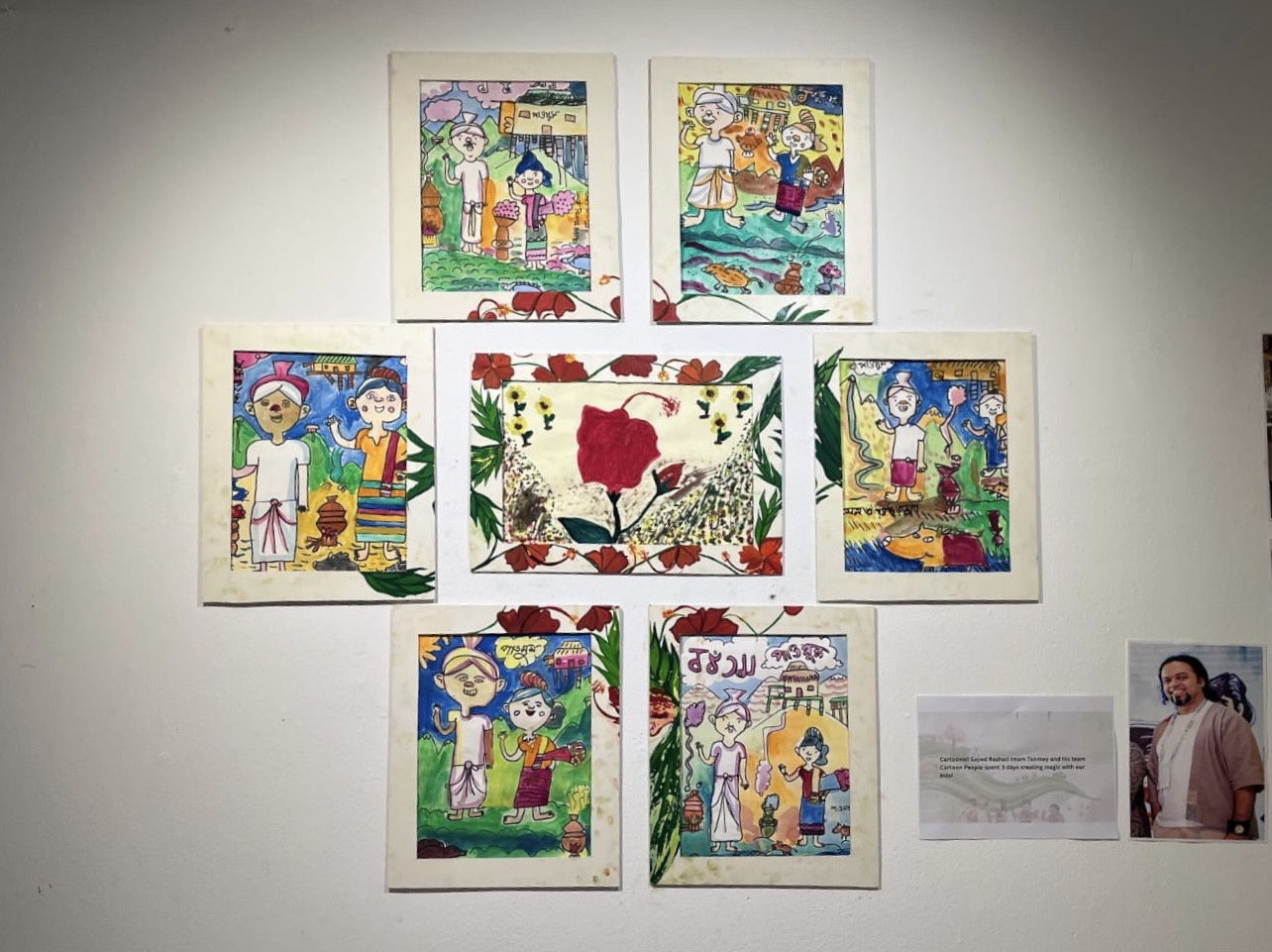
Artworks drawn by the Mro children depicting traditional Mro families
Inside the exhibition hall, visitors were greeted by artworks drawn by the Mro children, displayed along the walls. Some depicted hill landscapes—nature, flowers, and valleys—while others portrayed Mro families in traditional attire with their homes in the background. One drawing showed a Mro man holding a ‘plung’ flute in his hands. Photographs from Pawmum Tharkla School and Mro households were also exhibited.
The children were accompanied by their parents and elderly grandparents. Musicians had travelled with them as well—some playing the traditional bamboo instrument plung, others the violin-like tro, and some the flute called prui. Among Mro musical instruments, however, the plung remains the most widely made and played.
“There are several traditional plung that we make, including plung kakmo, plung klang, tinteng plung, and plung keycho,” said one plung player.
The seven-day programme features a range of activities, including cultural performances by Mro children, traditional songs and dances, cartoon workshops, calligraphy workshops, and storytelling sessions involving both Mro children and children from Dhaka.
There is also a theatre performance by Mro children in collaboration with Dhaka-based Prachyanat Theatre. Each day concludes with performances of traditional Mro music.
Chief organiser of Pawmum Parban and co-founder of Pawmum Tharkla, Uthoiyoy Marma, said, “This year, we brought the programme to the city so that our children can share their education, experiences, struggles, and the stories of their hills with children from urban Dhaka.”
“A child who has grown up entirely in the hills and has never known what a city looks like—we wanted them to experience a different environment and bring their learning into the heart of the city, to present it before people,” he added.
After completing their prayer songs and dances, the hill children—like young spirits of the mountains—wandered around the exhibition space, looking at drawings they had created years earlier.
Some paused to take photographs with their parents. The organisers also set up a stall selling traditional clothes, musical instruments, and daily essentials, with all proceeds going to the school fund.
Speaking about the school’s journey, Uthoiyoy said, “It has been more than ten years since we started the school. Throughout this journey, we have received support from many prominent artists and education advocates from the city. They have visited us in the hills and taught the children a wide range of skills—music, drawing, dance, and more.”
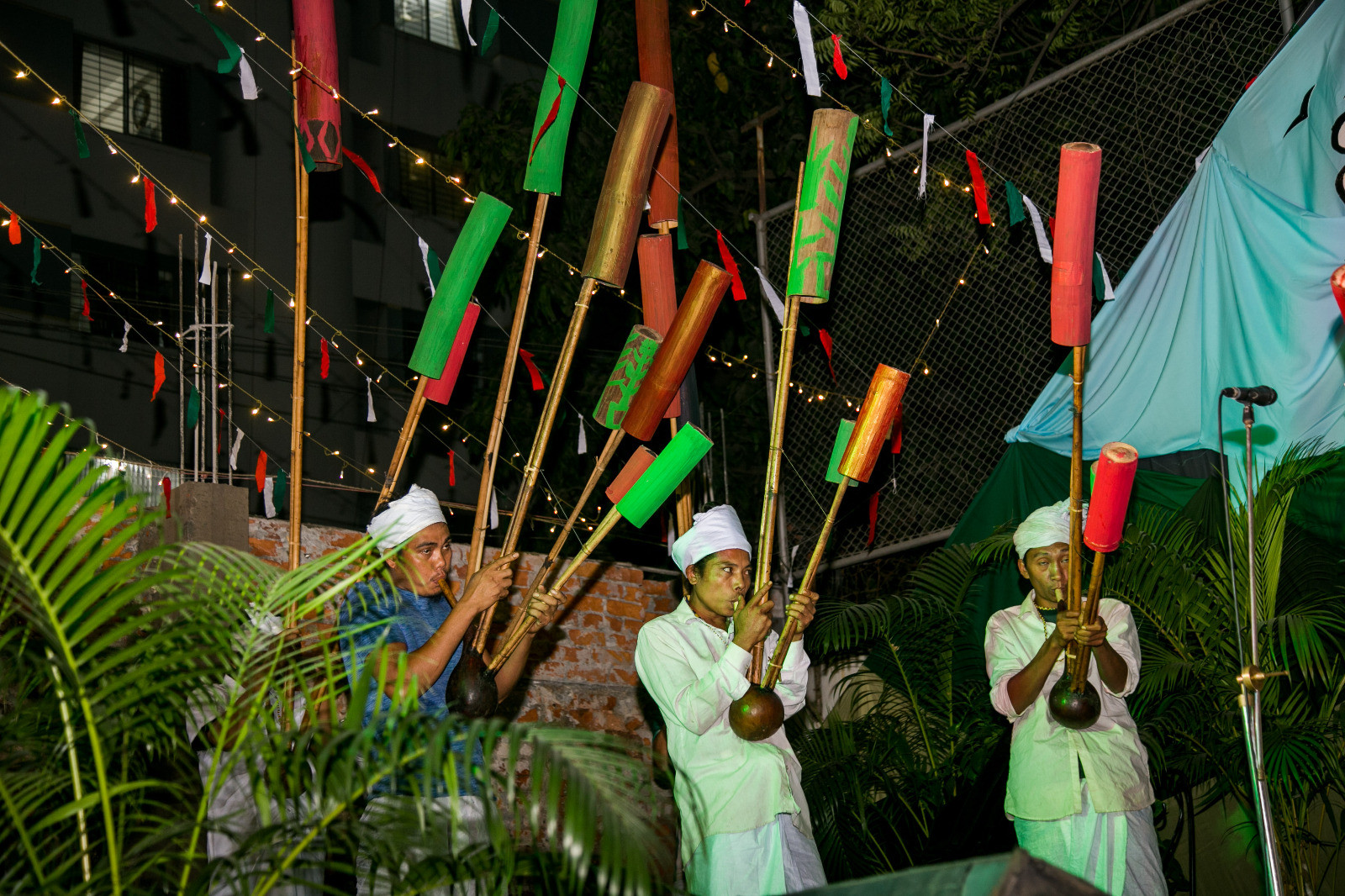
Mro musicians playing the traditional instrument ‘plung’
Several artistes, musicians, cultural organisations, and educators based in Dhaka have initiated collaborative projects with Pawmum Tharkla to work with the Mro children and introduce them to diverse forms of cultural expression. Cartoon People, a community of Bangladeshi cartoonists and visual storytellers, conducted cartoon workshops this year, while the theatre organisation Prachyanat also arranged acting workshops.
Another co-founder of the school, Shahariar Parvez, spoke of his dream: “We want to move across the entire landscape of the country with these children, so that they can draw every part of it, and grow.”