End of glacial ice in Venezuela
End of glacial ice in Venezuela
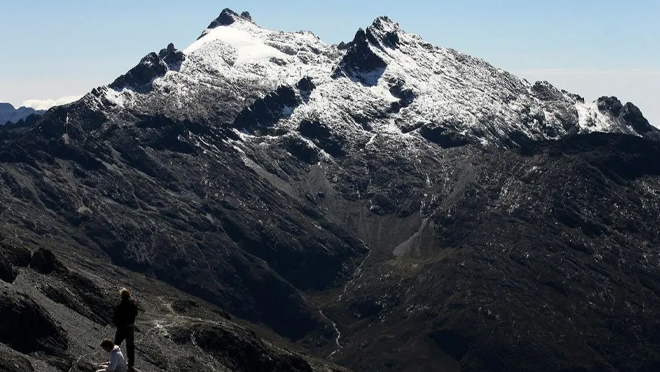
Venezuela is on the verge of becoming the first country in modern history to lose all of its glaciers, after scientists downgraded what was believed to be its last remaining glacier to an ice field, according to a report published by the BBC.
The International Cryosphere Climate Initiative (ICCI) said Venezuela’s only remaining ice mass, the Humboldt Glacier, also known as La Corona, is now too small to be classified as a glacier. Situated high in the Andes, the ice has steadily shrunk as global temperatures continue to rise.
Venezuela has already lost at least six glaciers over the past century, making the disappearance of the Humboldt a stark symbol of the accelerating climate crisis.
“There has not been much ice cover on the last Venezuelan glacier since the early 2000s,” Dr Caroline Clason, a glaciologist at Durham University, told the BBC. “Now the ice is no longer accumulating, so it has been reclassified as an ice field.”
In March, researchers from the University of Los Andes in Colombia told AFP that the glacier had shrunk from around 450 hectares to just two. Ecologist Luis Daniel Llambi later told The Guardian that the remaining ice mass may be even smaller.
There is no universal minimum size for a glacier, but the US Geological Survey commonly uses a benchmark of around 10 hectares. A study published in 2020 suggested the Humboldt glacier fell below this threshold between 2015 and 2016, although Nasa continued to list it as Venezuela’s last glacier in 2018.
Dr James Kirkham of the ICCI and Dr Miriam Jackson of the International Centre for Integrated Mountain Development explained to the BBC that size alone does not define a glacier.
“Glaciologists recognise a glacier as an ice mass that deforms under its own weight,” they said, noting that access challenges in recent years may have delayed updated measurements.
Professor Mark Maslin, professor of Earth system science at University College London, said an ice field the size of two football pitches no longer meets the scientific definition of a glacier.
“Glaciers fill valleys and flow under their own weight,” he told the BBC. “By that definition, Venezuela no longer has any glaciers.”
In December, the Venezuelan government announced plans to cover the remaining ice with a thermal blanket in an attempt to slow melting. However, local scientists warned the measure could damage the surrounding environment as the material degrades, according to El País.
Professor Maslin said mountain glacier loss is not easily reversible. “Once a glacier disappears, sunlight heats the exposed ground, making it much harder for ice to reform,” he explained.
Climate experts warn Venezuela will not be alone. Extreme weather researcher Maximiliano Herrera has suggested that Indonesia, Mexico and Slovenia may also become glacier-free in the near future due to warming temperatures and low-altitude mountain ranges.
Although the loss of small glaciers like Humboldt will not significantly affect sea levels, scientists stress that glaciers are critical sources of fresh water for many communities, particularly during dry periods.
Dr Kirkham and Dr Jackson warned that glacier loss is accelerating worldwide. “Between 20 and 80 percent of the world’s glaciers could disappear by 2100, depending on future emissions,” they said, adding that rapid reductions in carbon output could still protect remaining ice and safeguard water and food security.