NU reforms key to higher education quality, says VC
NU reforms key to higher education quality, says VC
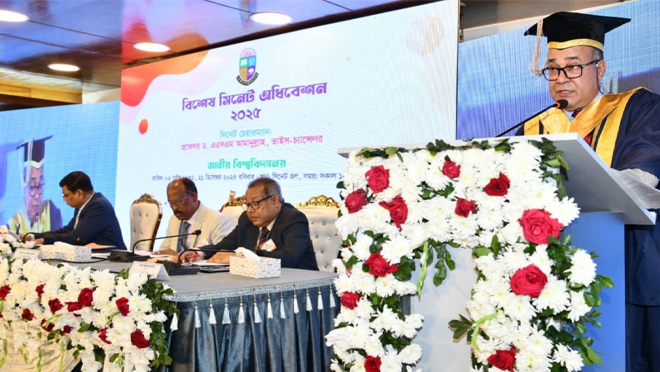
Developing the National University into a centre of excellence is essential to building a non-discriminatory, just and balanced society, as well as a developed and prosperous nation, National University Vice-Chancellor ASM Amanullah said.
He made the remarks while delivering the Senate Chairman’s address at a special Senate session held at the National University campus on Saturday.
The Vice-Chancellor said the National University provides around 70 percent of the country’s higher education and oversees nearly 2,500 public and private colleges and professional institutions nationwide. Strengthening the university, he said, is therefore critical to producing skilled leadership for state governance and national development.
Established in 1992 to improve undergraduate and postgraduate college education, modernise curricula and oversee teacher training, the National University has yet to reach its desired standard even after more than three decades, he said.
Referring to the changed national context following the July uprising, Professor Amanullah said the current administration has undertaken reform programmes and action plans to transform the university into a fully developed institution. If implemented, these reforms would bring qualitative improvements to higher education and create employment opportunities for students, he added.
He said initiatives have been taken to develop students into skilled human resources through training in information technology and multiple languages. As part of this process, ICT and English have been made mandatory in revised undergraduate, honours and postgraduate syllabuses.
The Vice-Chancellor said training in artificial intelligence and data science would be introduced to prepare students for the challenges of the Fourth Industrial Revolution. In the first phase, 50,000 students will receive freelancing training funded by the university, with further phases planned.
He added that steps have been taken to sign memorandums of understanding with domestic and international institutions, form career clubs at affiliated colleges, and establish specialised institutes and laboratories.
Professor Amanullah said several initiatives have already been launched, including the Virtual Learning Center, the Institute of Forensic Science and Cyber Security, the International Language Institute, the Institute of Media Studies and Journalism, the Institute of Remote Sensing and GIS, and the National University–Salford Center of Excellence for Emerging Technologies, in collaboration with University of Salford.
He said apprenticeship programmes have been introduced, alongside plans for centres of excellence, multimedia and online studios, industry–academia linkage initiatives, academic exchange programmes, and PhD and MPhil programmes in 31 subjects under the Liberation War and Bangladesh Research Institute. New courses, including the Master in Development and Policy Studies and the Master of Public Health, have also been introduced.
Skill development training for teachers and officials, construction of examination centres in all districts, establishment of new regional centres, and district-level college monitoring activities are also underway, he said.
“We have a long way to go and many obstacles to overcome,” Professor Amanullah said, seeking cooperation from the government and Senate members to implement the reform agenda.
Senate members participated in the discussion and assured support for the initiatives of the current administration.
The meeting decided to ratify revised governing body statutes of affiliated colleges and convert the university’s academic groups into faculties.
Earlier, a condolence motion was adopted and a minute of silence was observed.
The session was attended by Pro Vice-Chancellors Md Lutfar Rahman and Md Nurul Islam, Treasurer ATM Zafrul Azam, Senate members, deans, teachers and officials. Invited guests included Planning Commission Senior Secretary Md Mokhles Ur Rahman, academics and heads of higher education institutions.