Saving Shomeshwari: Ecology, economy, and the true cost of sand
Once ravaged by unregulated sand mining, Bangladesh’s Shomeshwari River is quietly recovering, as residents weigh recovery against looming economic pressures
Saving Shomeshwari: Ecology, economy, and the true cost of sand
Once ravaged by unregulated sand mining, Bangladesh’s Shomeshwari River is quietly recovering, as residents weigh recovery against looming economic pressures
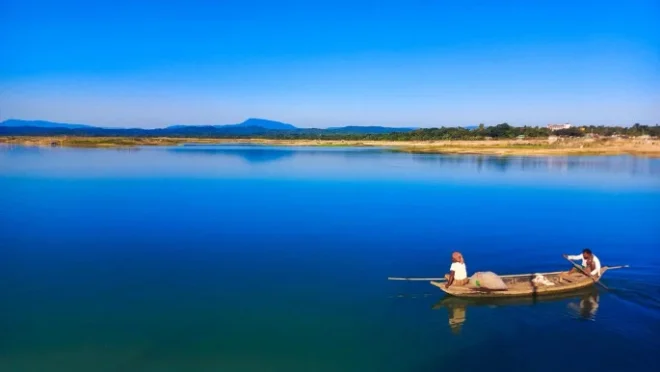
A few miles south of the Indian border, with the Garo Mountains looming overhead, the Shomeshwari River runs deep and blue. On one bank, golden foothill slopes rise gently; on the other stands Susang-Durgapur upazila. Unlike most rivers in Bangladesh, the water here is crystal clear, unclouded by a thick layer of alluvial silt. Instead, minerals and sand on the riverbed allow it to mirror the colour of the sky.
However, over the past decade, the Shomeshwari has been systematically stripped of its beauty. Only recently has the river begun to return to something resembling its original form. Ironically, the very mineral-rich sands that once set the Shomeshwari apart from other rivers of the delta became the basis of its exploitation.
For years, the river was mined, extorted, and pushed to the edge of ecological collapse.
At its peak, thousands of trucks lined up daily along its banks, hauling away sand and stone, hollowing out the riverbed and altering the Shomeshwari’s natural flow. The Mymensingh–Birishiri highway, never designed to bear the constant weight of sand-laden trucks, remained perpetually vulnerable, making everyday travel difficult for residents.
Roads across the otherwise scenic towns of Birishiri and Susang-Durgapur were frequently coated in thick layers of mud, while dust hung over entire neighbourhoods.
“We could barely breathe,” said Wahed Ali, a resident who has lived beside the river for the past two decades. “The dust seeped into our lungs, and the constant din of the extraction machines made it impossible to live anywhere near the river. Also, countless people have died accidentally trying to extract sand with dredger machines.”
Local residents say that a largely untrained workforce and the absence of regulation made sand extraction particularly dangerous, leading to numerous deaths over the past decade. According to available statistics, more than six people—including a child—died in 2021 alone.
Dredger machines and the deep cavities they carved into the riverbed turned the area into a hazardous environment for both workers and nearby communities.
But that reality has changed. In place of the raucous sound of mining machinery and the constant movement of sand-laden trucks, the Shomeshwari now flows in relative stillness, its waters uninterrupted and its biodiversity slowly beginning to recover. Under a directive from the High Court, sand extraction activities—including leasing operations at five sand quarries along the river—have remained suspended for the past two years.
Signs of balance, not abundance
Fishes are not available abundantly, but the ecological balance is restoring as their natural habitat is no longer disrupted. The habitat degradation has been temporarily suspended, and fishermen, after a long time, can again be seen fishing in the river.
“I live nearby, and my nephew and I come here to fish during the day. Some days we catch a few; other days we return empty-handed. It’s not a livelihood yet, but it has the potential to become one again,” said Alam, a local fisherman.
Claims circulating in fish markets in Dhaka and elsewhere suggest that the once nearly extinct Mohashol fish has reappeared, with some vendors asserting that the fish now being sold come directly from the Shomeshwari River. Fishermen and local residents, however, firmly reject this assertion.
“The Mohashol was last found here 20 to 30 years ago, when the river still had a swift current,” said Alam.
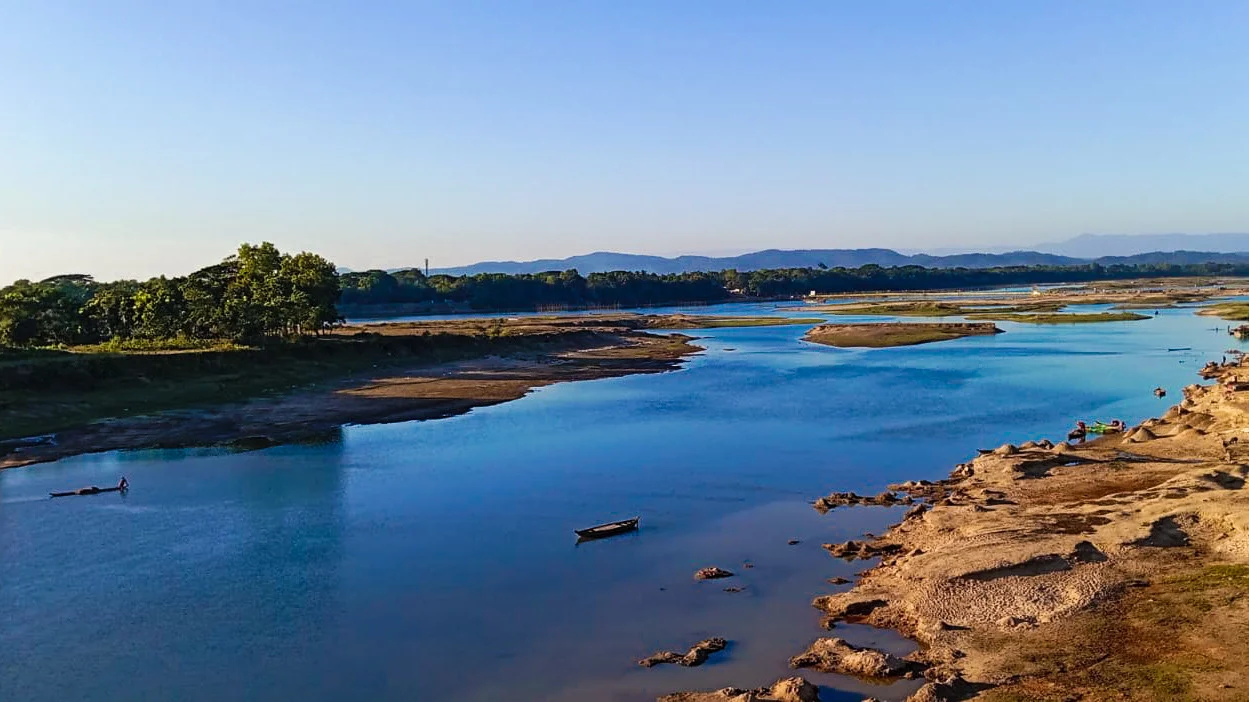
Photo: TBS
The untapped tourism potential
Earlier, the area was heavily congested, with constant vehicular movement making normal passage difficult. According to locals, the route was often completely blocked. A journey from Mymensingh to Durgapur, which now takes one to two hours, used to take significantly longer—sometimes close to three hours.
As a result, tourists were largely deprived of the scenic beauty of the Shomeshwari River, despite the white hills of Bijoypur holding immense tourism potential. Poor transportation discouraged visitors, which in turn limited the development of hotels and resorts in the area.
Eftekher Emon, a tourist who came all the way from Mymensingh, shared his experience with TBS.
“We knew a place like this existed here, but we had never visited before because the area and its transportation were not tourist-friendly. We came to see the white hills of Bijoypur and the blue lakes, but stumbled upon this beautiful river along the way. Standing here now, I’m really enjoying the view.”
Yet, for years, the area’s tourism potential remained largely overlooked. With sand extraction offering a quicker and more reliable source of income, most local residents and businesses gravitated toward it instead.
The threat of return
With elections approaching and the possibility of a change in government, many residents remain concerned about the course the next administration may take.
Some locals claim that sand extraction networks are already regrouping, with small-scale extraction continuing at night, under the cover of darkness and reduced surveillance. Many residents were directly or indirectly involved in the business.
The decision to halt unregulated sand extraction dealt a significant blow to the local economy. A local bank manager said deposits had declined sharply following the ban. The local administration, however, remains firm in its stance, maintaining that economic activity cannot come at the cost of the river’s ecosystem.
“A large portion of the local population depended economically—directly or indirectly—on sand extraction from the Shomeshwari River. However, when sand was extracted in an unplanned manner, it led to serious consequences, including riverbank erosion and significant hardship for people living in the surrounding areas,” said the UNO of Susang-Durgapur.
Given that the Shomeshwari contains mineral resources that support the local economy, a regulated approach to sand extraction could be considered. However, the priorities of future governments remain uncertain.