First manned mission to moon in 50 years set to be launched
The 98-metre-tall rocket completed a 12-hour journey of about four miles from the Vehicle Assembly Building to Launch Pad 39B at NASA’s Kennedy Space Center in Florida. The rocket was transported by a crawler-transporter at a top speed of 0.82 miles per hour
First manned mission to moon in 50 years set to be launched
The 98-metre-tall rocket completed a 12-hour journey of about four miles from the Vehicle Assembly Building to Launch Pad 39B at NASA’s Kennedy Space Center in Florida. The rocket was transported by a crawler-transporter at a top speed of 0.82 miles per hour
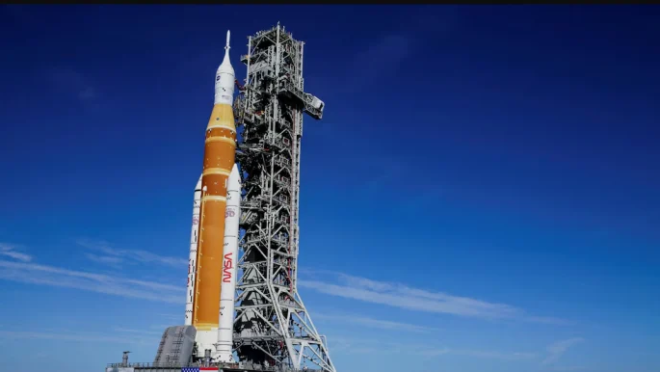
NASA has moved its Space Launch System (SLS) rocket to the launch pad in preparation for the Artemis II mission, the first crewed flight toward the Moon in more than five decades.
The 98-metre-tall rocket completed a 12-hour journey of about four miles from the Vehicle Assembly Building to Launch Pad 39B at NASA’s Kennedy Space Center in Florida. The rocket was transported by a crawler-transporter at a top speed of 0.82 miles per hour, says the BBC.
The SLS is now positioned for final testing, including a wet dress rehearsal designed to verify fuel loading operations and countdown procedures ahead of launch.
Artemis II is planned as a 10-day mission that will send four astronauts around the Moon without landing. NASA has said the flight is intended to lay the groundwork for Artemis III, a mission aimed at returning astronauts to the lunar surface at the Moon’s south pole no earlier than 2027 or 2028.
NASA said the earliest possible launch date for Artemis II is 6 February, with additional launch windows available in March and April.
Under the current mission plan, the crew will spend the first two days in a high Earth orbit about 40,000 miles from the planet before travelling roughly a quarter of a million miles to fly around the far side of the Moon. While near the Moon, the astronauts are expected to spend about three hours observing lunar geology and taking images to support planning for future landings.
The crew includes three NASA astronauts — Reid Wiseman, Victor Glover and Christina Koch — along with Canadian Space Agency astronaut Jeremy Hansen.
Koch said the mission would offer a rare view of Earth as a “single ball” from space. Hansen said he hoped the flight would encourage people to view the Moon with renewed interest.
The mission will use NASA’s Orion spacecraft, which is powered in part by the European Service Module built by Airbus for the European Space Agency. The module provides propulsion to reach the Moon, electrical power through large solar arrays, and life-support systems including water and a mix of oxygen and nitrogen for the crew.
NASA officials have acknowledged years of delays to the Artemis programme but said safety remains the agency’s top priority. John Honeycutt, chair of the Artemis mission management team, said NASA would only proceed with the mission when it is ready to ensure the safe return of the four astronauts.
Engineers are continuing work on future Artemis modules, with each unit requiring thousands of hours of design and construction to ensure all components function as intended.