Reclaim Your Heart: A gentle guide through loss and attachment
Ever notice how some losses change you slowly and shape who you become long after the event has passed? What happens when suffering demands understanding rather than answers?
Reclaim Your Heart: A gentle guide through loss and attachment
Ever notice how some losses change you slowly and shape who you become long after the event has passed? What happens when suffering demands understanding rather than answers?
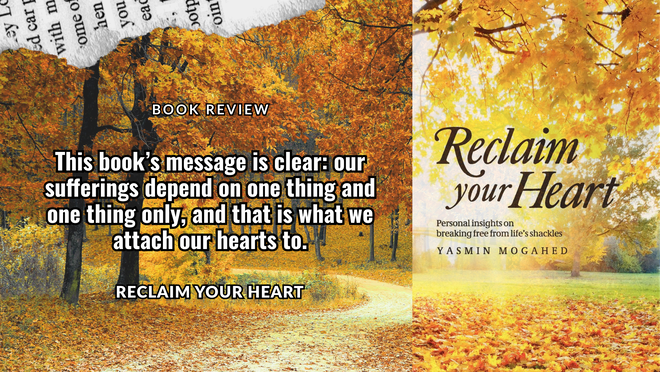
Reclaim Your Heart by Yasmin Mogahed speaks to that kind of loss, the kind that reshapes you. Yasmin Mogahed does not write to eliminate pain, nor does she promise healing in neat steps.
Instead, she offers something subtler: “perspective”. In moments of grief, disappointment, or emotional separation, this book does not pull the reader out of sadness; it sits beside them and gently asks where the heart has been resting.
This book’s message is clear: our sufferings depend on one thing and one thing only, and that is what we attach our hearts to.
She uses a powerful metaphor: when a glass is placed at the edge of a table and it falls, we do not blame gravity for the fall. We recognise that our choice led to that inevitable fall rather than gravity.
In the same way, we cannot blame someone or something for our misplaced attachments. True trust, she suggests, belongs to the Divine, the only constant in an impermanent world.
What is the book really saying about loss?
Unlike conventional self-help narratives that aim to “fix” grief, Reclaim Your Heart reframes loss as a form of redirection.
According to Mogahed, the sense of permanence we connect to things that were never meant to stay is what destroys us rather than loss per se. Loss, in this sense, is not failure. It is clarity.
Mogahed is adept at describing emotional suffering without discrediting it. Heartbreak is something she acknowledges. She contextualises it, suggesting we love fully, yet not depend entirely; care deeply, yet recognise limits.
Where faith is the foundation, not an afterthought
Reclaim Your Heart is unique because it offers tawakkul, a deep faith in the Divine, as an answer to emotional hardship rather than detachment.
Faith is not a secondary tool; it is the ground on which everything else stands. Mogahed keeps returning to the notion that real contentment comes from giving up control over life’s circumstances to a knowledge greater than our own.
She portrays trust as an emotional anchor rather than passive resignation. She argues that unanswered suffering is not equivalent to unanswered prayers and that loss does not equate to abandonment.
This perspective resonates powerfully with Muslim readers because it reflects a real-life experience of holding on to one’s beliefs while undergoing serious pain. Importantly, faith in Mogahed’s writing is not a shield that blocks pain.
Rather, it becomes a place where grief can rest. Pain is acknowledged honestly, but it does not dictate how we feel entirely.
Why Muslim readers connect so deeply
For many Muslim readers, Reclaim Your Heart feels more like understanding their own feelings than being taught something new.
For most Muslims, the idea that life is temporary and trust belongs only to God is not new; they grow up knowing it. However, there is a significant difference between knowing this truth and living it, and much of the suffering stems from this gap. Mogahed’s writing brings this realisation to light.
Mogahed talks about the balance between loving deeply and not becoming too attached, making the book very helpful during heartbreak, loss, or spiritual struggles. That is why it is so popular, with a 4.4 out of 5 rating on Goodreads, where readers often say it made them feel spiritually supported rather than just emotionally fixed.
Where the book may fall short
This book’s spiritual framework may be very comforting to Muslim readers, but others might feel alienated by the book’s frequent references to Islamic belief. However, Mogahed’s emphasis on universal emotions, loss, longing, and hope keeps the message accessible.
The book does not try to make its beliefs apply to everyone, but it shows that peace comes from grounding the heart in something beyond the temporary. Its focus on faith may feel limiting for readers who prefer psychological or secular approaches, and without openness to spirituality, some lessons might not fully resonate.
Ultimately, Reclaim Your Heart is best read when the heart feels heavy. When life seems fragile, it meets the reader where they are and provides consolation and perspective. It is more of a companion than a guide; one you can return to in times of grief, loss, or uncertainty, whose words stay with you until the heart is ready to heal.