No reform plan for education: How structural failures are undermining Bangladesh’s future
As Bangladesh undertakes broad reform initiatives, education remains conspicuously sidelined. Years of underinvestment and politicised decision-making have weakened the system at every level, putting the country’s human capital and long-term growth prospects at risk
No reform plan for education: How structural failures are undermining Bangladesh’s future
As Bangladesh undertakes broad reform initiatives, education remains conspicuously sidelined. Years of underinvestment and politicised decision-making have weakened the system at every level, putting the country’s human capital and long-term growth prospects at risk
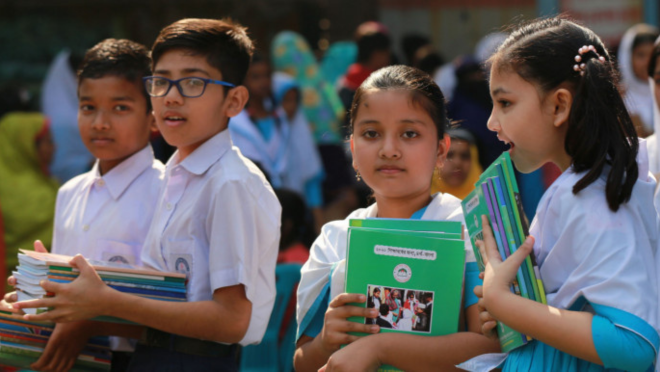
If you talk to a parent of any school-going child, one of their most common complaints would be, “In our days, we had such high-quality education! These days, the kids learn nothing!”
This may be an exaggeration; however, the concerns cannot be discarded as mere nostalgic ‘good old days’. The quality of our education has indeed fallen as the curriculum has been made into a partisan battlefield and years of low investment in education has hollowed out our education system.
Education is universally recognised as a foundational human right and a prerequisite for sustainable development. Yet, the country’s education system continues to lag behind regional and global benchmarks, constrained by structural weaknesses, chronic underinvestment, and politicised policy-making.
Moreover, though Bangladesh is going through a major reform process, none has been taken for the education sector.
Unless education is funded at scale and pursued through long-term, evidence-based reform, the country risks missing out on not only our demographic dividend and riding the Fourth Industrial Revolution, but also a generation’s opportunity for equitable and meaningful development.
Free and compulsory education: Bangladesh at the bottom
SDG target 4.1 stipulates that by 2030, all boys and girls should complete free, equitable and quality primary and secondary education. Bangladesh, however, has made limited progress, even by regional standards.
According to UNESCO’s World Education Statistics 2024, Bangladesh provides legally guaranteed free education only from 1st to 5th grades. This places the country among the most backward globally — and the weakest in South and Central Asia. Only three countries worldwide fall behind Bangladesh on this indicator.
By contrast, Sri Lanka guarantees free education from pre-primary to the 12th grade, while countries such as Nepal, Pakistan, Afghanistan, and Uzbekistan have extended free education up to the secondary level through legal frameworks. Even India ensures free education up to the 8th grade.
The same pattern emerges in compulsory education. While 155 countries worldwide have declared education compulsory up to the 8th grade or beyond, Bangladesh’s legal obligation ends at the 5th grade, under the Primary Education (Compulsory Education) Act of 1990. Three decades on, no extension has been enacted.
Educationists argue that the failure to expand free and compulsory education reflects weak political commitment rather than fiscal impossibility. As a result, the burden of education costs shifts sharply onto households, particularly at the secondary level, where families currently bear around 71% of total expenses.
The structural neglect of secondary education has produced alarming outcomes. Official education statistics show that while primary dropout rates are below 15%, the overall dropout rate at the secondary level stands at 34.46%. The situation is even worse in madrasas, where dropout rates exceed 40%.
Samina Luthfa, professor of Sociology at the University of Dhaka, emphasised that underinvestment lies at the core of Bangladesh’s education crisis.
“If education consistently receives the smallest share of the GDP or the national budget, meaningful development in the sector cannot be expected,” she said. “Unfortunately, this is reflected in the poor quality of education, which is most acute in less affluent areas.”
Curriculum instability and the erosion of learning
Beyond access and equity, quality remains a critical concern, particularly at the primary level. Frequent and politically driven curriculum changes have created instability in early learning.
Luthfa warned that constant textbook revisions harm children’s cognitive development, “With every change of government, textbooks are overhauled. This constant and often radical alteration of learning materials poses a serious problem for children’s mental and cognitive development.”
She added, “If textbooks are completely changed every five years, the impact on children is inevitably negative. In core subjects such as history, there is no meaningful provision to cultivate critical thinking.”
The consequences of this instability cascade through the education system, surfacing most visibly at the tertiary level.
Weak foundations, collapsing outcomes
According to Professor Luthfa, by the time students reach universities, the cumulative damage is already done.
“Because primary, secondary, and higher secondary education fail to nurture critical thinking or analytical reasoning, students arrive at universities without these essential capacities,” she said.
She explained the skills deficit in stark terms, “Students lack the three core skills that are repeatedly emphasised: language proficiency, numerical and quantitative skills, and analytical reasoning. Many cannot write properly in Bangla, have little command over language, and lack basic quantitative competence.”
These deficits are exacerbated by geographic inequality. Teachers gravitate towards urban centres, leaving rural schools understaffed and under-resourced. The result is a growing pool of graduates who are formally educated but functionally unprepared for employment.
“We are witnessing a growing population of educated but unemployed young adults,” she warned. “If this trend continues, Bangladesh will fail to fully harness its demographic dividend and will instead face escalating social problems,” said Luthfa.
Reform absent, politics dominant
Despite the scale of the crisis, education reform has remained conspicuously absent from recent political initiatives. Following the mass uprising, led by students, on 5 August 2024, 11 reform commissions were formed to address various sectors. None focused on education.
M Nazmul Haq, professor of Education at the University of Dhaka’s Institute of Education and Research, described this neglect as long-standing and politically motivated.
“Education has always been a neglected sector — not just now, but consistently,” he said. “Those in power may not want citizens to be genuinely well educated, because an educated population can become politically inconvenient.”
He criticised the cycle of policy announcements without implementation, “We have seen education commissions formed, only for another to appear months later, and then nothing for years. Even the National Education Policy that followed was never fully implemented.”
For Professor Haq, curriculum reform epitomises this dysfunction, “Education policy is not a one- or two-year undertaking; it is inherently a long-term project. Developing a curriculum alone takes years. Once developed, it should not be overturned overnight.”
He added, “Abruptly cancelling or replacing a national curriculum because of political change is a serious disservice done to the education system.”
Bureaucracy, budgets and broken incentives
Haq also pointed to bureaucratic inertia and distorted budget priorities as structural barriers.
“A significant portion of the education budget is absorbed by structural development and non-instructional expenditures,” he said. “As a result, core educational costs — particularly teachers’ salaries — are neglected.”
Low remuneration, he argued, deters capable educators and entrenches poor outcomes across levels. He was equally critical of elite detachment from public education, “Many senior bureaucrats do not send their children to public schools in Bangladesh. They have little respect for, or confidence in, the national education plans.”
Ultimately, he stressed, reform without resources is meaningless, “If a country does not allocate a substantial share of its resources to education, meaningful development is simply not possible. You cannot deny resources and still hope for progress.”
An unfinished constitutional promise
More than 50 years after independence, Bangladesh’s constitutional promise of free and compulsory education remains unfulfilled. Education is listed among the fundamental principles of state policy, but not as an enforceable right — leaving citizens without legal recourse when the state fails to deliver.
As Professor Luthfa observed, education in Bangladesh has been reduced to certification rather than transformation, “Education here has been reduced to rote learning and certificate acquisition. It does not transform the individual, nor does it shape behaviour.”