Gen Z embraces AI tools, raising concerns about long-term impact
Gen-Z are the youngest adults in the current workforce. They are the first generation to grow up with phones in their pockets, social media in their hands and the internet as background noise. Touch screen phones, which once felt new, have quickly became a universal necessity. Now, generative AI is trekking the same path to becoming a daily necessity.
Gen Z embraces AI tools, raising concerns about long-term impact
Gen-Z are the youngest adults in the current workforce. They are the first generation to grow up with phones in their pockets, social media in their hands and the internet as background noise. Touch screen phones, which once felt new, have quickly became a universal necessity. Now, generative AI is trekking the same path to becoming a daily necessity.
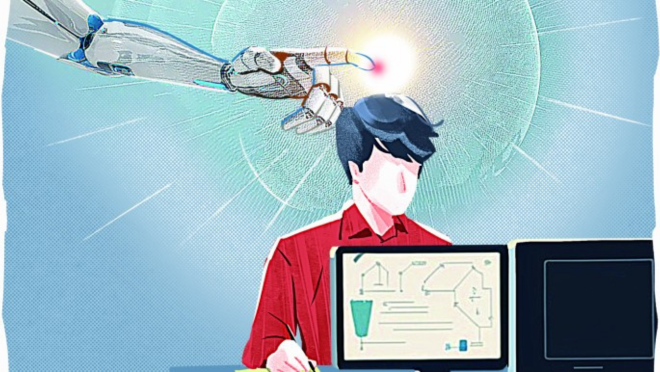
But the story of Gen Z and AI is not simple interest or obsession, it is something far more complex and much more human. A major new survey suggests that while young adults are using AI tools at striking levels, they are also quietly uneasy about what those tools might be taking away.
In October 2025, according to Harvard Business Review, researchers partnered with Gallup and the Walton Family Foundation to survey nearly 2,500 Americans aged 18 to 28, aiming to understand how Gen Z is actually using generative AI, and how they feel about it. What they found out was not the stereotype of Gen-Z treating chatbots as digital best friends, instead they found something far more practical.
Gen-z tends to use AI as a tool to get ahead in life instead of relying on it for everything. According to the survey, 74% of young adults in the United States used an AI chatbot at least once in the previous month. That is three out of every four people in the age group, a sharp rise from earlier estimates earlier in 2025.
The most common use by far was simple and familiar: search.
- 65% said they used AI as a replacement for Google searches
- 52% used it to help with work tasks
- 46% used it to help with writing
- 39% used it for image generation
The social uses were notably smaller:
- 32% turned to AI for personal advice about relationships or life decisions
- 23% used it “as a friend”
- Only 10% reported using it as a girlfriend or boyfriend
In other words, Gen-z is not outsourcing their loneliness, but outsourcing their workload.
One of the most striking findings is not just how many young people are using AI — but how many are doing so quietly. The survey found that one in six young adults (16%) admitted to using AI for tasks even when they were specifically told not to. That number reveals something employers may not want to hear: banning AI does not stop AI use. It simply drives it underground. The real issue is no longer whether young workers will use these tools. It is whether they will feel they have to hide it.
Despite the widespread use of AI, young adults are not blind to trade-offs. People are deeply worried about what AI is doing to human capability.
The survey found:
- 79% fear AI is making people lazier
- 62% worry it is making people less intelligent
This is not a small minority, but an overwhelmingly large population of a generation using the tool despite the drawbacks.
The researchers found three prominent causes of worry:
- Losing learning through effort
The largest concern was what happens when people stop struggling through tasks themselves. 68% of respondents worried AI crowds out “learning by doing.” One young adult put it bluntly:
“Bots do the work for people, so they don’t have to learn anything.” Another compared outsourcing thought to a kind of slow decay: “The mind is a muscle… when you don’t use it, it atrophies.” Supporting this anxiety, the article points to an MIT Media Lab study that found students writing with AI showed reduced brain activity, and many could not even quote their own work afterwards. The worry is not that AI is too powerful, but that it is too easy.
2. Losing critical thinking
65% of young adults said AI discourages real engagement with ideas. One respondent wrote:
“It promotes instant gratification, not real understanding.” Another said: “Chatbots allow you to access information, not process it.” A Wharton experiment backs this up: participants using AI for a research task put in less effort and produced shallower recommendations than those using traditional search.
3. Losing human learning
Finally, 61% worried that AI replaces learning from people. “It replaces conversation with real people,” one respondent said. This concern arrives at a fragile moment. Gen Z is already living through an era of collapsing in-person socialising, rising screen time, and isolation. AI, as a co-pilot, coach, or counsellor, may deepen that solitude.
And yet, the story does not end in despair. Even with all their anxiety, many young adults can still see possibility in AI. They do not always view it as a crutch, but sometimes as a bridge; a tool that can offer perspectives beyond their own circles, or break down complex problems into smaller, more learnable steps. For others, the value is simple: time. AI can handle tedious administrative work, freeing people up for deeper, more meaningful tasks. As one participant explained, it makes you more efficient while it takes care of the tedium. The researchers also describe an experiment where people practising writing with AI actually improved more by the next day, suggesting that AI can sometimes teach by example rather than simply replacing effort. In other words, deskilling is not inevitable. It depends on how the tool is used.
The researchers urge organisations to take Gen Z’s ambivalence seriously. Their worries about laziness, intelligence, and lost learning are not irrational — they are legitimate. They also warn that banning AI is unrealistic, since many young workers will use it anyway, often quietly. Instead, familiarity may reduce fear: those who use AI more frequently tend to worry less, perhaps because the unknown becomes easier to manage. Most importantly, employers should promote use cases that build human capability, using AI to improve learning and remove tedium, while protecting what it can never replace: authentic human connection.
Gen Z are not merely experimenting with the generative AI, they are living in the first wave of its impact and demonstrating to the rest of the society what this future would be like. And perhaps the most important lesson is this: they do not want a world where machines do everything on their behalf. They desire a world in which humans have not lost their ability to think, learn, and to contact each other, despite AI sitting quietly by the side of the room.