Riding without dignity: The reality of women’s seats on buses
Till recently, I would say I was privileged enough not to need to travel by bus for daily commuting and was blissfully unaware of the trauma a bus journey can be for everyone, especially females.
Riding without dignity: The reality of women’s seats on buses
Till recently, I would say I was privileged enough not to need to travel by bus for daily commuting and was blissfully unaware of the trauma a bus journey can be for everyone, especially females.
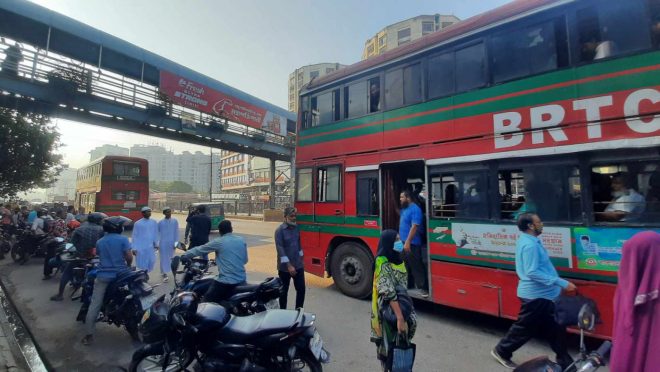
Every now and then, I would hear about the issues, though. The seats were taken by men, women and disabled people were made to sit in the same place in the name of equality, only nine seats were reserved in each bus as if that was ever enough, and of course, harassment.
As a non-traveller, I could not truly grasp the depth of the situation.
Now that I have started this journey myself, I can say the reality is far worse than what I had heard.
One of the most disturbing aspects of public bus travel for female students is the seating arrangement. In most local buses, the seats reserved for women are built directly on top of the engine. These are not even proper seats. They are makeshift structures made from scrap sofa pieces collected, I think, from junkyards.
There is no back support, no safety holder, and no consideration for comfort. The heat from the engine rises straight through the seats, making your feet burn and seating unbearable. In some buses, large tyres or the engine smoke chimney things are placed right beside the seat, which makes the experience even more frustrating.
Saba Siddika Shupto, a student of the University of Asia Pacific, describes her experience very clearly. She says, “Local buses I use to travel to university usually offer seats reserved for women built over the engine area. I get extremely motion sick; the smell of fuel and the direct heat released from the engine area appear as severe discomfort, especially on a hot and humid day. Elsewhere, the bench system seats instead of chairs also cause discomfort, as these do not offer safety holders when the bus brakes.”
I once asked a woman sitting beside me what she thought about these seats. She simply said, “This is omanobik.” Inhuman. That single word was enough.
The condition of local buses makes the situation worse. These buses are already risky and hazardous. Yet, conductors keep pushing people inside until there is barely room left for an ant. Amid this crowd, heat, and suffocation, women are forced to sit beside or on top of the engine.
An anonymous student from AUST explains why the seating itself feels insulting to her: “It feels unfair and disrespectful. Women’s seats should be in safe and normal places. Drivers and conductors should stop harassment. Buses should be safer so female students can travel without fear.” This daily struggle does not just affect the body; it affects the mind and raises another issue, harassment.
Sayeda Kazi, a student of BRAC University, says, “As a woman, I feel mostly mistreated just because of being a woman. During working hours, female passengers are easily harassed, both physically and verbally. Likewise, bus conductors and staff misbehave and try not to pick us up, reasoning that women are vulnerable and unable to stand in a moving bus.”
So, we are being harassed, and the solution for that is not to travel by bus. Just like men, women can also be in a hurry to get to school, university, or office. If buses refuse to stop properly or conductors hesitate to pick up women, it only adds to our daily stress.
Rukaiya Nuha, a student of Jahangirnagar University, shares, “I have witnessed men try to stand near women’s seats and attempt to brush against their bodies or skin. Once, I asked the bus conductor to intervene. He asked the man to move once; he did not move, saying he would get down soon, and the conductor did not do anything else. But the man did not get down at the next stop.”
There are examples that show improvement is possible. Rukaiya also notes herself that, “I have noticed that BRTC and Labbaik Lovely bus staff strictly impose the female seat rule when any man wants to sit there. Their behaviour seems as if they were not simply hired but also given training. So, I suggest that bus staff should get background checks and training before being hired.”
In my opinion, there should be more double-decker buses, where one full floor, or at least half a floor, can be reserved for women. These unsafe local buses should be banned. Women’s seats should never be placed over engines. Moreover, there are buses solely dedicated to women, where the passengers are women and the conductor is also a woman.
On these buses, the environment feels much safer and more respectful, and harassment is rarely seen. However, these buses run on very few routes and are not available to most female students. This type of bus should be introduced on all routes so women can travel without fear. Female students should not have to choose between education and dignity.
This is not just a transport issue. It is a question of basic human respect, something our buses are still failing to provide.