How Google CEO Sundar Pichai handles pressure at the top
Pressure, for Sundar Pichai, is not an occasional visitor. It is the background noise of the job.
How Google CEO Sundar Pichai handles pressure at the top
Pressure, for Sundar Pichai, is not an occasional visitor. It is the background noise of the job.
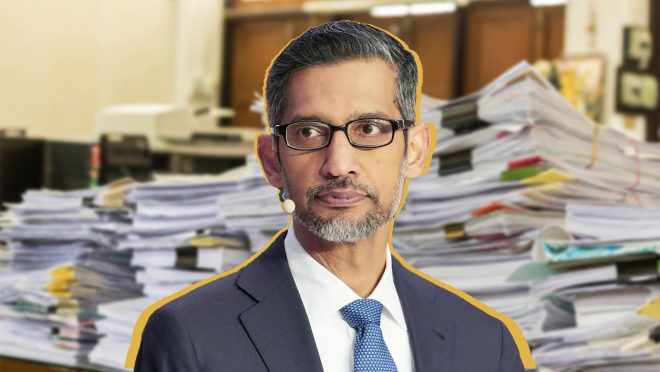
As the CEO of Google and Alphabet, Pichai carries decisions that stretch far beyond boardrooms. A minor modification of an algorithm may alter livelihoods. Global backlash can be caused by a delay in the reply. Every action is monitored and analyzed on the spot. The margin of error is extremely low in an age that technology influences the way individuals operate, think and even vote.
However, when asked as to how he copes with the burden of it all, Pichai does not turn to high theories or talk of dramatic leadership platitudes. Rather, he returns to something awkwardly innocent – a way of thinking he learned years ago, long before the titles, the headlines, and the trillion-dollar valuation.
In a recent meeting with students, Pichai was very open on the topic of pressure, not in the abstract sense of this word, but as a daily fact. His coping scheme he said is based on two concepts which have silently helped him to go through some of the most challenging periods in his career.
The first is this: Indecision is often more damaging than a wrong decision.
Pichai states that pressure feeds on hesitation. The more time a leader waits, the greater the moment. Fear multiplies and doubt takes over. But instead of trying to pursue the so-called perfect decision, he is trying to decide on a course of action and proceed. Even a bad action is better than no action. It releases the mental logjam and makes learning commence.
The second idea is even more grounding: Most decisions are not permanent.
During crisis, every act feels final. Careers seem to hang in the balance. Reputations feel fragile. But with time, perspective shifts. Many choices can be corrected. Some evolve naturally. Others, even the wrong ones, end up teaching lessons that no success ever could.
This way of thinking, according to Pichai, is softening the pressure. Fear will be eliminated when executives no longer make each choice a life sentence. The emphasis is no longer on mistake avoidance but mild mannered reaction to the mistakes.
He attributes a lot of this attitude to his childhood as a student and mentors who emphasized on steady reasoning as opposed to theatrical power. They included Bill Campbell, the mythical Silicon Valley coach who counseled some of the largest companies in the technology sector. The idea behind Campbell was straightforward but strong, that to be successful in leadership, you do not need to be always right but to be able to stay calm in a situation that seems like a maze.
In the case of Google, clarity is not a luxury but a necessity. The company stands at the middle of the most controversial topics of our age; artificial intelligence, data privacy, fake news, regulation. These are not far-off policy deliberations, but everyday business issues. Any decision can be put under the scrutiny of governments, users, employees and people who are critical all over the world.
At that place, Pichai’s motto is not merely a personal suggestion. It is transformed into a leadership style. He makes teams move by promoting action instead of inaction. He provides room to correct the course without panicking by admitting that errors are normal as we go on. It is a lesson that being a leader does not mean one has to be perfect, rather, one has to be responsible, humble and strong enough to modify.
The most notable is how mundane his approach sounds. There’s no heroic framing. No myth-building. Only a simple confession that one cannot avoid pressure, but one cannot be preoccupied with it. To readers who are far away on the Silicon Valley — nuts and bolts of it, running a newsroom, or simply facing uncertainty in their day-to-day life, the lesson learned feels quite cultural and close to home: take the risk, gain experience, and move on.
It is a very down-to-earth philosophy, in a man who heads one of the most powerful companies on the planet, evidence that, at times, the best way to remain in control is to be human.