IUB researchers repurpose ship-breaking motors for low-voltage green applications
IUB researchers repurpose ship-breaking motors for low-voltage green applications
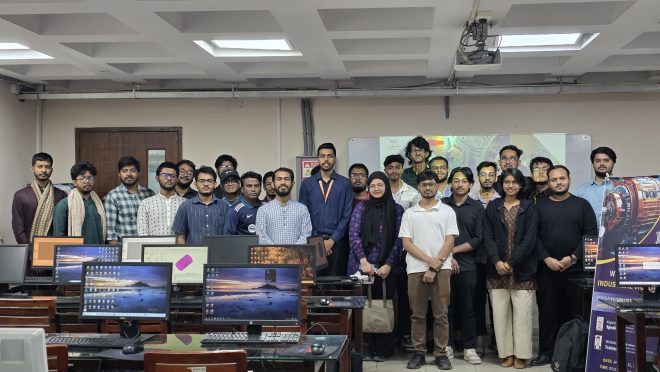
Bangladesh’s ship-breaking industry brings thousands of industrial induction motors into the country every year. While many remain functional, a significant number are discarded or melted as scrap, leading to material loss and missed economic value.
Researchers at Independent University, Bangladesh (IUB) are working to change that trend through applied research at the Green Energy Research Center (GERC) and the Department of Electrical and Electronic Engineering (EEE). Their work focuses on redesigning conventional 220V and 440V induction motors so they can operate on low-voltage battery systems such as 48V, 60V, and 72V, making them suitable for electric vehicles, irrigation systems, and small-scale agricultural and industrial use.
As part of this initiative, GERC and the EEE Department, in collaboration with Transforming Energy Access – Learning Partnership (TEA-LP), organised a two-day hands-on workshop titled Design, Simulation, and Analysis of Three-Phase Induction Motors Using ANSYS Maxwell on 30–31 January. The workshop provided undergraduate and graduate students with practical training in motor redesign, simulation, and performance analysis using industry-standard software.
The sessions were conducted by Md Imtiaz Abedin, Adjunct Lecturer of EEE and Research Assistant at GERC. Participants carried out modelling and simulation tasks to assess motor efficiency, losses, and voltage adaptability for real-world applications.
The research has already demonstrated tangible outcomes. An undergraduate team from IUB’s EEE Department, known as IUB FormulaE, successfully redesigned a low-voltage induction motor powertrain for their Formula Student electric vehicle project. The system received national recognition from Bangladesh University of Engineering and Technology (BUET), and the team qualified to compete in the Formula Student China competition. Similar motor conversion technologies are also being explored for irrigation systems and food-processing equipment.
Dr Khosru Mohammad Salim, Professor of EEE and Director of GERC, said that recycling industrial resources such as induction motors is crucial for sustainable engineering and long-term economic development. Dr Mustafa Habib Chowdhury, Head of the EEE Department at IUB and Assistant Director of GERC, highlighted the value of industry-oriented, hands-on training that aligns academic learning with current engineering practices.
The initiative reflects a growing emphasis on circular economy–driven research in Bangladesh, demonstrating how discarded industrial equipment can be transformed into productive assets for the country’s green and industrial transition.