NASA’s Mars Rover follows AI-planned route for the first time
For the first time in planetary exploration, a Mars rover has successfully driven along a route planned not by humans, but by artificial intelligence.
NASA’s Mars Rover follows AI-planned route for the first time
For the first time in planetary exploration, a Mars rover has successfully driven along a route planned not by humans, but by artificial intelligence.
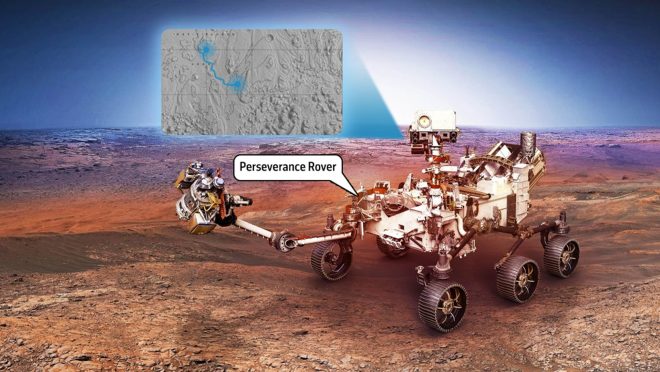
NASA’s Perseverance rover recently completed a series of test drives using waypoint plans generated by an AI system, marking a significant milestone in autonomous space exploration.
According to a report from earth.com, the demonstration took place on 8 and 10 December and was led by NASA’s Jet Propulsion Laboratory (JPL) in Southern California. Instead of relying solely on human route planners on Earth, NASA allowed an AI system to handle one of the most demanding tasks in rover operations: choosing a safe path across hazardous Martian terrain.
The AI used a vision-enabled, generative approach to analyse the same high-resolution images and terrain data that human planners typically study. Based on this information, it selected waypoint locations the “go here next” markers that guide the rover step by step designed to avoid risks such as sand traps, large rocks and steep slopes.
The proposed routes were thoroughly tested in simulation before being sent to Mars. “This demonstration shows how far our capabilities have advanced and broadens how we will explore other worlds,” said NASA Administrator Jared Isaacman, highlighting the role of autonomous technologies in improving efficiency and scientific output as missions venture farther from Earth.
During the trial, Perseverance followed AI-generated plans on two separate drives. On 8 December, the rover travelled 689 feet, followed by another 807 feet two days later. While modest in distance, the drives were long enough to prove the reliability of the AI-assisted planning method. Before execution, engineers validated the routes using JPL’s digital twin of the rover, checking more than 500,000 telemetry variables to ensure safety and compatibility with flight systems.
NASA believes this approach could reduce the workload on rover teams, allowing more time for scientific analysis and enabling future missions to travel farther and operate more independently. As automation improves, such technologies may play a crucial role in preparing for sustained human and robotic exploration of the Moon, Mars and beyond.