AIUB engages in global dialogue on responsible AI at AIFOD Winter Summit
AIUB engages in global dialogue on responsible AI at AIFOD Winter Summit
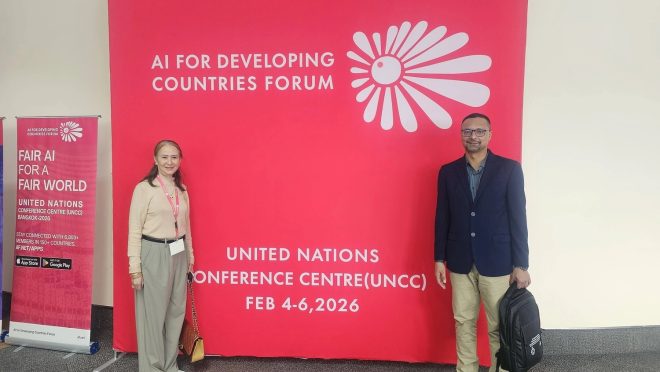
The American International University–Bangladesh (AIUB) participated in the AI for Developing Countries Forum (AIFOD) Winter Summit, held at the United Nations Conference Centre (UNCC) in Bangkok, Thailand, from 4 to 6 February 2026.
Representing AIUB were Dr Carmen Z. Lamagna, Member of the Board of Trustees and Former Vice Chancellor, and Prof. Dr Dip Nandi, Associate Dean of the Faculty of Science and Technology. Their participation reflected AIUB’s active engagement in international discussions on responsible, inclusive, and sustainable artificial intelligence, in alignment with the United Nations Sustainable Development Goals (SDGs).
Established to foster equitable AI access, AIFOD convenes policymakers, academics, technologists, and development practitioners to design AI solutions tailored to local contexts, moving beyond standardised global models. The Bangkok summit focused on enabling developing nations to become architects of their digital futures, rather than merely data suppliers or technology consumers.
Prof. Dr Dip Nandi moderated the panel session titled “How Can Developing Countries Build AI That’s Truly Ours?”, leading discussions on the global AI divide, where high-income nations—representing 17% of the world’s population—currently control nearly 87% of AI models.
On the sidelines of the summit, Dr Lamagna and Prof. Dr Nandi met with the AIFOD founders to explore academic collaborations bridging theoretical AI research and practical applications in developing nations. Drawing from Bangladesh’s experience, Dr Lamagna highlighted the use of AI on a university campus serving approximately 15,000 students, where AI predicts short-term energy demand alongside solar energy generation, facilitating more efficient and sustainable energy management.
AIUB’s participation in the AIFOD Winter Summit underscores the university’s commitment to global leadership in research, technology, and innovation, and its dedication to advancing ethical and locally relevant artificial intelligence for developing societies.