In the pursuit of ‘Beguni’
Recalling my earliest childhood Ramadan memory means remembering how I cried my lungs out because ‘Sehri’ was nothing different from an ordinary dinner.
In the pursuit of ‘Beguni’
Recalling my earliest childhood Ramadan memory means remembering how I cried my lungs out because ‘Sehri’ was nothing different from an ordinary dinner.
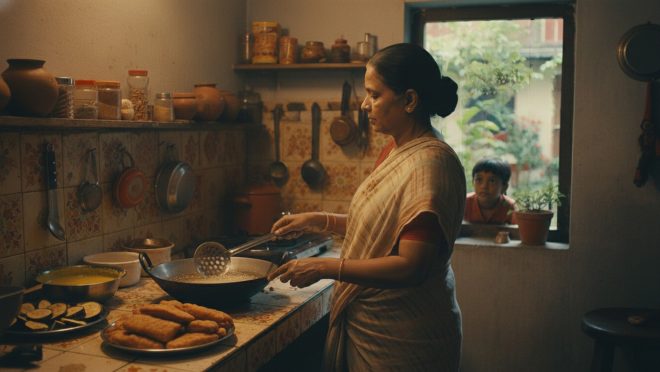
To stop my nagging, my mother brought me a plate of rice mixed with milk, egg, and banana, infused with the flavour of ghee.
I couldn’t gulp down the whole plate, as I had imagined Sehri would be something extraordinary.
I cannot recall any specific iftar moments in detail. Yet there are warm snippets of having iftar together in a big thali (large shared platter) with all my family members. The thali held a mixture of chola (spiced chickpeas), peyaju (lentil fritters), and beguni (batter-fried eggplant slices), blended with onion, carrot, cucumber, and pudina (mint leaves).
Before covering the mixture with muri (puffed rice), a drizzle of mustard oil was added. Then came the wait for the siren that would allow us to break our fast with the dates placed carefully at the side of the thali.
My duty was to take the bottle of lemonade out of the refrigerator and pour it into the glasses. I was always confused about the right proportion of distribution. My little self constantly questioned whether I was ensuring equality for all.
Every day, once I was done with my responsibility, I would look at the glasses and silently pray to Allah not to punish me if I had mistakenly poured a bit more lemonade into my own glass than my elder brother’s.
He would complain anyway, just to earn an extra share from Ammu. Ammu never complained. Mothers, indeed, are artists, portraying love with strokes of sacrifice and quiet gratification.
We would reach for the dates and take a sip of lemonade as soon as the siren rang. It felt as though we were in a hurry, chasing something sacred. I couldn’t wait to grab a handful of that chola-muri mixture because it held something I had already fallen deeply in love with: the little torn piece of outer crispness and inner softness.
Yes, you guessed it right, batter-fried eggplant, also known as beguni.
An artwork crafted from eggplant coated in besan and flour, the deadly combination of crisp and cosy made me its loyal admirer from the very first accidental bite. That was also the first time I began fasting.
I was restless with hunger after the Asr prayer, watching my mother prepare the iftar items. Suddenly, almost subconsciously, I picked up a piece of beguni and took a bite. It felt like something out of this world, something I had never tasted before, something I would cherish for the rest of my life.
“Aren’t you fasting?” my mother asked with a smile. I snapped back into awareness. Shame washed over me for not being able to complete my fast. While I stood staring at that one-bitten beguni, my mother understood my gloom.
She assured me that my fast had not broken since I had eaten unknowingly. She promised I could have as many pieces as I wanted at iftar, and that iftar was not too far away.
From that moment, I began counting the seconds. When the siren finally rang, I took two extra pieces of beguni with the mixture. Every bite felt like a new burst of joy.
From that day onward, there was an unspoken rule. I would receive two extra pieces of beguni as a gift for completing my first-ever roja (fast). It has been long since then. Now I can no longer afford the luxury of my mother’s beguni, as I live far away from home.
Still, I search for similar-looking ones here in Dhaka. Most are fluffy like pillows, yet I continue scanning the alleys and roadside stalls. The taste never feels like home, but I settle for the ones that come closest. Often, I barely find any brinjal beneath the thick coating. Nevertheless, I do not complain. Perhaps I am only trying to recreate my mother’s version of love.
It saddens me that I cannot have my favourite iftar item the way I want it, as I am yet to find the perfect beguni vendor. That is when I ask myself, “Do I really need to look for perfection outside my home?”
Definitely not.
And that is why my joy doubles when I return to my city during the last quarter of Ramadan, not only for Eid but also in pursuit of the incredibly best beguni I have ever known.