What if 1971 happened today?: The Liberation War in the age of Wi-Fi
If the Liberation War unfolded in today’s hyper-connected world, it would not just be fought on the battlefield but across timelines, live streams, and digital networks—reshaping how the world witnesses, responds to, and remembers conflict
What if 1971 happened today?: The Liberation War in the age of Wi-Fi
If the Liberation War unfolded in today’s hyper-connected world, it would not just be fought on the battlefield but across timelines, live streams, and digital networks—reshaping how the world witnesses, responds to, and remembers conflict
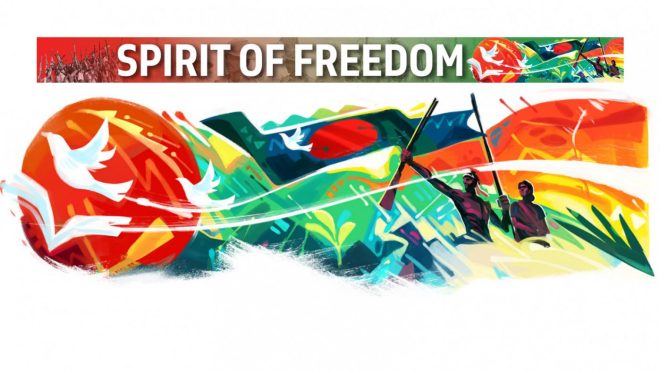
If the Liberation War happened today, the sound might not have been gunfire alone. It would have been the ping of notifications, the flicker of live streams, the sudden surge of hashtags. If the Bangladesh Liberation War had unfolded today, it would not only have been fought on the ground, it would have erupted across screens, satellites, and servers.
History tells us that when the crackdown began on 25 March 1971, much of the world did not immediately know. Newspapers were shut down, communication lines severed, and information tightly controlled. What leaked out did so slowly, often through diplomats, foreign journalists, or word of mouth. Today, that silence would be almost impossible.
Within minutes, videos from Dhaka University, Old Dhaka, and the cantonment would likely surface, raw and unfiltered. In the age of smartphones, a complete blackout of information would be nearly unthinkable.
In 1971, the declaration of independence came over the radio, relayed and re-relayed through uncertain channels. In a contemporary setting, Ziaur Rahman’s voice might not have travelled through static and shortwave frequencies.
It might have appeared as a Facebook Live, watched in real time by millions at home and in the diaspora. Within seconds, clips would be shared, translated, subtitled, and amplified across platforms like Facebook, X, and YouTube.
The difference is not just speed; it is scale. In 1971, global awareness of atrocities took weeks, even months, to build. Today, satellite imagery could verify troop movements within hours. Human rights organisations now use open-source intelligence to track conflict zones, making it possible to map and archive destruction almost instantly.
This immediacy would fundamentally alter the dynamics of war. International media, instead of piecing together reports, would broadcast live updates. The images of displaced families crossing borders, over 10 million people fled to India in 1971, would dominate global headlines within days, not weeks. Governments and multilateral organisations would face immediate pressure to respond.
Back then, there was room for denial and delay. In a digital era, visual evidence would circulate too quickly to be easily dismissed.
Yet, visibility does not always guarantee intervention. Recent global conflicts have shown that even with overwhelming documentation, geopolitical calculations often delay action. Still, the sheer volume of information would make it harder for the world to look away.
On the ground, the war itself would also be different. Communication between resistance fighters, which relied heavily on physical couriers and coded messages, would shift to encrypted apps like WhatsApp or Signal. Coordination would be faster, intelligence more precise. Satellite maps and GPS could guide movements, replacing the reliance on local knowledge alone.
But technology cuts both ways. Surveillance capabilities have also evolved. Governments today possess advanced monitoring tools, facial recognition systems, and digital tracking mechanisms. The same smartphone that helps document injustice could also expose locations and identities, making digital footprints a potential risk in conflict zones.
Economically, digital transactions would play a role. In 1971, financial systems were largely physical and localised. Today, mobile banking and digital wallets could both support and complicate resistance efforts. Funds could be raised globally within hours, but they could also be tracked and frozen.
Perhaps the most significant difference, however, lies in time. The Liberation War lasted nine months. In a hyper-connected world, a conflict of that scale might be compressed into a much shorter period, potentially two to three months.
This projection rests on several factors: faster information flow, quicker international mobilisation, and the strategic calculations of global powers in an interconnected world. The entry of neighbouring countries, the imposition of sanctions, or even digital warfare could accelerate outcomes.
And then there is the human element, the way ordinary people would experience and narrate the war. In 1971, stories were preserved in diaries, letters, and, later, oral histories. Today, they would unfold in real time: a mother posting a final message before fleeing, a student live-streaming protests, a soldier recording a moment of fear or defiance.
Social media would not just document the war; it would shape it. Narratives would be contested, misinformation would spread, and propaganda would evolve in new forms. The battle for truth would run parallel to the battle on the ground.
Yet, despite all these changes, some constants would remain. War, at its core, is still about people, their resilience, their losses, their hope. Technology may alter the speed and visibility of events, but it does not erase the human cost.
If 1971 happened today, the world would see more, know more, and react faster. But whether it would act differently remains an open question.