Birds that belong to no shore
The black-legged kittiwake is a North Atlantic bird. The species has no particular biological business in the northern Bay of Bengal. And yet there they were, off a low sandy island in silt-rich coastal water
Birds that belong to no shore
The black-legged kittiwake is a North Atlantic bird. The species has no particular biological business in the northern Bay of Bengal. And yet there they were, off a low sandy island in silt-rich coastal water
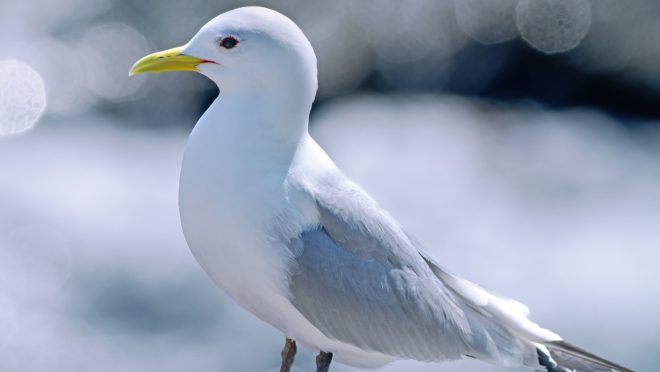
Last week, a black-legged kittiwake was recorded off Sonadia Island, Cox’s Bazar. In the recent past, a couple more check-ins happened. These birds were, by any biogeographical measure, in the wrong ocean.
The black-legged kittiwake is a North Atlantic bird. In short summer, it breeds on sheer cliffs in Iceland, Scotland and Norway. It braves winters on open water thousands of kilometres from the nearest shore.
The species has no particular biological business in the northern Bay of Bengal. And yet there they were, off a low sandy island in silt-rich coastal water.

Guillemots and razorbills on the Isle of May — the guillemot in dense masses, the razorbill keeping slightly apart in the crevices.
I know what a kittiwake looks like in its proper context. On the Isle of May — a small island off the Fife coast of Scotland — I have stood at the edge of the eastern cliffs with thousands of them screaming about a couple of feet from my face.
Kittiwakes’ base colour is porcelain white, with lemon yellow beaks, grey-tinted wings, black namesake webbed feet, even blacker beaded eye with a contrasting crimson eye ring. They were a contrast to the island’s more iconic dwellers whose base colour leans towards black tones — razorbills, guillemots and puffins.
Kittiwakes were relentless, stacking and circling and landing on ledges barely wide enough to hold them. The noise was always at crescendo. But the colony has a logic to it — each pair maintaining their precise few inches of cliff with absolute conviction, the whole structure holding together through some combination of aggression and familiarity that looks, from a distance, almost like order. A kittiwake in that setting is unremarkable. One off Sonadia is something else entirely.

The Bay of Bengal is not considered a seabird country. It is warm, turbid in its northern reaches. Its productivity is driven by monsoon-fed river systems rather than the cold upwellings that concentrate fish and attract pelagic birds in the North Atlantic or the Southern Ocean.
But the Bay is also underwatched — the continental shelf, the deeper offshore water, the mixing zones where the Ganges-Brahmaputra plume meets open sea — these are not blank spaces. They are spaces with very few people looking at them.
Several skua, shearwater, and storm-petrel species have been registered for Bangladeshi waters. Most are driven off their usual paths by storms. Others may simply follow productive current systems rather than fixed geography, breeding on distant islands far from where they are spotted. The records are sparse not because the birds are absent but because the observers are.
Pelagic seabirds are built for a life that makes most birds seem sedentary. To the point of timidity, if you are up for a comparison. On the Isle of May, I watched puffins shuttle between their burrows and the sea in small hurrying groups, beaks crammed with sand eels.
Improbable, round-bodied birds, nevertheless capable of diving 60 metres underwater, using their wings to fly through the water column with the same efficiency they use in air. The guillemots packed every available ledge in numbers that made individual birds nearly indistinguishable from the mass. They do not build nests. Their eggs are pointed so that if disturbed they spin in a tight circle rather than rolling off the cliff — a solution, arrived at over millions of years, to a problem that never required a human engineer.
The razorbill kept slightly apart, preferring crevices, its laterally compressed bill crossed with white lines. All of them — puffin, guillemot, razorbill — would leave the island in late summer and spend the following months entirely at sea, returning to the same square foot of rock the next spring as if nothing had intervened.
The fulmar is another interesting bird I encountered on the cliffs of St Andrews town. It closely resembles an albatross to an untrained eye; I called it one in my first encounter with them. This bird, in fact, belongs to an entirely different lineage — the tubenoses, relatives of albatrosses and shearwaters, carrying in their biology the signatures of deep oceanic commitment.
It can drink seawater, processing the salt through a gland above the bill. It produces a stomach oil it feeds to chicks and ejects at threats with startling accuracy. It glides the cliff updrafts on stiff, straight wings with barely a visible wingbeat, wholly unbothered by the wind that made standing upright on Scottish shores an active physical effort. It can live for over 50 years.
Watching it, you understand that the word seabird covers an enormous range — from birds that tolerate the coast to birds that have made the open ocean so completely their element that land is merely an inconvenient place except for breeding.

A fulmar pair at nest. They mate for life, return to the same site annually, and live for over 50 years.
The kittiwake sits toward that second end of the spectrum. Its legs are short and poorly suited to walking. It feeds at the surface of open water, sleeps on the sea, and returns to cliff colonies only to breed.
In the non-breeding months, it is simply out there — in the North Atlantic, following cold productive water, crossing distances that accumulate into thousands of kilometres without any particular event marking them.
That one arrived off Cox’s Bazar suggests displacement on a scale that is difficult to imagine unless we have a birds-eye-view. A storm system, a current, a navigation error compounded over weeks — something carried it from its ocean into ours.

Or perhaps the Bay of Bengal holds more than we account for. Or there are more hidden layers than what we know of these birds. The monsoon-driven circulation creates seasonal upwellings along the shelf edge that concentrate prey.
The offshore waters beyond the muddy coastal fringe are deeper, cleaner, more productive than their reputation suggests. What moves through them between October and March — when pelagic birds are at sea and Bangladesh’s birdwatching attention is concentrated elsewhere — remains largely unknown. The Sonadia kittiwake did not arrive from nowhere. It arrived from a sea we have not yet fully read.
These birds do not experience the Bay of Bengal as a boundary or an anomaly. The ocean has no walls. In the Bay of Bengal or the Arctic, birds that often roughly cross 1 kilogram mark evolve to thrive in one of the harshest, roughest, and most numbing of conditions.
What we call a vagrant, these pelagic birds call horizonless waters home — displaced perhaps, storm-tossed perhaps, but unbroken, always unbroken.