How Asif Muqtadir got into Harvard — and how you can make it too
Rejected by seven universities at home, Asif is now headed to Harvard for a full-time Master of Public Health in Health Policy and Management. The story worth telling is the years of deliberate, sometimes invisible work that made that moment possible
How Asif Muqtadir got into Harvard — and how you can make it too
Rejected by seven universities at home, Asif is now headed to Harvard for a full-time Master of Public Health in Health Policy and Management. The story worth telling is the years of deliberate, sometimes invisible work that made that moment possible
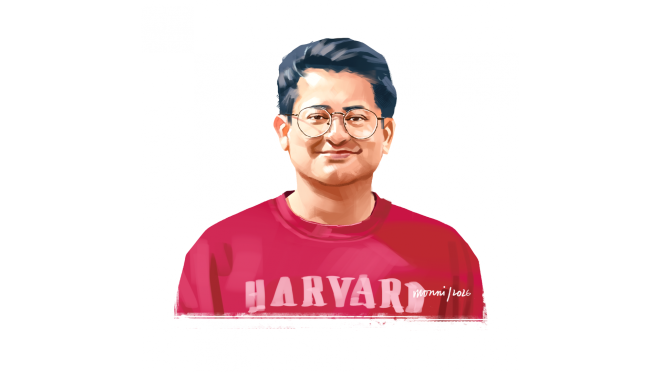
Asif Muqtadir, a Physician Associate at a primary care clinic in Buffalo, New York, had just seen someone out of his exam room when his phone buzzed. An email from Harvard T H Chan School of Public Health — asking him to log into the portal and check.
He scrolled from the bottom of the page upward, heart somewhere in his throat, until the word appeared: Congratulations. “It changed me as a whole person,” he says, weeks later, still processing it. “My confidence, my aim, my belief — everything. Like, I feel I am a completely different person now.”
But the story worth telling is not the moment of arrival. It is the years of deliberate, sometimes invisible work that made that moment possible.
Asif, born in 1996 in Moulvibazar, Sylhet, is now headed to Harvard T H Chan School of Public Health for a full-time Master of Public Health in Health Policy and Management. He also holds an offer from Columbia University’s Mailman School of Public Health — the Accelerated MPH in Population and Family Health.
Seven doors, seven rejections
Those who know Asif’s story in Bangladesh know the number ‘seven’. Seven public university entrance exams. Seven straight rejections. Dhaka University, BUET, CUET, KUET, SUST, MIST, IUT — all closed their doors.
Asif, who had earned straight A-pluses throughout school in Moulvibazar, suddenly found himself with no clear path forward. His grandmother had always worried that he was too soft for the world.
The rejections seemed to confirm it. “That time, I felt like there were no more opportunities in life,” he said. “I was afraid to even go outside because of people’s questions.”
Eventually, on his second attempt, he gained entry to SUST’s Genetic Engineering and Biotechnology department. He studied there for three semesters before a family immigration visa came through, and he moved to the US with his parents. The hardship didn’t end there — it deepened. His first job in America was at a coffee shop, standing all day, making sandwiches, stealing a few minutes with his phone when he went to take out the trash. Some evenings, he came home and cried in his mother’s arms.
He enrolled at Buffalo State University and started again — this time in Biological Sciences. His first semester GPA was a 2.67. “I was devastated,” he recalls. “But that’s when I made a promise to myself.”
What followed was three consecutive Dean’s Awards, resulting in graduation with CGPA 3.5. A minor in Chemistry alongside his Biology major. A Master of Science in Physician Associate Studies. A clinical career. Two books. A nonprofit. A government scholarship. A $50,000 foundation grant. And finally, Harvard. The journey was seven years in the making. The application was not.
Building the profile before you need it
Ask Asif what the single biggest mistake aspiring students make, and the answer is immediate: they start thinking about their application when they start to apply. “But you have to build something over five years, six years, ten years,” he says.
His own profile was constructed with that long view from the beginning. But the first impressive part of his profile is his upward trend of CGPA. “The admissions committee likes the upward trajectory,” he noted.
From his undergraduate years, he committed to shadowing physicians and PAs — not because someone told him to, but because he understood that exposure and lived experience were the building blocks of a compelling story. He volunteered. He conducted research — not groundbreaking, he is quick to clarify, but present. “It was decent, not high-level. I used to go there and try to separate organisational structures under a microscope. But I had the exposure.”
He also wrote. A lot. Over 200 articles and pieces of journalism, published across various platforms. And then, while working full-time as a clinician, he wrote two books — Sambhavanar Deshe Shopnajoy and Americar Brittanto — practical guides for new Bangladeshi immigrants navigating American life.
Visible proof is a phrase he emphasises. Anyone can claim they are hardworking. An admissions committee cannot verify a personality trait. But a book, a nonprofit, a government award — those are tangible.
That government award — the National Health Service Corps Scholarship — came from the US Congress, given to clinicians who commit to serving underserved communities. Asif applied for it with a full SOP and recommendation letters. He later chose not to take the service obligation, but the award itself remained on his application as a testament to his standing in the field. The Mother Cabrini Health Foundation scholarship of $50,000 followed, recognising his work with marginalised immigrant patients. These were not accidents. They were outcomes of a profile deliberately constructed over years.
He founded ACHIEVE — a nonprofit educational initiative aimed at giving Bangladeshi students real career guidance, not just motivational speeches. Five strategies, five years in the building: a national Career Readiness Framework for schools, a research and policy unit, a fellowship model for university students to mentor younger ones, a global mentorship network of Bangladeshis abroad, and a digital platform housing scholarships, SOP guides, and recorded courses. ACHIEVE was the kind of structural, systems-level initiative that elite public health schools look for. Intention and strategy, inseparably combined.
What AI can and cannot do
When it came time to apply, Asif did something most people do not even think of. He went to LinkedIn and searched for current and former Harvard School of Public Health students, one by one. He studied their trajectories — where they had worked before, what they had published, what awards they carried. He got LinkedIn Premium and reached out to some of them directly, had video calls, and asked about their experiences.
“What I would do is take a screenshot of their work experience or awards and put it into ChatGPT,” he explains. “After documenting it, I’d ask: ‘Here is mine and here are the admitted Harvard students — can you please evaluate from the Harvard standpoint?’ ChatGPT won’t give you 100%, but at least you have an idea.”
He used ChatGPT as a mirror, not a ghostwriter. He uploaded his documents and asked to review them from Harvard’s perspective. He uploaded his book’s summary and asked how the experience could be framed within a public health leadership narrative — then he took that framing as an idea and wrote the actual text himself. He would ask it to rate individual lines of his SOP out of ten. He would take a weak line and ask how it could be rewritten at a policy level — then write a new version in his own voice. “You take the idea of how you could present your story. Then you write it in your own way.”
Admissions committees are sophisticated readers. They read dozens of SOPs from a single applicant pool. If your personal statement does not match the tone and voice of your other written work — your essays, your emails, your journalism — it will be noticed. AI-detection tools flag certain phrasings. More importantly, inconsistency flags itself, even to human readers.
Your SOP is the one place in your entire application where you speak directly to the committee. Let it actually sound like you.
SOP: The most important document
“The main thing for these applications is your SOP,” Asif says plainly. “You have to write it in such a way that the members of admissions committee will fight for you — that ‘I want that student in our program.'”
He reviewed friends’ statements and found them painfully generic. “They wrote: ‘I am very persistent, I am a good observer, I am a quick learner, I work hard’ — no one wants to hear these.” Admissions committees are not looking for adjectives. They are looking for stories. Specific scenes that reveal character.
Asif believes that the SOP is written in days but is built over the years. However, it should be worked on months in advance — four to six months at minimum — with multiple rounds of revision. Each revision should answer: will an admissions officer who finishes reading this feel they cannot let this person go elsewhere? If the answer is not a confident yes, keep writing.
The other documents matter too. Recommendation letters should come from people who know your work in specific detail — not just prominent names, but professors and supervisors who can speak to concrete contributions. Asif emphasises building genuine relationships with professors over time, not approaching them cold at application season.
Networking as a long-term practice
Perhaps the most underrated part of Asif’s approach is what he calls staying in the “bubble” — maintaining an active, professional presence in the communities you want to join. “Many of us don’t know how to build communication and networks,” he says.
The mistake is treating networking as a moment — a favour asked, a message sent — rather than an ongoing practice of giving value and being visible. “If you tell me: ‘Brother, I wrote this book, can you review it?’ — something will trigger in me. But if you just suddenly say, ‘I will go to Ivy League’ — I don’t have time for that.”

The most underrated part of Asif’s approach is what he calls staying in the “bubble” — maintaining an active, professional presence in the communities you want to join. Photo: Courtesy
Asif stayed active in public health circles throughout his clinical career. He published. He founded a nonprofit. He attended events and meetings, including, recently, a Zoom call with a Special Advisor to the World Health Organization — from which he immediately turned to ChatGPT to map out the career path to that role.
He advises thinking carefully about what your visible, verifiable skill is — and making it a point. Writing was his. Everything he did reinforced it: the journalism, the books, the nonprofit’s education framework. When he told an admissions committee he was a communicator who built things for others, his application already proved it.
The moment everything changed
When Columbia’s letter came first on 27 January, Asif was in his office between appointments. He assumed he had no chance at an Ivy League school. When he saw “Congratulations,” he was so surprised he could barely process it. He decided immediately that he would wait for Harvard — and if Harvard rejected him, he would reapply next year. Columbia would be his floor, not his ceiling.
Harvard’s email arrived a month later, on 26 February, asking him to log into the portal. He started reading from the bottom of the page. When “Congratulations” appeared, something shifted in him that has not shifted back.
“Now I think about how to get into the WHO or the World Bank,” he says. “I look at who is working at the White House, how to get a White House fellowship. You always need to increase your level. The sky is the limit.”
He is still a PA in a primary care clinic in Buffalo, seeing patients five days a week, documenting each encounter, treating people who often have no one else. He will start at Harvard in the 2026–2027 academic year. He has been receiving emails from the university since his acceptance — about career coaching, about the alumni network, about the 93% of 2024 graduates who found employment or continued their education within twelve months of finishing.
But for Asif, Harvard was never the destination. It is a tool, a platform, a launching point. His dream — shaped by years of watching immigrant patients navigate a healthcare system that did not speak their language, that did not know their names — is structural change. An equitable health system. Bangladesh’s name is spoken with pride in international corridors. A generation of young people who know, from the start, what is possible for them.
The boy who hid from guests as a child, who failed seven entrance exams, who cried in his mother’s arms in a Buffalo apartment after a long shift at a coffee shop — he is going to Harvard.
And he left the recipe behind for anyone who wants to follow.