Writing their way to the world: Abir and Anmana’s literary journey
Shazed Ul Hoq Abir and Anmana Manishita, two talented writers from Bangladesh, have been shortlisted worldwide for the prestigious Commonwealth Short Story Prize 2026 from a global pool of 7,806 participants.
Writing their way to the world: Abir and Anmana’s literary journey
Shazed Ul Hoq Abir and Anmana Manishita, two talented writers from Bangladesh, have been shortlisted worldwide for the prestigious Commonwealth Short Story Prize 2026 from a global pool of 7,806 participants.
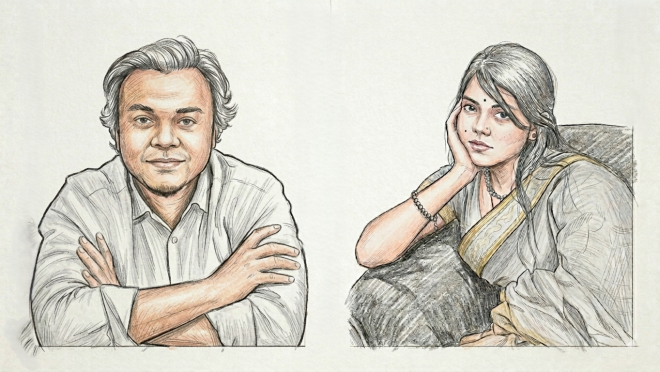
Shazed Ul Hoq Abir’s short story is titled Mofiz-er Relation Spark Nai (No spark in Mofiz’s relation). The story has been rendered into English by Arunava Sinha and Shabnam Nadia. Meanwhile, Anmana Manishita’s short story is titled A Masculine Fest.
Among the 25 writers selected, the two brilliant Bangladeshi minds have managed to secure their places with two very different short stories, each highlighted for its distinctiveness and compelling literary sense.
Shazed Ul Hoq Abir is a distinguished fiction writer and translator. He completed both his undergraduate and postgraduate studies in English literature at the University of Dhaka. He is currently serving as a Senior Lecturer in the Department of English at East West University.
Anmana Manishita is a Lecturer at BRAC University and also works as an Editorial Assistant at University Press Limited. She completed both her Bachelor’s and Master’s degrees in English literature from the University of Dhaka.
Shazed Ul Hoq Abir and Anmana Manishita shared their stories that led them to this international achievement.
Hearing the news
It is not every day that one finds oneself shortlisted on an international literary platform. For Shazed Ul Hoq Abir and Anmana Manishita, the news of their Commonwealth Foundation nomination arrived quietly at first, but its impact quickly grew into something far louder.
For Abir, the announcement came through an email from the foundation almost one and a half months before it became public.
“I received the news almost one and a half months earlier via an email from the foundation. I was not allowed to share the news publicly,” he said.
“I was definitely excited to receive the news, but I didn’t have too many people around me to share the news and celebrate—only my family members and a handful of close friends.”
For Anmana, the feeling was more internal and immediate, though equally overwhelming.
“It felt surreal. It didn’t fully sink in right away,” she said.
“But after a day or so, the thought that kept coming back was, ‘Oh no, a lot of people are going to read my story now.’ It started to feel a little overwhelming, to be honest.”
The journey
“My journey began in Old Dhaka… and Old Dhaka is a bucket full of stories,” shared Abir. The bustling streets and tightly knit corners of Puran (Old) Dhaka shaped the pen which Abir uses to write.
He also shared another unique experience that many of his contemporaries do not possess. “I earned pocket money by translating articles from English to Bengali in my father’s magazine (fortnightly Anandadhara), where he used to work as an executive editor. My knowledge of the Bengali language was gradually taking shape with each assignment.”
While Abir followed a methodical path towards his writing prowess, for Anmana it was somewhat spontaneous.
“I never chose writing as a career. I’ve always had a very vivid imagination, and I’ve been making up stories in my head since I was a child. Writing them down on paper was simply what came naturally,” shared Anmana.
However, her father’s influence also played a definitive role. “When I was about four or five years old, Baba asked me to write a story. I used to badger him with requests for a story every day after he came home from the office, and there was a day when he was quite tired… he asked me to tell a story to him instead.”
“But I was not one to back down from a challenge, and so I wrote a story instead of telling him one,” she added. Thus, without even being conscious of it, she had begun her journey as a writer.
Challenges
While everyone focuses on the end recognition, the daunting aspects often remain hidden behind the glitz and glamour, and for both of our interviewees, the path was not smooth at all.
Anmana addressed this issue quite candidly. “A city like Dhaka, for instance, especially at night, is teeming with stories, but I know there are parts of it I can’t access because of my gender and the social class I belong to.”
Abir shared a more pressing aspect. “The initial challenge was to be taken seriously by the editors of the literary pages of our national dailies. Without being referred to by anyone (any senior writer, or someone from the industry), it is still very difficult for young and unknown Bangladeshi writers to publish their write-ups on the pages of a national daily.”
He also expressed discontent about some of the publishing mediums. “The literary scenario is very polarised here, divided into camps. There is house-based favouritism.”
Inspiration
Crafting stories is not a science; rather, it pushes one to produce sparks of creativity each time a pen touches paper. Inquiring about Abir’s and Anmana’s inspiration, this sentiment is more evident than ever.
“My stories uphold an individual’s struggle against a system. I don’t write stories that serve the purpose of any particular political party, any Western ‘ism’, or any caste and creed, rather I focus on how an individual struggles against those pressing ideologies to survive,” explained Abir.
Abir was quick to note that he does not think of any social obligation beforehand. He focuses on the individual’s journey, and if he deems it interesting, he may write a story surrounding that experience.
For Anmana, the idea comes in bits and pieces. “I just can’t forget. It could be something I saw, felt, or overheard—often something quite small, actually. But if it stays with me, I sort of linger on it, trying to get under its skin a little.”
She also shared the inspiration behind her nominated story. Her grandmother’s experience played a part in it as well. “I’ve seen, time and again, how marriage can reshape a woman’s life in our country… sometimes in ways that are very obvious, and sometimes in ways that are so subtle they almost go unnoticed. Growing up, I heard my grandmother’s stories about the hardship and loss she faced in her in-laws’ house, and those stayed with me.”
When asked what they thought made their stories stand out, both expressed that they could not pinpoint any reason in particular.
Anmana shared the need for constructive feedback. “My experience has taught me that it is immensely helpful to have a friend or acquaintance who is well-read and who means well to criticise your writing.”
These two spirits interviewed are reminders that compelling stories from Bangladeshi literature can resonate far beyond its borders despite all the challenges and limitations.
The 2026 regional winners will be announced by Commonwealth Foundation Creatives in May, followed by the overall winner at the official awards ceremony in June.
Bangladesh eagerly awaits its creative minds to be finally recognised on the world stage, and for which, we here at TBS Graduates wish them the best of luck.