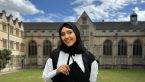
Against the odds: Inside the journey of the first Mro woman at Dhaka University
We are often blinded to the plight and disadvantages prevalent amongst the minority communities present in Bangladesh today.
Against the odds: Inside the journey of the first Mro woman at Dhaka University
We are often blinded to the plight and disadvantages prevalent amongst the minority communities present in Bangladesh today.
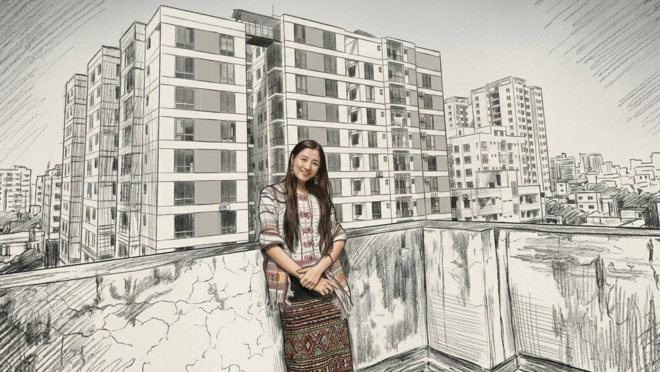
Privileges that we seem to take for granted may be luxuries for many. And whenever a member of those disenfranchised communities achieves an ounce of recognition, you can bet he or she had to overcome a lot compared to his or her contemporaries.
One such example is Yapau Mro, who became the first woman from the Mro community to secure a seat at Dhaka University.
To understand what this journey looked like from the inside, I reached out to Yapau directly. A brief conversation with her was enough to shift my perspective, and the phrase “life is not a bed of roses” gained another dimension.
Growing up
Yapau grew up in a village that does not appear on most maps. It is located in the region of Bandarban, in the Chittagong Hill Tracts.
It is a small Mro village tucked between mountains with no school, no hospital and no electricity. For years, reaching the nearest road required five to six hours on foot. After partial road construction during the pandemic, that walk is now two hours.
Yapau grew up here, the third of four siblings. Her family was supportive, but the nearest school was nowhere nearby in that part of the area.
To continue her education, Yapau moved to Thanchi and enrolled in a hostel. The early years went by reasonably well.
The persistent difficulty was language. Yapau’s mother tongue is Mru, but her entire education was delivered in Bangla. Managing a second language alongside distance from family proved overwhelming at one point, and she ran away from the hostel in class 3. An action born out of frustration, she eventually came back and continued.
Things became even harder when she was in class 6. She received two meals a day. Meat or fish appeared two or three times a month. The students around her came from similar villages, children for whom reaching a classroom had already required considerable effort from their families.
She continued her studies in the hostel till the end of college.
The admission test
After finishing college, Yapau began her admission preparation in Chittagong. According to her, the environment was not encouraging at all, and she began to feel like giving up.
At that time, a community brother told her about “Manush Manusher Jonno Foundation”, an organisation that supports underprivileged students. Her case was submitted after the application deadline had passed. She was kept under consideration. When one of the selected candidates turned down their scholarship, Yapau was offered the place.
With that support, she moved to Mohammadpur in Dhaka to continue her preparation. She was the only student from an ethnic minority community in her coaching batch. Adjusting to the food and the pace took time. Her batchmates were welcoming, and she eventually found her footing.
Yapau’s goal was not Dhaka University specifically. Any public university would do.
She studied seven to eight hours a day. The main obstacle, she has said, was the gap in her foundational knowledge. Years spent studying in a second language in under-resourced schools had left her behind in areas that other students had covered thoroughly.
She appeared in multiple admission tests. She secured seats in Chittagong University and Jagannath University. In the B unit of Dhaka University, she secured merit position 1,125, earning a seat in the Department of Political Science. She became the first woman from the Mro community to be admitted to Dhaka University.
Home, from a distance
Her village still has no electricity and no mobile network. To make a phone call, residents climb to higher ground to find a signal. Yapau’s parents have never visited Dhaka. Travelling back to the village takes two full days each way.
When she got into Dhaka University, her parents did not mark the occasion the way many urban families might. It was not indifference; it was the weight of what Dhaka University represents that simply does not have an equivalent frame of reference in Yapau’s village. She understands this and has said she hopes this achievement becomes part of something larger that she is able to do for her community.
On the broader picture, Yapau has been direct. “We hear about Digital Bangladesh and Smart Bangladesh,” she said. “But we never got to see the developments.”
Most of her peers from the village have not been able to continue their education; the obvious barriers are financial, logistical and structural.
Yapau has named her father as her most consistent source of support. He made sure, across years and distance, that she kept going.
A small reflection
As a child, Yapau grew tired of the village. She would want to see buildings, the city, a world outside the mountains. Now in Dhaka, she misses the calmness of her home.
She cannot reach her parents when she wants to. They have never seen where she lives. For her, getting home is a two-day journey.
Yapau is still here. The village that took five hours to leave on foot now has a daughter sitting in a Political Science classroom in Dhaka University.
For the children still between those mountains, with no school, no signal and no road that goes all the way, that is not a small thing.
On campus, students regularly ask her about her background and her community. She says that she answers with delight.
Her goal beyond her degree is to work towards better conditions for the Mro community. She considers her admission not an endpoint but a beginning.