Why is Bangladesh’s food system under strain despite stable supply?
Deep structural vulnerabilities—import dependence, climate stress, weak distribution, and inequality—are leaving millions in Bangladesh unable to afford food and making the system highly exposed to future shocks
Why is Bangladesh’s food system under strain despite stable supply?
Deep structural vulnerabilities—import dependence, climate stress, weak distribution, and inequality—are leaving millions in Bangladesh unable to afford food and making the system highly exposed to future shocks
The 2026 Global Report on Food Crises (GRFC) carries an uncomfortable message for Bangladesh. The country is not facing famine, nor is it experiencing a catastrophic collapse of food systems. Yet it remains among the top 10 globally in terms of the absolute number of people facing acute food insecurity.
Around 1.6 crore people experienced crisis-level hunger or worse during the 2025 peak—roughly 17% of the analysed population. And this came in a relatively stable year, marked by fewer major disasters, easing food inflation, and stronger remittance inflows. With global instability persisting and projections suggesting a 2% decline in global grain output in 2026–27, the question becomes unavoidable: how resilient is Bangladesh’s food system to future shocks?
A supply chain under pressure
For agricultural economist Dr Jahangir Alam Khan, this contradiction is not surprising. In his view, the issue is no longer about food availability—it is about systemic vulnerability.
“Bangladesh has been on this list before,” he noted. “That tells you the problem is structural. It is not just about one bad year or one disaster. It is about underlying weaknesses in the system.”
Bangladesh’s food system is deeply embedded in global supply chains. While domestic rice production has grown steadily, the broader food basket remains heavily import-dependent. Nearly 80% of wheat, over 70% of lentils, and significant portions of onions and edible oil come from international markets.
This dependency creates structural exposure. Global disruptions, whether from conflict, export restrictions, or logistics bottlenecks, translate quickly into domestic price volatility. The recent period has shown how fragile this balance can be. Political unrest, combined with supply chain disruptions in 2024, pushed food inflation to over 14%, with cascading effects on household consumption.
Ram Das, country director of CARE Bangladesh, framed the risk in even sharper terms. Bangladesh’s reliance on imported wheat (used in bread and biscuits) and maize (used in poultry feed), often sourced from a limited set of markets, means global shocks are quickly transmitted domestically.
“Bangladesh depends heavily on imported wheat and maize, and that too from a limited market since local production isn’t enough. This means when global prices go up, or when the taka weakens, food prices rise quickly at home,” he said. “Rice is somewhat insulated because we produce it locally and can be sourced regionally. But for wheat and maize, we don’t have strong backup systems.”
He added, “The impact is highly regressive. Urban poor and landless rural households feel price spikes almost immediately. So even a 2% global production decline can have disproportionate domestic consequences if compounded by currency pressure or supply chain disruptions.”
The government, however, signals cautious confidence in its ability to manage supply pressures. Agriculture Secretary Rafiqul I Mohammad noted that Bangladesh has weathered similar global shocks before.
“As we saw in 2022 during the Ukraine war, we are significantly dependent on imports for commodities like wheat, edible oil and pulses,” he said. “If such conflicts are prolonged, risks remain—but through efficient management, we have so far been able to navigate these challenges.”
The fertiliser trap
The country imports around 80% of its fertiliser requirements, making domestic agriculture highly sensitive to global price swings and supply constraints.
Acute natural gas shortages have forced the closure of five out of six major state-owned urea fertiliser factories. These plants, managed by the Bangladesh Chemical Industries Corporation (BCIC), require approximately 197 million cubic feet of gas daily to operate at full capacity. Meanwhile, recent international tenders have drawn limited interest from global suppliers amid rising prices and shipping uncertainties.
“Relying on imports is not a sustainable solution,” Dr Jahangir Alam argues. “Importing fertiliser is becoming increasingly difficult and expensive.”
“Only one factory is running, while four are closed,” he pointed out. “These are government-owned facilities. They should be brought back into operation.”
“In a time of fertiliser crisis, we cannot keep our own factories closed and depend on external sources,” he added. “We must ensure our own production.”
Ram Das underscores that fertiliser disruptions are already feeding into broader supply risks. “Fertiliser imports have been disrupted, especially urea, due to the Middle East crisis. For ordinary people, especially the poor, this shows up immediately as higher food prices and reduced purchasing power.”
However, the government maintains that the situation, for now, remains under control.
“At present, there is no immediate shortage,” said Rafiqul I Mohammad. “Our major fertiliser plants have been reopened, and the efficient ones are expected to begin production within the next couple of days. So far as fertiliser supply is concerned, the situation remains manageable.”
Climate as a force multiplier
Bangladesh’s agricultural system operates under increasing environmental stress. Floods, salinity intrusion, and extreme weather events continue to disrupt production cycles and livelihoods. The 2024 floods in the north-east, for instance, affected over 3 million people and caused significant crop losses.
“The main reason is that Bangladesh is one of the most climate-vulnerable countries,” Dr Jahangir Alam explained. “Even when there is no major disaster, the risk remains. Weather conditions directly affect output.”
This year, that risk is already materialising. Early projections suggest a decline in agricultural production, with some estimates indicating a drop of around 7.5%. Others warn that the situation could worsen depending on irrigation constraints and weather patterns.
If production declines by as much as 10%, the implications could be significant. “We could see a shortfall of around 20 to 25 lakh tonnes,” he warns. “That would make Bangladesh much more vulnerable this year.”
Yet adaptation remains uneven. “Bangladesh has strong climate-smart solutions,” said Ram Das, pointing to salt-tolerant crops and water-saving irrigation. “But the problem is not innovation—it is adoption.”
From his perspective, efforts remain fragmented. “These are still islands of excellence, not oceans of adoption,” he said. “Scaling requires a combination of technology, finance, market assurance, and extension services. This is something we need to fix if we want rapid scaling of our good work. We need to stop doing ‘pilots’ and invest in long-term, sustainable and scalable models. At the same time, we are not able to keep pace with the rapid change in climate, especially countering erratic weather conditions, which is not specific to Bangladesh but a global phenomenon.”
The government acknowledges climate risks but points to ongoing efforts.
“Bangladesh is widely recognised as one of the most climate-vulnerable countries. Improving climate adaptation programmes is a priority. And the government is working tirelessly to fulfill the priority,” the agriculture secretary said.
The Rohingya factor
The Rohingya crisis introduces a parallel food system—one that is almost entirely dependent on humanitarian assistance, yet deeply intertwined with local economies.
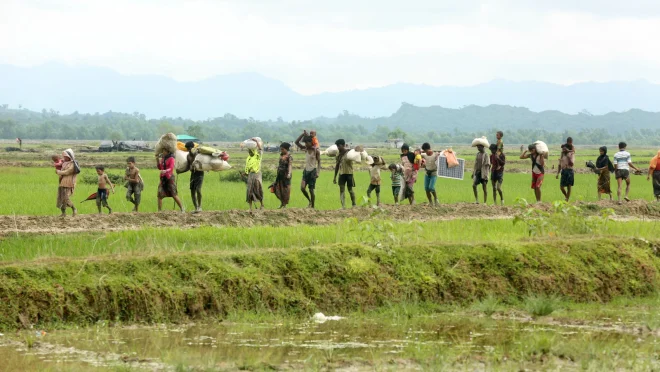
Nearly one million refugees remain in camps, where food access is contingent on external funding. The GRFC identifies these populations as a “hunger hotspot”, with conditions worsening due to reduced aid, new arrivals, and environmental pressures.
“The situation in Cox’s Bazar is already very fragile,” said Ram Das. “If more refugees arrive, food aid may be spread thinner, meaning less food per person.”
The impact extends beyond the camps. “Poor host communities may suffer more, as they share the same markets,” he added. “Households in Ukhiya and Teknaf are already showing coping strategies similar to refugees. This is no longer just a humanitarian issue – it is a protracted food security challenge, requiring integration of assistance with local market strengthening and livelihood access, not just ration top-ups.”
Officials acknowledge the added strain. “The report highlights increased pressure due to a new influx of Rohingya refugees,” Rafiqul I Mohammad said. “This has understandably added to the burden. And the government is committed to mitigate the crisis with utmost sincerity.”
Rethinking resilience
The policy challenge, therefore, is not simply to increase production or expand safety nets—though both remain important. It is to address the structural vulnerabilities embedded within the system.
Ram Das is blunt in his assessment. “Food is available in Bangladesh, but not always affordable everywhere. To fix this, we need to improve targeted support for the poorest (like cash or food assistance), strengthen local supply systems so food reaches all districts efficiently.”
He added, “Another important aspect of this process is to monitor markets better to prevent price manipulation or shortages. Producing enough is often not the solution, but making sure people can afford to buy it where they live. This is fundamentally a distribution and access failure, not just a production issue.”
Market governance is another weak point. “Instead of blunt controls, we need real-time market intelligence to address hoarding and bottlenecks,” he added.
Dr Jahangir Alam echoes the need for immediate support alongside long-term reform. “Cash assistance should be provided to buyers,” he suggests, to maintain access and stabilise demand.
At the same time, input support must be strengthened. “We have to ensure that inputs are delivered properly,” he said, with particular emphasis on fertilisers.
In the longer term, the focus must shift to increasing production capacity and reducing external dependence.
“The most important thing now is to increase production and invest in agriculture,” he argues. “Without that, vulnerability will continue.”
Ram Das added a critical dimension of inclusion.
“The fact that 1.6 crore people remain acutely food insecure even in a ‘normal’ year indicates a chronic vulnerability baseline, not just episodic crisis. Economic growth has helped Bangladesh overall. However, many of the poorest people are still struggling to afford enough food. But the issue is not that the growth model is failing. It is that it is not sufficiently inclusive or shock-resilient.”
“Food security interventions still focus heavily on calories, not dietary diversity,” he noted, “From my standpoint, we need to integrate livelihoods with nutrition and climate resilience practices. The last mile 20% needs to be prioritised in the national planning process.”
For now, the government remains cautiously optimistic. “These pressures are real,” Rafiqul I Mohammad said. “But we have managed so far, and we hope conditions will improve.”
That cautious optimism, however, rests on a system increasingly under strain where food may be available in aggregate, but stability, affordability, and resilience remain far from guaranteed.