Coexistence with elephants has improved in Sherpur, but remains a work in progress
A series of conservation measures introduced by the interim government has reduced human-animal conflict in the border area, but lasting coexistence will require habitat restoration.
Coexistence with elephants has improved in Sherpur, but remains a work in progress
A series of conservation measures introduced by the interim government has reduced human-animal conflict in the border area, but lasting coexistence will require habitat restoration.
The same scene repeated itself across the border villages of Sherpur last Tuesday: women bent double in rows across hillside fields, sickles moving fast, children perched on embankments watching, nobody resting.
“The herd of elephants is in the hills. We are harvesting now before they come over,” said Gajni upazila’s Rajib Koch.
But this has not always been the case.
For more than three decades, farming communities strung along the Garo Hills struggled with herds descending from the forests and trampling what took months of labour and borrowed money to grow.
Farmers put up electrified fences to protect their crops and tried to drive away the herds with torches, firecrackers, sticks, etc, sometimes leading to the death of elephants.
Change finally arrived during the tenure of Bangladesh’s interim government. It was an attempt, arguably the most organised to date, to address the conflict institutionally rather than seasonally.
Under the Bangladesh Climate Change Trust Fund and a dedicated elephant conservation project, allowances were introduced to mitigate human-elephant conflict. Elephant Response Teams, or ERTs, were trained and deployed to intercept herds before they reached populated areas.
Awareness campaigns on coexistence were conducted across affected communities. Within forest areas, shrub species preferred by elephants were planted to give the animals a reason to stay inside the tree line.
Syeda Rizwana Hasan, who served as Adviser to the Ministry of Environment, Forest and Climate Change under the interim government, also pushed for legal accountability.
“During our tenure, legal action was taken against several individuals and some were imprisoned,” Rizwana, also the Chief Executive of the Bangladesh Environmental Lawyers Association (BELA), said, referring to cases involving harassment, injury and killing of elephants.
The interim government had also begun building the case for a multi-ministry response, bringing together agriculture, forestry and district administrations to address what is, at its root, a habitat problem.
Kazi Muhammad Nurul Karim, Divisional Forest Officer of the Mymensingh Forest Division, confirmed that the current government has not unwound any of these measures.
“All the initiatives undertaken during the interim government’s tenure remain in operation,” he said. ERT training continues. Community awareness work continues. The compensation mechanism remains in place.
But farmers are not satisfied with the compensation.
Mejes Sangma, a Garo farmer from Andharupara village who spends his nights in a watchtower beside his field, armed with tin sheets and torches and a dwindling supply of kerosene, said flatly, “Although the Forest Department provides compensation for damaged crops, not everyone receives it.”

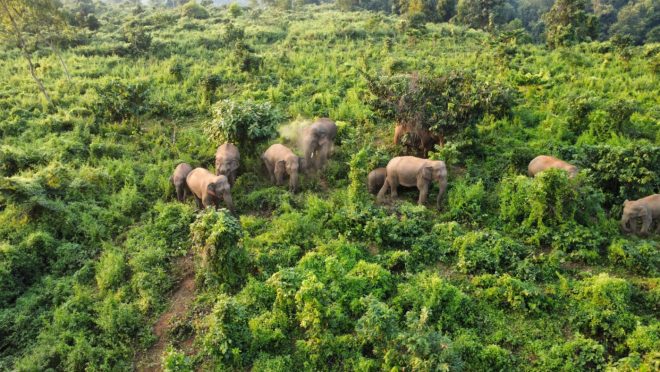
The elephants come from Meghalaya in India. Photo: Hasan Jamilur Rahman Saikat
Halim Uddin from Daodhara said, “The government compensation does not even cover a quarter of the damage. Occasionally, some farmers receive it, but that too comes after a long delay.”
However, this dissatisfaction is often unjustified because the Forest Department cannot pay compensation money to farmers (illegally) cultivating khas lands or land belonging to the Forest Department, which is a common practice, Tanvir Ahmed Emon, Assistant Conservator of Forests (ACF) at the Rangtia range in Sherpur, told TBS for an earlier report.
Divisional Forest Officer Nurul Karim noted, “Around 80-90% of the paddy has already been harvested [this season]. The remaining 10% is still in the fields, and farmers are now bringing that in. Compared to previous years, deaths from human-elephant conflict have also been relatively fewer.”
He also pointed to a constraint that no domestic policy can resolve on its own, “The elephants come from Meghalaya in India. But because of the barbed-wire fencing along the border, they can no longer move back. They have been living here for many years now.”
The structural answer, as Rizwana Hasan describes it, is neither quick nor simple, but it is also not unknown. Other countries have faced versions of this conflict and found their way through it. The question is whether Bangladesh will move fast enough, and with enough coordination, to do the same.
For this season, she called for two things immediately: public announcements guaranteeing crop compensation within three to seven days, and a crackdown on electric fencing. “Farmers often connect electric wires around their fields, and the current is strong enough to kill elephants,” she said. “This practice must be stopped.”
In the medium term, the harassment of elephants, which she described not as a deterrent but as a provocation that returns at night with interest, must be treated as the legal offence it now is under the new wildlife law. “Elephants do not attack unless they are provoked. They are harassed throughout the day, and then at night they come and attack.”
Her long-term prescription centred on designated feeding zones within the forest, specific plots where elephants can feed without crossing into cropland, with farmers who cultivate those plots receiving compensation in return.
Suman Mia, Ranger of the Balijuri Range, made a parallel point about the tree-planting programme already underway, “If elephant-friendly plants were cultivated on a much larger scale, attacks on localities could be significantly reduced.”

Now, instead of putting up electric fences and trying to drive away herds, farmers harvest the paddy early. Photo: Hasan Jamilur Rahman Saikat
Md Mahmudul Haque Rubel, BNP Member of Parliament for Sherpur-3, called for swift government intervention to find a permanent solution.
What Rizwana Hasan kept coming back to was something simpler than policy: the basic nature of the animal at the centre of all of this. “Elephants certainly do not wish to come into human settlements to be beaten with sticks or frightened by fire. They come out of necessity and hunger. If we can keep them well-fed and restore their habitat, then the work we do for elephant conservation here will become an example for other countries.”
According to the Forest Department, more than a hundred elephants, divided into three herds, currently inhabit the Sherpur border areas.