Scientists honour David Attenborough’s 100th birthday with newly named species
Scientists have named a newly identified species of parasitic wasp after David Attenborough to mark the legendary naturalist and broadcaster’s 100th birthday.
Scientists honour David Attenborough’s 100th birthday with newly named species
Scientists have named a newly identified species of parasitic wasp after David Attenborough to mark the legendary naturalist and broadcaster’s 100th birthday.
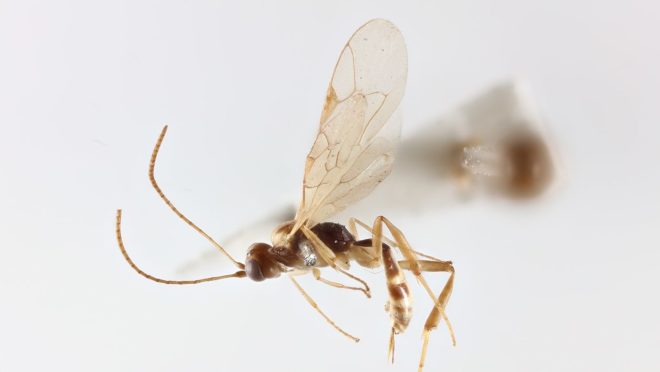
The insect, Attenboroughnculus tau, is just 3.5 millimetres long and had been resting unnoticed in the collections of London’s Natural History Museum since 1983, after being collected in Chile’s Valdivia province. Only recently was it recognised as both a new species and an entirely new genus.
Gavin Broad, principal curator of insects at the museum and lead author of the study published this week, said such delays are not unusual. “Sometimes taxonomic discovery is quick, you find something and describe it immediately,” he explained. “But often it’s a slow, methodical process of working through collections built up over decades.”
The wasp was spotted by Augustijn De Ketelaere, a volunteer researcher, during a survey of ichneumon wasps, a vast group of parasitic insects with around 25,000 known species and tens of thousands more thought to be undiscovered.
Closer examination revealed that the specimen did not fit into any existing genus. “It had a unique combination of features,” Broad said, “so we had to describe a new genus to accommodate this lovely little species.”
Attenboroughnculus tau has a slender, curved abdomen and belongs to a small subfamily found in parts of Chile, Argentina, Australia and New Guinea. According to Broad, this unusual distribution reflects the ancient supercontinent Gondwana, which began breaking apart around 180 million years ago. “These wasps are relics of that time,” he said, “and have likely disappeared from much of the rest of the world.”
The species name tau refers to the T-shaped markings on the wasp’s abdomen, resembling the Greek letter τ. The genus name honours Attenborough, a distinction Broad described as particularly fitting. “Most genera have already been named, unlike species,” he said. “David Attenborough deserves a genus. I think everyone would agree.”
Attenborough’s work inspired Broad to pursue a career in science. “I grew up watching Life on Earth and The Living Planet,” he said. “It was through David Attenborough that I first understood what a taxonomist was.”
The centenarian naturalist has more than 50 species named after him, spanning fish, birds, reptiles, insects and plants, as well as several genera. On hearing about the wasp, Attenborough sent Broad a handwritten note of thanks.
Born on 8 May 1926 in Isleworth, England, Attenborough first appeared on the BBC in 1954 with Zoo Quest. Knighted twice, he holds more than 30 honorary degrees and continues to work well into his second century, most recently narrating a series on wildlife in British backyards, Secret Garden.
“Attenborough has transformed how we see life on Earth,” Broad said. “He’s revealed the hidden lives of plants and animals, and in recent years, he’s become one of the most powerful voices urging us to protect the natural world.”