Water analysis reveals interstellar comet 3I/ATLAS was formed beyond our solar system
Astronomers studying the interstellar comet 3I/ATLAS, only the third confirmed visitor from beyond our solar system, have made a landmark discovery about the comet’s water, and what it tells us about where it originated.
Water analysis reveals interstellar comet 3I/ATLAS was formed beyond our solar system
Astronomers studying the interstellar comet 3I/ATLAS, only the third confirmed visitor from beyond our solar system, have made a landmark discovery about the comet’s water, and what it tells us about where it originated.
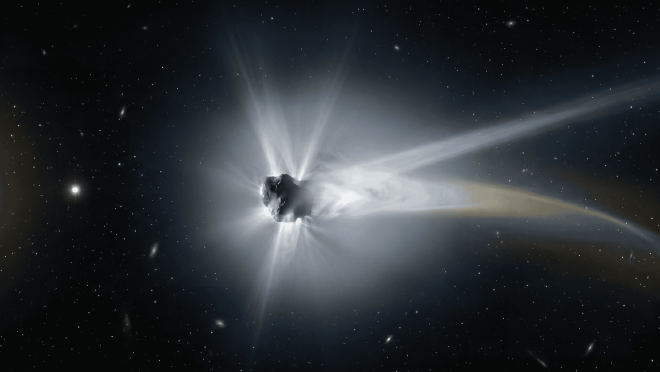
Using the Atacama Large Millimeter/submillimeter Array (ALMA) in Chile, researchers were able to measure the abundance of deuterated water, a form of water where one hydrogen atom is replaced by heavier deuterium, in the comet’s icy material shortly after it passed close to the Sun.
The results showed exceptionally high levels of deuterium compared with ordinary water: 3I/ATLAS contains at least 30 times more deuterated water than comets from our solar system and more than 40 times the ratio found in Earth’s oceans.
Scientists say this unusually high ratio acts like a chemical fingerprint, revealing that the comet formed in a far colder environment than the one that produced our solar system’s comets. Temperatures in that region were likely below about 30 K (–243 °C / –405 °F) — conditions that promote deuterium enrichment during water formation.
Because deuterium enrichment is sensitive to temperature and radiation in the birth environment, the data suggest 3I/ATLAS came from a planetary system that evolved under very different physical and chemical conditions. These findings give astronomers a rare glimpse into processes at work in distant parts of the Milky Way and offer a direct comparison between the chemical histories of different star systems.
The research was published this year in Nature Astronomy and highlights how interstellar visitors like 3I/ATLAS can act as time capsules, helping scientists study environments that predate and contrast with our own planetary neighborhood.