Masculinity, misinformation and the digital classroom
A young man has questions about his body. He cannot ask his parents. He is not comfortable asking a teacher. His biology school book provides information, but information is not clarity itself. And so, he turns to the place that most unanswered questions now go: the internet.
Masculinity, misinformation and the digital classroom
A young man has questions about his body. He cannot ask his parents. He is not comfortable asking a teacher. His biology school book provides information, but information is not clarity itself. And so, he turns to the place that most unanswered questions now go: the internet.
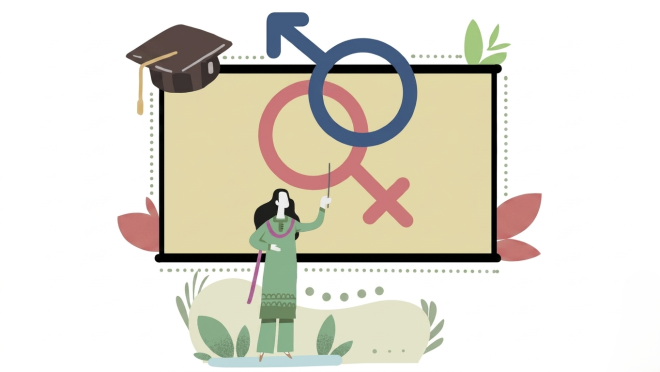
This confusion is no longer hidden behind closed doors for many young men in Dhaka. Our study revealed that if families and schools do not talk about sexuality, then digital spaces soon become the primary source for young men to find answers.
In this case, their first mise-en-scène: a Google search, a post on Facebook, an image, a meme, messages from friends, and maybe even a video of porn. The issue, though, is that most of these ‘lessons’ are incomplete, exaggerated, sexist, or simply false.
Our study involves focus group conversations with 45 participants aged 18 to 25. Young men are actively in search of sexual knowledge, but many rely on uninformed, unverifiable sources to make their choice of what is correct. In this process, harmful myths about masturbation, loss of semen, manhood, consent, and relationships continue to circulate and be normalised in daily online spaces.
The silence around sex
In Bangladesh, conversations about sexuality are still surrounded by discomfort. Families often avoid the subject, while schools tend to limit discussions to biological reproduction. Hence, in this way, young men become curious but have no means of guidance.
Friends and peers were subsequently the first and most accessible sources of sexual information they found. Discussions with family members, when they took place, tended to include only warnings. From our conversations, it was evident that formal education is thought of as incomplete and overly focused on biology, leaving emotional, ethical, and relational aspects of sexuality largely untouched. This silence does not stop young people from seeking answers. It only changes where they look.
The role of the internet
Digital media has a two-way effect. It provides information for young people, but it also exposes them to disinformation. Study participants described turning to Google, Facebook, online videos, and social media discussions in their quest for sexual information.
That said, not all online spaces clearly distinguish between reality and myth. Little do they know: this sexual information usually reaches young men via memes and jokes, sensational posts, and peer-shared content. Repeated often enough, misinformation becomes normal in such domains.
One of the most powerful influences came from pornography. Participants associated it with unrealistic sexual performance expectations, male control versus female submission, and distorted ideas of consent. Instead of depicting sexuality as mutual, loving, and consensual, pornography propagates a narrative where men must be tough, seasoned, and dominant.
This study then identified several misconceptions among male students that cropped up repeatedly. Many of these were related to masturbation and semen loss, masculinity, menstruation, and sexual performance.
A few participants mentioned that they had heard claims about masturbation causing weakness or mental illness. Some described beliefs that semen loss is unhealthy. Such ideas are not new, but they survive thanks to digital platforms and conversations among peers.
These myths are not only powerful in content, but also spread without correction. If a teen reads the same statement from friends, finds it on the internet, and has no credible adult to approach about it, misinformation starts sounding like fact.
Masculinity under pressure
It is not simply that the information available is wrong. It is also about what young men learn to think men should be.
We found that digital media usually reinforces gendered mental representations. Some male students referred to notions associating masculinity with sexual conquest, power, and control. These ideas create social pressures, feelings of inadequacy, and violent mindsets about women.
In this way, misinformation does not stay secret. It shapes relationships. It influences how young men perceive consent, trust in relationships, emotional safety, and gender roles.
Misconceptions also have emotional consequences. Fear, guilt, anxiety, and confusion about sexual development were common in the interviews. A few referred to how it could impact their relationships, leaving them with a sense of mistrust and unrealistic expectations.
This clearly demonstrates that sexual misinformation is not a trivial problem. It can shape mindsets, confidence, and the way young people relate to others.
Talking about sexuality is considered shameful, so young men conceal their questions. But unasked questions do not go away. They tend to return through winding routes.
Education must catch up
This research points to a singular need: inclusive, age-appropriate, and culturally relevant comprehensive sex education.
This does not mean encouraging people to be reckless, as so many fear. It means giving young people the ability to understand their bodies, recognise consent, intervene when they see something harmful, and create healthy relationships.
The study suggests adding critical media literacy to sexuality education. Aside from learning biological facts, students should be taught how to assess information on the internet, understand how pornography distorts reality, and identify harmful gender stereotypes.
Teachers also need training. If educators remain uncomfortable, classrooms will continue to reproduce silence. Peer education can also help, as peer groups are an extremely important source of information for young people.
Blocking sites or warning students that they should not use digital media will not suffice. Young people are already online. The better question is whether they possess the tools to contextualise what they see.
Policy must promote transparency, the availability of youth-friendly services, and mental health care. Even social media campaigns can be created in vernacular language to combat prevalent myths.
Young people should be educated out of fear instead. Education should be informative, respect-oriented, and pragmatic.
The one conclusion that is clear from this study is that silence is not neutral. Digital media fills the gap when sexuality is ignored by families, schools, and institutions. While the loudest voices online can be sexist or simply wrong in a world where they are not verified, young men are forced to build on sand.
Male students do not need more shame. They need clarity. They need the space to ask questions without fear. Their education must not treat them as the problem, but rather as young people seeking to understand themselves in a mixed digital environment.
Because when silence becomes the teacher, misinformation becomes the lesson.