Joan of Arc and why patriarchy’s favourite woman is a dead one
Joan of Arc and why patriarchy’s favourite woman is a dead one
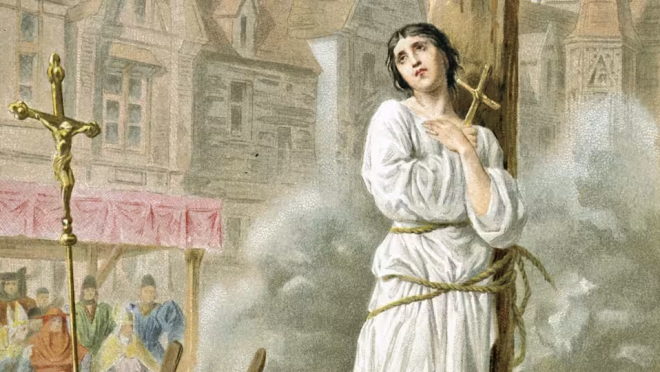
History has a strange habit of burning women first and worshipping them later.
In 1431, a nineteen-year-old girl was tied to a wooden stake in the marketplace of Rouen, France, and burned alive. The men who condemned her called her a heretic, a witch, a liar.
They said she was dangerous. They said she needed to be stopped. Her name was Joan of Arc, and she had just helped save her country from foreign occupation.
Twenty-five years after her death, the same Church that burned her reopened her case and five centuries later, in 1920, they declared her a saint.
She went from ash to angel. From criminal to icon.
What had changed, you ask?
She was dead.
Who was Joan of Arc?
Joan was a peasant girl from a small village in north-eastern France. She had no military training, no noble family name, no political power. What she had was a belief. She claimed to hear the voices of saints telling her that God had chosen her to help Charles, the French prince, reclaim his throne from English forces who had invaded and occupied large parts of France.
This was the Hundred Years’ War, a long and exhausting conflict between France and England. By the time Joan appeared, France was losing badly. Large cities had fallen. Many French leaders had given up.
At seventeen, Joan walked into the royal court, convinced a sceptical prince to give her armour and an army, and led French troops to a series of stunning victories. Historians still debate how a teenage girl with no experience inspired an army that trained soldiers had failed to motivate. She was bold, direct, and completely unafraid to speak her mind, including to men who outranked her in every way.
Eventually, she was captured by enemy-allied French forces, sold to the English, put on trial for heresy, and executed. She was nineteen years old.
The pattern
Here is the interesting bit: Joan of Arc was not celebrated when she was alive and powerful. She was tolerated, and when she became inconvenient, she was destroyed. The prince she helped crown king did not send anyone to rescue her. The generals who fought alongside her did not speak up for her. The people she saved did not protest in the streets.
But centuries later? Statues. Paintings. Movies. A national holiday in France. Patron saint. Symbol of courage, purity, and patriotism. The suffering is what made her safe to admire. A living Joan, a woman who commanded armies, contradicted bishops, and refused to wear dresses, was a problem. A dead Joan, frozen in the image of a young martyr with flames around her, was a story people could control.
This is not unique to Joan.
Think about Pritilata Waddedar, from Chittagong, in what is now Bangladesh. She was a schoolteacher and a revolutionary who, at a time when women were not even allowed inside the meetings of armed resistance groups, led an armed attack on a whites-only club that displayed a sign reading “Dogs and Indians not allowed.” Cornered by police afterwards, she chose to swallow cyanide rather than be captured alive. She was twenty-one years old. Her final note, found on her body, read: “I declare myself a revolutionary.”
Today, roads, schools, and statues carry her name across Bangladesh. But when Bollywood made a film loosely based on the uprising she helped lead, it reduced her to a romantic interest for the male hero, erasing her political role entirely. Death made her safe enough to honour. Distortion made her easier to swallow.
Think about Princess Diana. When she was alive, the royal family and much of the British press treated her as unstable, embarrassing, too emotional. Too much. She gave an interview that horrified the establishment. She spoke openly about her struggles with depression and an eating disorder. She shook hands with AIDS patients when the world was terrified of them. She was punished for all of it. But in death, she became the “People’s Princess”, mourned by millions, turned into a symbol of grace and tragedy. Her rebellion was quietly erased. What remained was the suffering.
Why does this keep happening?
The French philosopher Simone de Beauvoir wrote in her landmark book The Second Sex that society has always been more comfortable with women as symbols than as people. A symbol does not argue back. A symbol does not ask for equal pay or leadership or the right to make her own decisions. A symbol just means something, usually something beautiful and tragic.
A rebellious woman, when living, is highly inconvenient for the patriarchy. She challenges things. She makes people uncomfortable. She refuses to shrink.
But a dead one? The one who suffered? She becomes a myth. And myths are easier to manage than people.
You can decide what the myth means. You can strip away the inconvenient parts, Joan’s aggression, Diana’s anger, Plath’s rage, and keep only the parts that make a good story. Usually: she suffered, she was beautiful, she was tragic, she is now at peace.
This is what martyrdom does. It takes a complicated, living, difficult woman and turns her into something soft and unthreatening, something societies can finally, safely love.
Look at young female activists today. The ones being mocked, surveilled, arrested for climate activism, for women’s rights, for speaking in front of governments that do not want to hear them. In fifty years, some of them will probably have statues built in their honour. The same institutions currently trying to silence them will eventually try to claim them. That is the cycle.
Joan of Arc was not remarkable because she died. She was remarkable because she lived, loudly, boldly, and on her own terms for as long as she could. The tragedy is not the burning. The tragedy is that for so many women throughout history, the world only finds room for them in the story once they are no longer here to tell it themselves.
The question worth sitting with is this: How many women alive right now, speaking, leading, refusing, are we ignoring, dismissing, or punishing, while reserving our admiration for the version of them that only exists after they are gone?