The Blind Girl and an Elephant: How Ishtiyak Zihad’s debut feature reached the Shanghai International Film Festival
For years, filmmaker Ishtiyak Ahmad Zihad carried stories inside his head without knowing exactly where they would take him. Today, one of those stories has travelled all the way to one of Asia’s most prestigious film festivals.
The Blind Girl and an Elephant: How Ishtiyak Zihad’s debut feature reached the Shanghai International Film Festival
For years, filmmaker Ishtiyak Ahmad Zihad carried stories inside his head without knowing exactly where they would take him. Today, one of those stories has travelled all the way to one of Asia’s most prestigious film festivals.
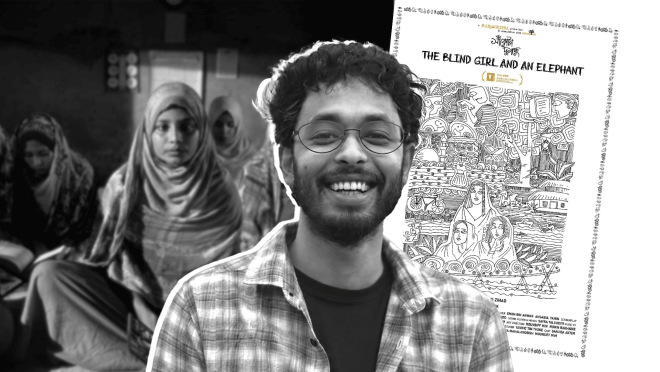
The Bangladesh-German co-production has been selected for the Asian New Talent Competition at the 28th Shanghai International Film Festival. The Asian New Talent section, which spotlights debut and second features by Asian directors, draws 12 titles from across the continent and beyond.
The film will premiere on 15 June. Produced by actor and producer Manoj Pramanik under the banner of MANpaCHITRA, the film is part of a section dedicated to debut and second features by emerging Asian directors. German producer Christoph Thoke served as the associate producer.
The cast of this eighty-minute film includes Sanjida Akter Sorna, Tahmida Rahman Touhida, Sumaiya Haque, Ashok Bepari, Mounsiff Mim, Pial Sarker and Sabiha Zaman, among others.
For Zihad and his team, the selection marks the culmination of a journey defined by patience, perseverance and an unwavering belief in the project.
From storytelling to filmmaking
Long before filmmaking entered his life, Zihad was immersed in stories.
His mother worked as a librarian, and as a child he spent countless hours reading in libraries while waiting for her after school. The habit gradually developed into a passion for writing.
“Before entering high school, I had already entered the world of novels,” he recalled.
Although he initially dreamt of becoming a writer, a chance admission to a Film and Media Studies programme altered the course of his life. There, he found himself surrounded by senior students whose enthusiasm for cinema proved contagious.
“Working with them on projects and productions, I never even realised when the desire to make films began growing inside me,” he said.
The story behind the film
The origins of The Blind Girl and an Elephant are deeply personal. Zihad says his mother, sister and girlfriend played a significant role in shaping his understanding of women’s lives, allowing him to observe different experiences and perspectives that would later influence the film.
The story itself began taking shape during the COVID-19 lockdown. The vulnerability created by the pandemic, particularly in rural Bangladesh, became an important source of inspiration. During that period, Zihad found himself reflecting on the contrast between the life of a female university student and that of a girl living in a village. The differences between their realities prompted him to think more deeply about the social and emotional worlds of women from different backgrounds.
Those observations gradually evolved into the foundation of The Blind Girl and an Elephant, giving him the motivation to continue developing the story during an uncertain and difficult period.
“Perhaps it was this contrast that made me think more deeply and gave me the strength to continue writing the story,” he said.
Making a feature film against the odds
Neither Zihad, producer and actor Manoj Pramanik, nor production company MANpaCHITRA had previous experience making a feature film when they embarked on The Blind Girl and an Elephant. Rather than being overwhelmed by the scale of the project, the team approached it incrementally.
“We thought shot by shot, sequence by sequence, day by day,” Zihad said.
Limited funding presented one of the biggest challenges throughout the production. Zihad credits Pramanik with ensuring the film remained on course while allowing the team to realise its creative vision without artistic compromise, describing the producer’s support as a constant presence throughout the journey.
He also praised the cast and crew, whose commitment carried the project through years of development and production. According to Zihad, everyone involved shared the same determination to see the film through to completion.
“The entire team shared one goal: we had to reach the end and complete the film no matter what.”
Reflecting on the film’s journey, Zihad is careful not to treat it as a formula for success, noting that every independent production follows its own path. Still, he hopes emerging filmmakers can draw encouragement from the experience. In an industry where resources are often scarce and uncertainty is constant, he believes determination and belief in a story can carry a project much further than expected.
From Bangladesh to Shanghai
The film’s international journey gained momentum through Film Bazaar in India, where members of the team met German producer Christoph Thoke. His involvement eventually helped transform the project into a Bangladesh-Germany co-production and provided valuable support during the film’s development.
For Zihad, the selection to the Shanghai International Film Festival was both validation and relief after years of work. He recalls having a strong sense that the film would resonate with the festival when it was submitted, a feeling he even shared with producer Manoj Pramanik at the time.
Despite receiving the invitation, the team initially took time to consider their next steps before ultimately deciding to accept it. The selection marked a major milestone for a project that had been years in the making.
“After so many years of hardship, sacrifice and perseverance, we finally got the opportunity to bring our film to audiences,” Zihad said. “It was very much a ‘finally, we did it’ kind of feeling.”
Now, as the film prepares for its international premiere, the team is looking forward to seeing how audiences respond to the story and the world it brings to the screen.
A different Bangladesh on screen
As the film prepares for its international premiere, Zihad hopes audiences will discover a side of Bangladesh that is rarely represented in global cinema.
“Beyond the usual narratives, there is a world of human emotions, folklore, beliefs, landscapes, and everyday resilience,” he said.
Through the film, he wanted to portray rural communities and the people living on the margins with dignity and complexity.
“Their struggles are local, but their hopes, fears, friendships and dreams are universal.”
Following its international festival run, The Blind Girl and an Elephant is expected to be released in Bangladesh next year.
Influenced by filmmakers such as Kim Ki-duk, Ritwik Ghatak, Buddhadeb Dasgupta and Apichatpong Weerasethakul, Zihad belongs to a new generation of Bangladeshi filmmakers finding recognition on the international stage while telling distinctly local stories.
Asked to describe the journey behind his debut feature in a single sentence, he pauses before offering a simple reflection:
“Eventually, all waves settle.”