The girl behind the drums and the noise around her
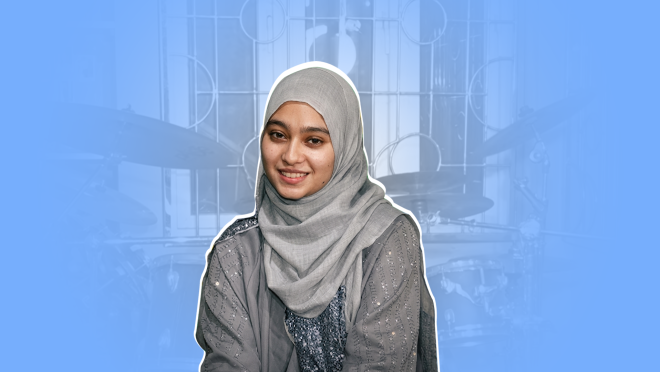
Nazia Samantha went viral for playing drums in a hijab. What happened next says a lot more about us than it does about her.
The girl behind the drums and the noise around her
Nazia Samantha went viral for playing drums in a hijab. What happened next says a lot more about us than it does about her.
There is a particular kind of cruelty that hides behind these concerns. It does not announce itself as hatred. It arrives wrapped in the language of religion, of culture, of family values. It says: we are not attacking you.
We are guiding you. We are worried about you. We just want you to stop. Nazia Samantha found that out the hard way.
A few weeks ago, a video of a young Bangladeshi woman playing drums started circulating on social media. She was good. She was confident. And she was wearing a hijab. That combination, for reasons that say everything about where we are as a society, was apparently too much to handle. The video spread fast. So did the comments.
What followed was the now familiar cycle of online pile-ons in this country: screenshots shared across groups, strangers weighing in on a woman they had never met, moral verdicts delivered from keyboards with all the confidence of people who had thought very hard about very little.
The criticism was not about her technique. It was not about the music. It was about the image of a covered woman sitting behind a drum kit, playing with skill and visible joy, and whether that image was permissible. The answer, according to a very loud portion of the internet, was no.
Her father then made a public statement. He expressed regret. He apologised. And in the same breath, he urged people not to bully or insult his daughter. He just wanted, he said, for people to encourage her to stop playing drums. The distinction mattered to him, apparently. The difference between insulting someone and simply pressuring them, through sustained public shame, to give up something they love. It is worth sitting with that for a moment.
Because here is what nobody seems to be asking: what does this do to the next girl? The girl who is fifteen and just started covering her hair. The girl who is still figuring out what her faith looks like in practice. The girl who loves something, music or sport or art or anything else, and is trying to understand how it fits alongside her growing sense of herself as a Muslim woman. She watched this. She saw what happened to Nazia Samantha. She saw the comments. She saw the father’s statement. She filed it away.
And she learned something. She learned that covering yourself does not protect you from scrutiny. It increases it. That when you wear a hijab and do something that draws attention, you are not just a person doing a thing anymore. You are a representative of something. And representatives are held to standards that ordinary people are not.
That lesson will push some girls away from hijab altogether. Not towards it. And if that outcome troubles the same people who flooded Nazia Samantha’s comments with corrections, they should think carefully about the connection between those two things.
When a girl does something visible, something public, something that draws a crowd, the scrutiny that follows is rarely just about the thing itself. What happened to Nazia Samantha is proof of that. She was not scrutinised because she played drums poorly. She was not scrutinised because she caused harm. She was scrutinised because the image of her, confident and skilled and present, did not match what a certain part of society had already decided she should look like. The comment sections were not filled with music critics. They were filled with people who had appointed themselves the authority on what she was allowed to be.
That says something. Not about Nazia Samantha. About us. About a society that watches a young woman do something with skill and joy and responds not with curiosity or even indifference, but with the urgent need to correct her. A society where the instinct, when a girl steps into view on her own terms, is to pull her back. To make the space smaller. To make sure she understands that her visibility came with conditions she was never told about until she broke them.
That is not a religious value. That is not a cultural strength. That is just control. And the fact that it arrived so quickly, so loudly, and from so many directions at once, is the part of this story that should make all of us uncomfortable.
Disclaimer: The views and opinions expressed in this article are those of the author and do not necessarily reflect the opinions and views of The Business Standard.