Fractured Reflections
Fractured Reflections
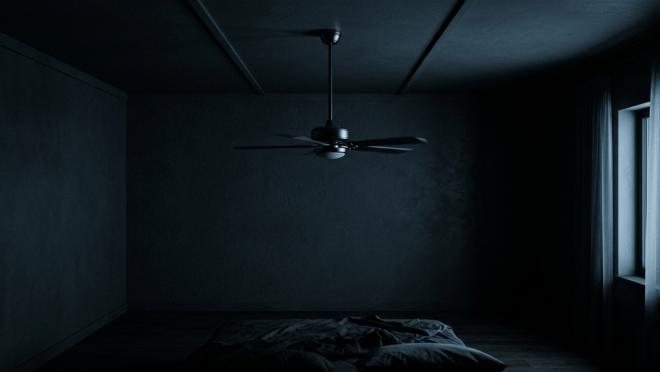
The ceiling fan was revolving more and more slowly, as if it were choking to death.
It was a slit of wetness, in which Britto was lying awake, looking over his bed. It was a queer room at three in the morning, as though the night was taking the furniture about when he was pretending to be asleep. The medicine bottle beside his pillow was reminiscent of the street light that was peeking through the curtains. Half-empty, or half-full. He did not like the way people always took fractions and made significance out of them.
The drip of rain in the outside world was beating off the electric wires at sporadic times.
Inside, his mind refused silence.
He checked his phone again.
No reply from Mahbub.
Last seen: 2:11 a.m.
Britto swallowed. His heart was contracting at a comical haste. Mahbub must have been angry. Perhaps he had now grown tired of him. So perhaps everybody did.
It was not the thought itself that was frightening. It was as scary as reality.
Britto was well acquainted with this trend. Late reaction was converted to distance. Distance became rejection. Rejection became abandonment. Dots and typewriting signs were his fancies, turning disasters.
He placed the phone face down.
After 12 seconds, then picked it up again.
Nothing.
The fan kept on whirling around him.
All the things in his life revolved.
Even his name.
Britto never talked much, and people believed that it was because of his ego.
He was a legend in college because he was the boy who was bright when making speeches, when he gazed across the entire classroom with a deadpan comment, when he passed examinations with the highest marks without seeming to have studied it at all, and when he was unable to bring down a question to the personal level. Girls admired him as he bore sadness gracefully. Boys admired him as he did not seem to be seeking validation.
But none of them caught a glimpse of the rest.
As his thoughts were now physically audible, they had never seen him seated on the floor of the bathroom at four in the morning.
They did not even see him practising basic conversations before sending messages numerous times.
They never observed how he managed his words so well in emotional conversations, since he was afraid that he would be inhuman without his intent.
An invisible theatre was bipolar disorder. The audience just viewed fragments of the performance and believed that they had the entire plot.
His mum was the most ignorant and loved him the most.
“Why do you overthink everything?” she would ask softly while folding clothes.
As if overthinking is similar to a switch.
The brain, as though it were not at times a room with mirrors and mirror reflections multiplying into distortion, reflections.
“You talk,” Shristy had once said to him, “like you would rather go away before people could go away.”
During the winter, they had been sitting by the lake behind the campus. Her hands were numb, and she had her sleeves over her sweater. Britto recalled all that had happened that night but forgot the colour of the sky.
He had laughed at her, saying:
“Sounds poetic enough to be fake.”
“It’s not fake,” she said quietly.
That frightened him.
Shristy was a dangerous, observant woman.
For months, their relationship was in nameless land. Too near to be friendship. Too wanton to be love. Britto would talk all night to her and keep her awake until morning, of philosophy, family trauma, and absurd humour, about religion and whether loneliness was the natural state of humankind.
And in the evening, she replied.
Only late.
Nothing more.
But Britto caught a glimpse of the briefness, the missing emoji, the chilliness which he fancied in time.
The fear in the feign of anger was aching his heart.
And so first he withdrew.
Three days passed without contact.
He was in his defence when she at last got onto him, tired and sick as she was.
“You clearly needed space.”
“I had university exams, Britto.”
“Right.”
“Why are you doing this again?”
Again.
Nothing was to that word charge.
Since it was a pattern.
Patterns were made to identify.
The bickering had become such that the love giving way had been changed to silence. Weeks later, Shristy capitulated.
Britto explained to all that it just “did not work out”.
However, secretly, he re-enacted the dialogue for months as a crime scene investigation.
One day, his psychiatrist asked, “Do you fear being abandoned or harming?”
Britto smiled a bit.
“Both.”
The psychiatrist believed that this was a textbook response.
Never was it rightly written in textbooks how the exhaustion was to be.
They did not discuss the hard work that it was to love human beings and not to believe your feelings.
Meherin loved certainty.
Britto was never able to think of it.
The first thing that she liked about him was his smartness. Then his humour. Then the queer tenderness stifled in his impatience. She could even leave him voice messages, laughing her eyes out at his silly jokes about politics, Bengali TV drama, and the existential sufferings of group work.
Nearly, it came true with Meherin.
And that was the worst that was to him.
One evening, she asked casually, “Do you ever think about marriage?”
Britto’s stomach tightened instantly.
Marriage.
Permanence.
Expectation.
The appalling idea of having to be emotionally permanently accountable to someone.
He was playing a joke, and escaped the question, but was unable to breathe again for hours later. His mind was whirling round and round.
What would be the case if he took away the life of somebody?
But what would happen if he should get sicker?
What will happen when love ultimately turns into hatred?
What then should he have done had intimacy shown the extent of unsteadiness in him?
Meherin, the days he evaded the calls of Meherin. At last, she defied him, and pain under her, calmness.
“You disappear whenever things become serious.”
“I’m just busy.”
“No, you’re afraid.”
The reality of it was too difficult to hear when uttered by another person.
She too finally left—not in a melodramatic, not in an indignant, just in a weary manner.
Britto went as far as to be nearly respectful of her.
Diba had been ushered into his life inconspicuously, in the monsoon rainfall before night.
She was a student of fine arts. She had silver bracelets that made soft sounds as she was drawing. She was Hindu. This Britto looked at in a glance, and laboured not to think of it afterwards.
But thoughts did not very often attend him.
He never confessed anything to Diba. They identified with each other in a rather incomplete or part-way style, through books, and through sharing of moments which were half-protracted friendship.
But guilty yet was he.
It was not that he thought affection per se to be a sin, but that he thought that he was already divided enough within himself. Religion, family needs, social reality, all that was another turn of the labyrinth of his mind.
One afternoon in a dreamy state, Diba, in his class, sketched his portrait.
He looked on when she displayed it to him.
The sketch appeared to be torn. The black spots at the edges of the eyes were intentional.
“You broke me,” he jested.
“You already looked like that.”
She smiled in saying.
He was not sure whether he felt comprehended or naked.
Then he started avoiding her as well.
Once, Mahbub told him, “You make storms out of air.”
Due to that saying, Britto detested him.
Not that it was inhumane.
It was correct, therefore.
It was a battle that started over a small thing.
A gathering.
That was all.
Mahbub, Orsha, and Badol had gone to a café without telling him since they had assumed that he was sleeping after he had gone sleepless throughout the night once again. Orsha then put up a group shot.
Britto gazed at it for twenty minutes.
Nothingness was instantly turned into betrayal by his mind.
They wished that he were not there.
Without him, they were happier.
Now he had become of less account.
In the evening, he ceased to respond to everybody.
Mahbub called repeatedly. Britto ignored him.
Finally, Mahbub emerged from his home, furious and confused.
“What’s wrong with you?”
“Nothing.”
“And what is the reason that you do so?”
Britto laughed bitterly. “You wouldn’t understand.”
“Then explain it!”
But the explanation required the discovery of the humiliating illogic of his answers. What could he say that had made him feel that a mere photograph had made him basically forgettable?
Rather, he got defensive.
Voices rose.
Badol tried to conciliate them.
Orsha made no reply, but looked sickly sad at Britto.
Finally, Mahbub snapped.
“You think that they are all out to get you. How boring that is, do you know?”
The phrases were long-lasting.
That evening, Britto hit the mirror in the bathroom so hard that it broke.
Not dramatically.
Almost absentmindedly.
Then he gazed at his broken image in broken glass and was racked with the want to laugh.
When his father awoke the next morning, he discovered the mirror.
Neither of them mentioned it.
Only his father responded when making tea: “Some things break because pressure remains trapped inside too long.”
Britto did a drawing of his head.
Fathers were indirectly loving.
And good days also there were.
That made things even more difficult.
On other afternoons, Britto was magnetic, hyperalive. He raved and wrote poetry by the twitch of the finger, and made everybody laugh till they cried, and plotted mighty things to come, and swore himself to be cured. During these times, he was almost invincible—as though his mind had finally pulled itself into harmony with light.
Then came the fall later.
The unbearable fatigue.
The emotional ash.
The only version that people remembered was the charismatic one, and because of this, they could not assimilate the withdrawn one. They claimed inconsistency was deliberate.
Even Britto himself had forgotten which was the truth.
It must have been all of them.
Perhaps none were.
One of the nights, it was raining, and Orsha even met him at the university gate.
“You push everyone away and then mourn being alone.”
Half of her scarf had been wetted by the rain. The flooded streets had cars hissing along.
Britto looked away. “Probably people should go then.”
“Do you suppose so?”
“No.”
“Then why say it?”
It was safer to experience pain when anticipated.
As it was not as painful when it was self-inflicted to abandon.
Since he had faith in people to love but not to stay.
But to utter this was pathetic.
So he said nothing.
Orsha sighed.
“You know what your problem is?”
Britto smiled weakly. “There are several. You’ll need specificity.”
“You think that everything is to be answered immediately.”
He frowned.
“You don’t sit with feelings,” she continued. “You obey them.”
For weeks, it was the subject of the sentence.
He was not able to sleep at night, hence the city was a ghost.
Dhaka at night was an incomplete sentence: closed pharmacies light green, stray dogs dozing in the flickering lights, azan floating away in damp air, deserted tea stalls reeking a little of cigarettes and rain.
During the other hours, Britto would walk about in this manner, aimlessly.
Movement soothed him.
Stillness invited overthinking.
One night, he had been in the dark in front of a shop window. The glass was his mirror, and the marks of the scratches were in bits.
He suddenly remembered something Diba once said:
“Distorted reflections are still reflections.”
When he relegated it to the rank of artistic nonsense.
He was now afraid.
Since what to think, must his perceptions be twisted, and yet not at all false? Imagine that people were so weary of him? How nice would it be to be able to lead a life with sadness but not necessarily emotional ups and downs?
The self-awareness issue was that it hardly came with self-control.
Months passed.
People drifted subtly.
Here nor there.
Shristy became polite.
Meherin became distant.
Diba became memory-like.
He, Mahbub, would call here once in a while. Badol sent memes. Orsha would keep on checking on him.
Life was not fragmented to such an extent.
It simply thinned.
Britto had an opportunity to continue his studies; he joked, taught, took medications, and pretended to be functional. Occasionally, he even persuaded himself that he was getting better.
Then would occur something small, something amiss in the time, in the composition, in the mode, and the ancient disasters were before your eyes.
The broken-reflection room was his head.
Every reflection was a bit different.
All reflections were true.
One morning, not being able to sleep any more, Britto sat by the window, and with the first shout of prayer, as the neighbourhood lay still in the dark, the first call to prayer resounded.
The sky was colourless.
His weary face was lit by his phone screen.
The informal messages were a few.
Mahbub enquired whether he wanted to meet.
Orsha reminded him of an assignment.
Badol sent a ludicrous, manipulated photo.
Nothing extraordinary.
Nothing emotionally profound.
But at this point, Britto came to a bitter, depressing realisation:
Human beings had not forsaken him as he thought.
They had all now grown sick of ploughing through his reactions, which were a complete mess.
And maybe, he had been weary.
It becomes too tiresome to read silence as hatred.
And to be sick of the maze of fear and intuition.
In an instant, weary of making every moment that they could locate difficult to find an indelible tragedy.
The ceiling fan that was above him kept on turning slowly.
Circles within circles.
This had always been the case in his life, back and forth to the same injuries, the same phobias, the same perverted thoughts.
But this time, he was posing a question to himself as to whether the mirrors had not been giving him a clear view of other people.
They must have been smashing his bones; maybe they had been pricking his bones.
The morning sun was slowly setting down below, on the pavements of the town that were getting wet.
Britto was lying indoors. He was listening to one of his favourite songs, “Some Nights” by Fun., on repeat, reflecting on its opening lyrics as he gazed at the rising morning sun:
‘Some nights, I stay up cashing in my bad luck
Some nights, I call it a draw
Some nights, I wish that my lips could build a castle
Some nights, I wish they’d just fall off
But I still wake up, I still see your ghost
Oh Lord, I’m still not sure what I stand for,
what do I stand for?
what do I stand for?
Most nights, I don’t know anymore’
Not healed.
Not transformed.
Then, lastly, when it was discovered that the mind might be made a hall of mirrors in which loneliness might magnify itself, until not even love itself might seem otherwise than desertion.
And somewhere in the midst of these disjointed perceptions, a boy persisted in seeking a likeness to himself, a likeness which did not dissolve when people were too close.