The economics of 180 seconds
For over a century, football’s uninterrupted flow was celebrated as the purest expression of the sport. Unlike cricket, basketball or the National Football League (NFL), where frequent stoppages provide broadcasters with regular advertising opportunities, football offered just one guaranteed commercial interval: half-time.
The economics of 180 seconds
For over a century, football’s uninterrupted flow was celebrated as the purest expression of the sport. Unlike cricket, basketball or the National Football League (NFL), where frequent stoppages provide broadcasters with regular advertising opportunities, football offered just one guaranteed commercial interval: half-time.
That continuity delighted fans but created an unusual economic constraint. The world’s most watched sport generated remarkably little in-game advertising inventory.
The 2026 FIFA World Cup has quietly changed that equation.
When three minutes became an asset
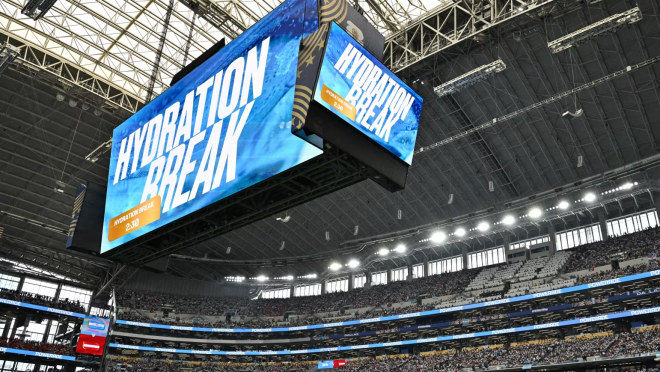
For the first time in the tournament’s history, FIFA has mandated two three-minute hydration breaks in every match. Officially, the decision is rooted in player welfare, protecting athletes from heat stress during a tournament spread across the United States, Canada and Mexico. Economically, however, the policy has done something equally significant.
It has converted uninterrupted playing time into a new commercial asset. The official rationale is straightforward. Scientific evidence increasingly links extreme heat with reduced athletic performance, dehydration and greater injury risk. With the 2026 tournament scheduled across the United States, Canada and Mexico during the northern hemisphere summer, FIFA has expanded its heat protection protocols to prioritise player safety. From a medical standpoint, the decision is difficult to dispute.
Economics, however, is less concerned with intentions than with outcomes.
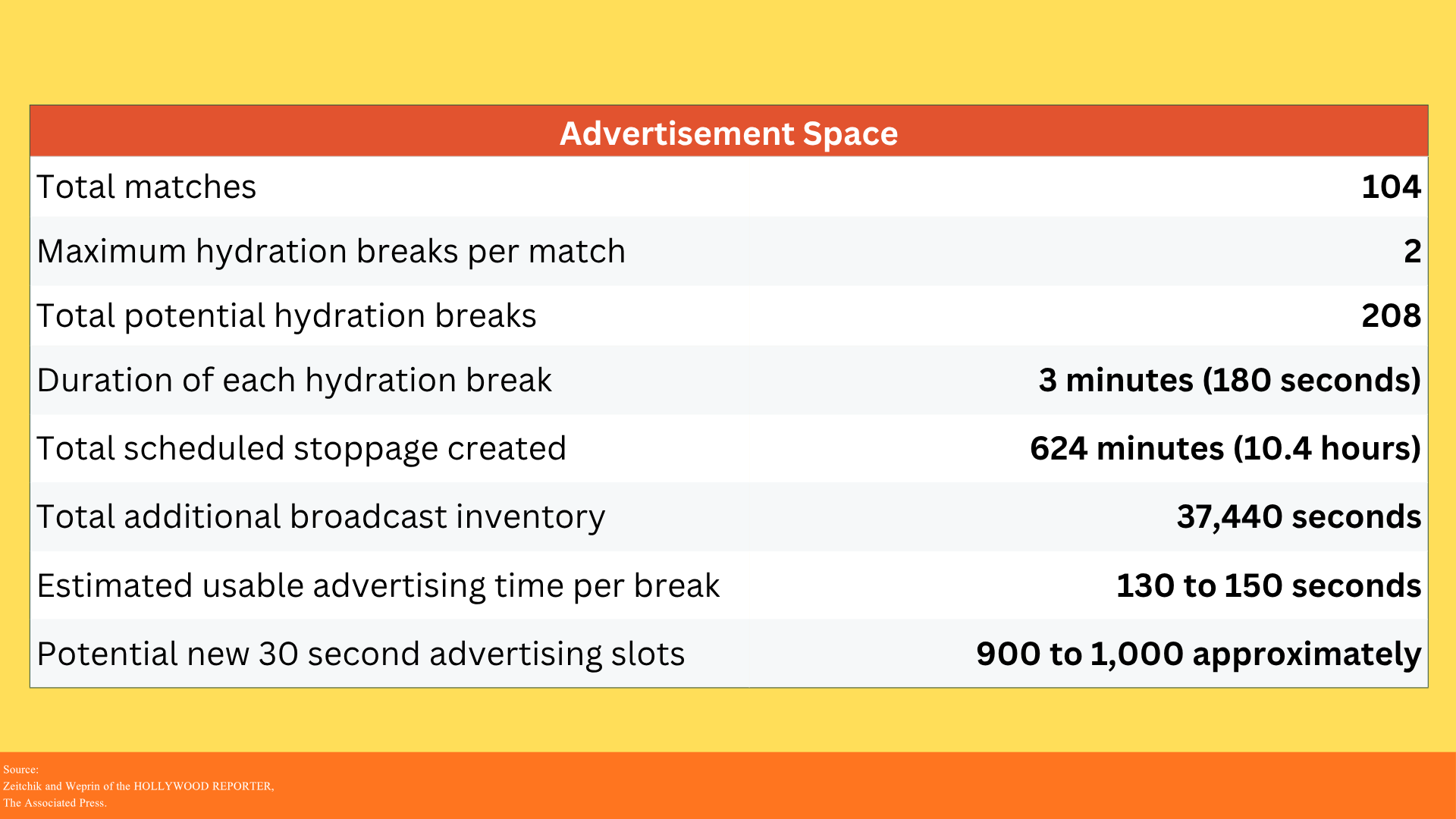
Across 104 matches, the tournament will feature approximately 208 hydration breaks. At three minutes each, FIFA has created 624 minutes, or more than 10.4 hours, of entirely new broadcast inventory without increasing the number of matches or extending the official ninety-minute format. Those 624 minutes are not merely pauses in play. They represent additional advertising inventory in one of the world’s most valuable media properties.
Economists define scarcity as the gap between unlimited demand and limited supply. For broadcasters, advertising inventory is scarce because there are only so many moments during a live event when commercials can be shown without interrupting the product itself. Football has historically been one of the scarcest sports in this respect. While an NFL game contains dozens of scheduled commercial breaks and cricket incorporates innings intervals and strategic time-outs, football’s continuous forty-five-minute halves have left broadcasters with little flexibility beyond half-time.
This scarcity has always shaped football’s business model. Broadcasters pay enormous sums for World Cup rights because live sport attracts audiences that watch in real time rather than on demand. According to Nielsen, live sports consistently dominate television viewership, making them among the few programmes where advertisements are rarely skipped. Yet despite commanding one of the largest global audiences, football has offered fewer opportunities to monetise that attention than almost any other major televised sport.
Hydration breaks fundamentally alter this equation.
Instead of expanding the tournament or lengthening matches, FIFA has increased the supply of premium advertising inventory embedded within the existing product. From an economic perspective, this is equivalent to increasing the productive capacity of an asset without significantly raising production costs.
The arithmetic illustrates the scale of the opportunity.
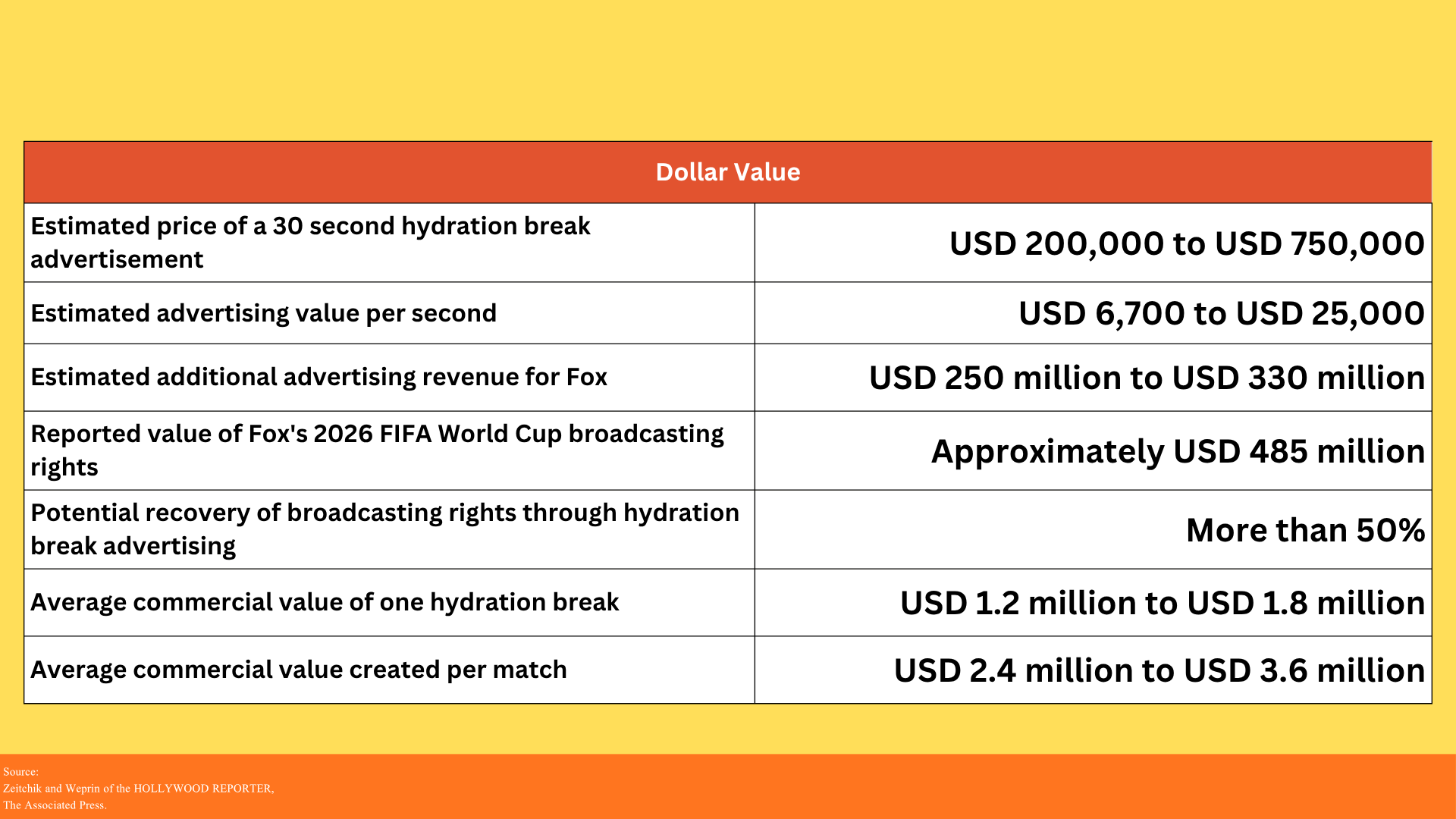
Each three-minute hydration break can comfortably accommodate six conventional thirty-second television advertisements. Across 208 hydration breaks, the tournament creates a theoretical maximum of 1,248 individual commercial slots. Even allowing for studio analysis and broadcaster discretion, the increase in monetisable inventory is substantial.
Industry estimates suggest that thirty-second advertisements during early World Cup matches are selling for around US$200,000, while premium fixtures involving the United States or the knockout rounds can command as much as US$750,000 per slot. If a broadcaster airs just four advertisements during each hydration break at an average price of US$300,000, the calculation becomes straightforward.
208 hydration breaks × 4 advertisements × US$300,000 equals approximately US$250 million.
That industry estimates that Fox Sports could generate between US$250 million and US$330 million in additional advertising revenue from hydration break commercials alone. Considering Fox acquired English-language broadcasting rights under a long-term agreement worth roughly US$425 million, these scheduled breaks could recover well over half of its rights investment before accounting for half-time advertising, sponsorships or digital revenue.
From an economist’s perspective, this is not simply additional revenue. It is the monetisation of an asset that previously did not exist. FIFA has effectively created more than ten hours of premium commercial inventory through a regulatory change lasting only 180 seconds per interruption.
Few industries can generate hundreds of millions of dollars in additional revenue without producing more of their core product. Football has done exactly that.
The significance of hydration breaks extends beyond the sale of additional commercials. They have fundamentally changed the commercial architecture of a football match.
Reengineering football’s commercial architecture
Traditionally, football consisted of two uninterrupted 45-minute halves separated by half-time. From a broadcasting perspective, there was only one guaranteed monetisation point during the entire contest. Hydration breaks have effectively transformed that structure into four distinct commercial segments. Each scheduled interruption creates an opportunity for broadcasters to air advertisements, sponsors to activate campaigns, betting companies to deliver live promotions, and television analysts to retain audiences that might otherwise disengage.
Economically, this represents an increase in what might be called the monetisation density of the product. The match still lasts 90 minutes and the sporting contest remains unchanged, but the revenue that can be extracted from those ninety minutes has increased substantially. In manufacturing, firms improve profitability by producing more output from the same factory. In football, broadcasters improve profitability by generating more revenue from the same match.
The economics of certainty
Perhaps the most intriguing aspect of FIFA’s policy is that hydration breaks are mandatory across all 104 matches, including those played in climate-controlled stadiums such as Atlanta’s Mercedes-Benz Stadium and Vancouver’s BC Place. If player welfare alone were the objective, one could argue that such venues require less intervention than outdoor stadiums exposed to summer heat.
FIFA’s explanation is one of consistency. A uniform protocol ensures equal treatment of teams, simplifies officiating and avoids uncertainty over when breaks should be introduced. From an economic standpoint, however, standardisation produces an equally valuable outcome. It creates certainty.
Certainty is one of the most valuable commodities in advertising markets. Unlike injuries or VAR reviews, which occur unpredictably, hydration breaks are scheduled. Broadcasters can therefore sell advertising packages months before the tournament begins with guaranteed time slots. Sponsors know precisely when their advertisements will appear. Television producers can standardise programming across every match, while digital platforms can synchronise promotions with remarkable precision.
Economists describe this as reducing transaction costs. Markets function more efficiently when buyers and sellers face less uncertainty. By converting an unpredictable interruption into a guaranteed commercial window, FIFA has inadvertently improved the efficiency of football’s broadcasting market.
Selling attention
The economic implications extend even further Modern media companies no longer compete only for viewers. They compete for attention. Technology firms such as Google, Meta, Netflix and TikTok have demonstrated that attention itself has become one of the world’s most valuable economic resources.
Sports broadcasting follows the same principle. Advertisers are not purchasing thirty seconds of screen time. They are purchasing thirty seconds of focused human attention.
Hydration breaks make that attention more predictable. Rather than leaving during open play to visit concession stands, check their phones or use the restroom, spectators know there will be scheduled opportunities to do so. Television audiences behave similarly. Many viewers postpone distractions until the break, allowing broadcasters to anticipate audience behaviour more accurately and price advertising inventory accordingly.
This transformation helps explain why a seemingly minor rule change has generated such significant commercial interest. The true innovation is not the additional three minutes themselves but the conversion of uninterrupted audience attention into a measurable, predictable and marketable economic asset.
More than a medical rule
To be clear, there is little evidence that FIFA introduced hydration breaks primarily to increase advertising revenue. The governing body has consistently argued that the policy exists to protect players from increasingly extreme summer temperatures and to ensure a uniform standard across the tournament. Those objectives are both credible and necessary as climate conditions become more challenging for elite sport.
Economics, however, is less concerned with intentions than with incentives and outcomes.
Whether introduced for medical reasons or not, hydration breaks have increased the supply of premium advertising inventory, enhanced the value of broadcasting rights, reduced uncertainty for advertisers and created new revenue opportunities for broadcasters and sponsors. A welfare policy has simultaneously become an economic innovation.
The World Cup still lasts ninety minutes on paper.
Economically, however, it has become a different product.
The most consequential change to football at the 2026 FIFA World Cup may not be a new tactical system, a revolutionary player or even the tournament’s expansion to 48 teams. It may be the realisation that 180 seconds of scheduled interruption can reshape the economics of the world’s most valuable sporting event.

Ramadan Abdullah is a Management Trainee Officer at IPDC Finance PLC and a Summa Cum Laude graduate of North South University with a dual major in Economics and Finance. He is the former President of North South University Young Entrepreneurs’ Society (NSU YES!). His interests include economics, finance, public policy, and Bangladesh’s economic development.