Game Theory: Trust, betrayal and the mathematics of cooperation
A game theory lesson nobody taught you directly
Game Theory: Trust, betrayal and the mathematics of cooperation
A game theory lesson nobody taught you directly
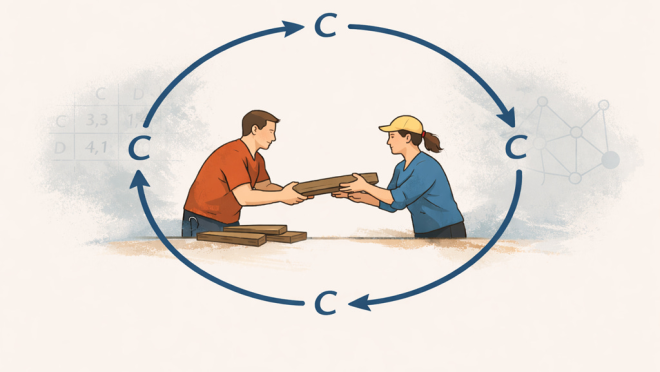
There is a certain kind of person we have all encountered: the ones who treat every interaction like a transaction, every favour like a trap, and every act of generosity from someone else as evidence of stupidity rather than character. In the short term, they often look like they are winning. In the long run, they almost always are not.
This tension between the cynic who grabs everything and the cooperator who builds slowly sits at the heart of one of the most fascinating ideas in modern social science: the evolution of trust. It is a field that combines game theory, biology, and psychology to answer a question that should matter to every professional, every team member, and every human being operating in a world full of other human beings: under what conditions does trust actually emerge, survive, and pay off?
The answer is more concrete than most people expect, and the best way to understand it is through a simple game.
Imagine you and another person each have to make a choice simultaneously, without talking. You can either Cooperate or Cheat.
If you both cooperate, you each walk away with two points, which is a genuine mutual gain. If you Cheat while they Cooperate, you get three points and they lose one. If they Cheat while you Cooperate, they get three and you lose one. And if you both cheat, you both get nothing.
In a single round, played once, the “logical” move is to cheat. Whatever your partner does, cheating either wins you more or protects you from loss. This is the classic Prisoner’s Dilemma, and it has confused people for decades because it seems to prove that self-interest will always beat cooperation. But the thing is: life is a repeated game with many rounds. And in the long run, the entire logic flips.
Bojack himself is the Always-Cheater, reflexively. He takes more than he gives, burns bridges faster than he builds them, and operates on the deep-seated belief that the world is indifferent and everyone is ultimately looking out for themselves. His strategy in the game would be simple: cheat every single time, regardless of what the other person does. Against a trusting partner, he gains three points. Against another cheater, he gains nothing. He never loses, but he never builds anything either.
Princess Carolyn is the Copycat, running the strategy researchers call Tit-for-Tat. She starts every new relationship by cooperating: giving the benefit of the doubt, showing up, doing her part. After that, she simply mirrors whatever the other person did in the previous round. She is not a pushover, but she is also not a cynic. She is responsive.
Todd is something close to the Always-Cooperator. He gives, forgives, gives again, and keeps trusting long past the point where most people would have stopped. Against a Bojack, this is catastrophic, as he gets exploited repeatedly and his score craters. But against another cooperative player, he is the foundation of something genuinely warm and productive.
Diane plays the Grudger. She enters every relationship with good faith and real generosity, but she keeps a record. The first time someone cheats her, she closes the door permanently without giving them a second chance.
Mr. Peanutbutter is the Forgiving Copycat, aka the Copy-Kitten. He mirrors behaviour like Princess Carolyn, but he gives one free pass for what looks like a betrayal before he retaliates. He understands that accidents happen, that messages get misread, and that sometimes people mean well and come across badly.
In short interactions, Bojack wins. He extracts points from Todd, avoids losses against everyone else, and looks like a genius. This is the phase where cynics feel most vindicated. But run the game over thirty, fifty, or a hundred rounds, just like real working relationships actually do, and the picture changes completely.
Todd goes first. His unconditional generosity makes him an easy mark, and without any mechanism to protect himself, his score collapses. And the moment Todd is gone, Bojack loses his most reliable source of easy points.
Now Bojack is mostly playing against Princess Carolyn and Diane. He cheats on Princess Carolyn in round one, she mirrors it back in round two, resulting in both scoring zero, round after round. Against Diane, it is worse: one cheat and the relationship is finished permanently.
Princess Carolyn, meanwhile, has been quietly accumulating. Against Mr. Peanutbutter, they cooperated from the start and never had a reason to stop: two points per round, every round, compounding over the entire game. Against Diane, the same: both started in good faith, neither cheated, both kept gaining. By the end of the experiment, Princess Carolyn’s total score is almost embarrassingly higher than Bojack’s.
Now comes the twist in the game.
Researchers introduced “noise” into the game: a ten percent chance that a cooperative move would be misread as a cheat by the other player. Suddenly, the Tit-for-Tat strategy became dangerously fragile. Princess Carolyn cooperates, but Mr. Peanutbutter misreads it as a cheat and retaliates. She mirrors the retaliation. He mirrors hers. A single accident sends two people who were building something good into a spiral of mutual punishment that neither of them actually chose. Diane, as the Grudger, fares even worse: one misunderstanding and an entire relationship is permanently written off.
This is where Mr. Peanutbutter’s version of the strategy proves its real value. By only retaliating after two consecutive betrayals rather than one, he absorbs the noise. A single accident does not detonate the relationship. A genuine pattern of exploitation still does. That small margin of forgiveness is enough to keep cooperation alive in a world that is, by its nature, imperfect.
The researchers who first ran these tournaments in the 1980s, most notably Robert Axelrod, in a series of computer simulations that became the foundation of a landmark book called The Evolution of Cooperation, found that the strategies which accumulated the most points over time shared four qualities. They never cheated first. They responded firmly when cheated. They were willing to forgive after a mistake. And they were predictable enough that their partners always knew where they stood.
But more than individual strategy, the game revealed that trust evolves most reliably under three broader conditions. The first is repeated interaction: when people know they will see each other again, the calculus shifts. The second is a genuine possibility of mutual gain: when cooperation can make both parties better off, rather than just redistributing a fixed pie. The third is low miscommunication: when people talk to each other directly enough that accidents do not get mistaken for attacks.
Remove any one of those three, and the cynics start winning again. Keep all three in place, and cooperation becomes not just the moral choice, but the strategically dominant one.
In a world of repeated interactions, being genuinely trustworthy is the self-interested move. It is the strategy that compounds. The person who cooperates, responds firmly to exploitation, forgives honest mistakes, and stays consistent does not just feel better about themselves; they end up with a higher score. The cynic finishes the sprint ahead. The cooperator finishes the marathon first. And most of life, it turns out, is a marathon.
And for a better understanding, you can play this game: https://ncase.me/trust/ and learn more about it!