Inside Bangladesh's quest for World Schools glory
From giving a speech in a classroom or on Discord (during Covid) to being about to deliver a speech on an international stage representing Bangladesh, an experience both gratifying and, for all intents and purposes, also terrifying.
Inside Bangladesh's quest for World Schools glory
From giving a speech in a classroom or on Discord (during Covid) to being about to deliver a speech on an international stage representing Bangladesh, an experience both gratifying and, for all intents and purposes, also terrifying.
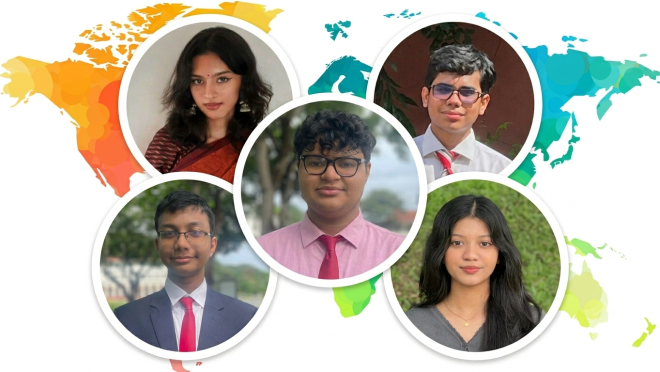
Earning a place in Bangladesh’s WSDC team takes a lot of dedication, hard work, and sleepless nights. But ultimately, the drive to be the best paves the way.
After a competitive and extensive selection process, five debaters have been selected from Bangladesh. Samarah Azad, Rabib Shafi, Nandita Saha, Syed Samirul Islam Khan, and Ahnaf Tahmid Saiyanta will be representing the nation at the upcoming Kenya World Schools Debating Championship to be held on 14 July 2026.
As a debater myself, I had a deep desire to know how it feels, and to understand what it really took for these fantastic five to reach this far. This interview was conducted back in February, and as the entire WSDC team leaves for Kenya tonight, let’s revisit the journey that made it all possible.
Comeuppance
For Saiyanta, the biggest obstacle he encountered was convincing his parents to allow him to do the Pre-Worlds (the biggest debate tournament in Bangladesh). Being a 10th grader, he had his work cut out for him. “Balancing my coaching, mock tests, and parental pressure while still preparing for National Camp was one of the most gruelling experiences of my life.”
For Nandita, it was a test of resilience. Her biggest obstacle was convincing her single mum to take on the immense financial strain of going to Kenya alongside her upcoming O Levels. But in the end, her mum was convinced, seeing her put in dedicated hours at school giving shape to her arguments.
Samarah admittedly had self-esteem issues. It was her first time as a NAT camper in a sea of debaters where everyone had familiarity. “What if I am not enough?” was a recurring question she would have to tackle every moment, but in the end, she persevered. “The realisation that, in the grand scheme of things, debating is one of many chapters of my life just settled in, along with the growing sense of finding ‘family’ within the circuit.”
The unstructured days of winter vacation, the creeping dread of board exams, and the selection process led Samirul to scramble to find some solace in an increasingly pressurising environment. “Balancing the high-pressure environment and rigorous standards of selection with the rest of my life was the biggest obstacle for me.”
Preparations
All five had prepared in their own distinct ways.
Samarah didn’t have any prolonged sessions with coaches but had endless support from people who had been with her since the start of her debate journey.
A blend of both external assistance and self-practice, such as a list of practice drills for each speaker role, a prep talk a day before the rounds, analysing the motion, and watching previous WSDC videos.
The patterns were different for Samirul. “Training isn’t seasonal. I tried to train for 2–3 hours a day, a couple of days a week consistently, and watch a single debate video every day (usually a recording of an out-round from an International University Debating Competition). I paired this with regular research on debate-relevant topics.”
Saiyanta had a close personal mentor. Alongside him, he watched previous debate videos and followed his words of advice.
For Nandita, having off days was never an option. “Every single night, despite having 8 hours of coaching all day, we, teammates, would sit together and watch videos, prep on motions, or do drills on responses. It pushed me to be the best version of myself.”
Winning the ESL Finals at Paris WSDC was the biggest turning point for these debaters. Their self-doubt was at times crippling, which was replaced with an unwavering faith in the whole team.
But for the debaters, the ultimate goal is to win Worlds. Nandita stated, “Bangladesh is no longer at the stage where we can be content in ‘standing our ground’ and hope to make it to the out-rounds. We hope to achieve what no Bangladeshi team has achieved before and win.”
The concerned authority, the Bangladesh Debating Council (BDC), undertakes various steps to facilitate debaters for international representation.
Samirul shared, “We have made it to various international Pre-WSDCs, where we face off against national teams from across the world. We completed matter assignments every week, where we had to write a report on topics ranging from Korean reunification to Saudi gaming investments. Although much of this training was done after team selections, a test trial of it was done during selections to stress-test and see how we handle the workload.”
Representing Bangladesh is a matter of pride for all five of them. It is an opportunity for the debaters to give back something valuable to their country, a way to repay and validate their coaches and friends, and not to let their efforts and dreams go in vain.