The Atlas Lions have outgrown the underdog label
The fan-favourite team Morocco had put together another trailblazing generational run, proving the fairytale written four years ago was not a fluke. While some nations leave the World Cup empty-handed, the Atlas Lions inspired others to be unbowed, resilient, and adamant against the old hierarchy.
The Atlas Lions have outgrown the underdog label
The fan-favourite team Morocco had put together another trailblazing generational run, proving the fairytale written four years ago was not a fluke. While some nations leave the World Cup empty-handed, the Atlas Lions inspired others to be unbowed, resilient, and adamant against the old hierarchy.
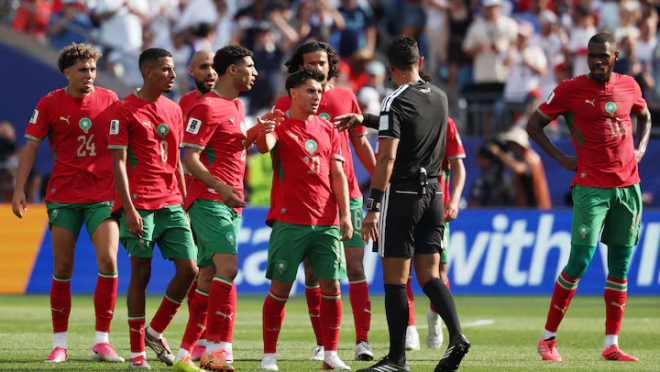
They have held their own against some of the football powerhouses, announcing their place among the elite and retiring the underdog label.
Yet their quarter-final exit to their nemesis France, with heads held high, mirrored the scoreline of the last edition through tactical and technical shortcomings, proving it takes more to reach the summit.
Fearless Mentality
The Atlas Lions have forged their mentality from the mountains that bow to no one. With their unshakeable mentality, they have repeatedly demonstrated their resilience. While other nations panic when adversity strikes, Morocco have weathered the storm with belief. They faced an immediate test by holding tournament favourites Brazil to a thrilling 1-1 draw, came back from a 2-1 deficit to secure a 4-2 victory over Haiti, edged past Scotland with one of the fastest goals of this year’s edition, ground out a penalty shootout win against the Netherlands, and dismantled the party of co-hosts Canada.
Breakout Star Saibari
Ismael Saibari announced himself on the Earth’s greatest stage in the most intimidating way possible. Seasonal fans may have put favourites Brazil ahead, but Saibari came out of the shadows, chipped the veteran goalkeeper Alisson Becker, and asserted the roar of the Atlas Lions. The roar stood out strongly in the next group-stage fixtures, netting the only goal against Scotland in just 71 seconds and levelling the score against Haiti to inspire a 4-2 victory. His intelligent movement, sublime finishing, ability to carry the ball through tight spaces, and willingness to drop deep allowed Morocco to transition from defence to attack. The calm and composed taking of the decisive penalty marked a historic win against the Dutch to send the Moroccans into the next round. German record champions Bayern Munich, impressed by his attacking style, wasted no time in signing him from PSV Eindhoven for €55 million to bolster their attack.
Blade and Shield
Achraf Hakimi’s world-class brilliance proved why he is ranked among the best full-backs. He led the team by example, being a constant threat in the opposition’s half with rapidly interchanging roles between defence and attack, alongside providing valuable leadership to keep the Atlas Lions roaring. Morocco was able to gain tactical flexibility against opponents who dominated possession or maintained a low central block. Alongside that, Yassine Bounou acted as a commanding shield between the posts, enabling his teammates to rely on him as the last man standing and focus on creating scoring opportunities. His crucial saves and long-ball distribution kept the side within touching distance of victory.
Versatility from the Mountains
Mohamed Ouahbi’s men carried the momentum from Qatar to North America. They displayed an ability to adapt to rapidly changing situations through fluid rotations and versatility. The 18-year-old Ayyoub Bouaddi orchestrated the midfield, exhibiting his strength by dropping deep to cover the defensive line and surging forward to accelerate the attack whenever opportunities beckoned. The Atlas Lions gained more creativity this year thanks to Brahim Diaz. Real Madrid’s star playmaker registered four assists to become the second-highest assist provider in this year’s edition so far. He glided from the centre to the wide flanks, slicing through compact defences to make their attack more dangerous in numbers.
Injury Blow Before the Defining Moment
To turn a dream run into a triumphant journey, a degree of luck is required, something the Moroccans missed out on. Their best demolition man, Saibari, suffered a hamstring injury in the early minutes against Canada, ruling him out of the World Cup quarter-final entirely. What could have been a glimpse of the trophy turned into ashes. It was noticeable that the Atlas Lions found themselves toothless without his lethal conversion rate, struggling to register only one shot on target against Les Bleus during the entire 90 minutes. The team found it difficult to advance from the back line into the final third, unable to penetrate the French defence.
No Answer to the World’s Best Attack
The defence remained compact and disciplined throughout the tournament but could not cope with the highly intense and terrifying French attackers. The defence lost its shape and concentration, leaving it deeply vulnerable when Michael Olise launched balls through the centre, ultimately leading to the clinical strikes of Kylian Mbappé and Ousmane Dembélé. The demotivation of failing to create opportunities and the sheer exhaustion of chasing the French wingers culminated in the breakdown of the Moroccan system of play, reminding them to sharpen both their tactical and technical arsenal before facing the juggernauts of the World Cup.
The tears at the final whistle told the story. Morocco had come so close to another unforgettable chapter, only to discover that the last few steps towards footballing immortality are the hardest of all. Yet there is no shame in this defeat. The Atlas Lions leave the World Cup with the respect of the footballing world, another generation of heroes, and a nation that now expects, rather than dreams of, deep tournament runs. Four years ago, they surprised everyone. This time, they proved they belong. The fairytale may have paused in the quarter-finals, but for Morocco, this feels far more like the end of a chapter than the end of the story.