80 years and the pigs are still running the show
I thought I was picking up a short novel about talking animals. Less than two hundred pages later, I realised I had been reading one of the sharpest books ever written about people. George Orwell’s Animal Farm did not leave me shocked because of its ending.
80 years and the pigs are still running the show
I thought I was picking up a short novel about talking animals. Less than two hundred pages later, I realised I had been reading one of the sharpest books ever written about people. George Orwell’s Animal Farm did not leave me shocked because of its ending.
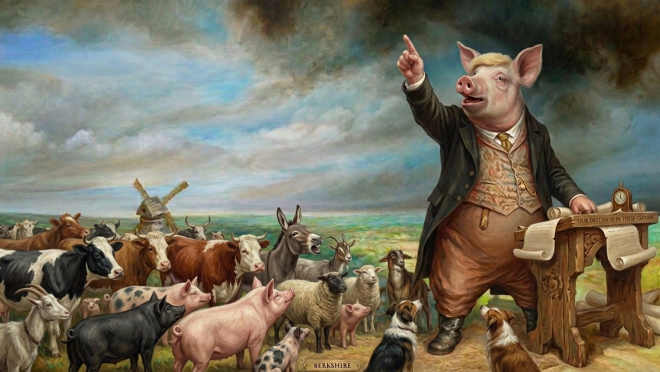
It unsettled me because I recognised its beginning. A group of ordinary animals dream of a better life. They rise against injustice with hope in their hearts, believing that freedom will finally belong to everyone.
It sounds inspiring, almost comforting. But as I turned each page, that hope slowly disappeared, replaced by something much more familiar: broken promises, manipulated truth, and the quiet acceptance of injustice. By the time I closed the book, I was not thinking about pigs or horses. I was thinking about us.
The brilliance of Animal Farm lies in its simplicity. Orwell never asks readers to understand complicated politics before opening the book. Instead, he tells a story anyone can follow. A group of farm animals overthrow their cruel owner, Mr Jones, hoping to build a society where every animal is equal. They rename their home Animal Farm and create seven commandments that promise fairness, dignity, and freedom. Among them is the ideal that becomes the heart of the revolution: “All animals are equal.” At first, it feels like the beginning of a perfect world. Everyone works together, everyone believes in the future, and everyone dreams of a life without oppression. Reading these early chapters, I found myself rooting for the animals. Like them, I wanted to believe that a revolution built on equality could remain equal forever.
But Orwell does something remarkable. He never lets power arrive all at once. Instead, it enters quietly. The pigs begin making “small” decisions for everyone else. They take a little extra food because they claim they need it to think. They move into the farmhouse because they say they require better working conditions. They change tiny details in the commandments, believing no one will notice, and most of the animals do not. That frightened me more than anything else. Dictatorships are often imagined as dramatic events, but Orwell suggests something different. They grow through small compromises, everyday excuses, and the willingness of ordinary people to accept one more change for the sake of stability.
Napoleon, the pig who eventually controls the farm, may be one of literature’s coldest villains precisely because he never behaves like one. He rarely delivers passionate speeches or dramatic threats. Instead, he quietly removes rivals, rewrites history, and surrounds himself with loyal followers. When Snowball, his intelligent rival, proposes new ideas for improving the farm, Napoleon simply drives him away using trained dogs. From that moment onwards, every failure somehow becomes Snowball’s fault. A broken windmill? Snowball. Missing food? Snowball. Poor harvest? Snowball again. Reading those chapters reminded me how easily societies can be persuaded to believe convenient enemies rather than uncomfortable truths. Blaming others is often easier than admitting failure.
Then there is Squealer, the pig whose greatest weapon is language. I found him even more disturbing than Napoleon because he never uses violence himself. He uses words. Whenever the pigs break another rule, Squealer explains why it is actually necessary. He twists facts, changes memories, and repeats the same arguments until the other animals begin doubting their own eyes. One sentence in particular stayed with me: “Surely, comrades, you do not want Jones back?” It is a clever piece of manipulation. Every criticism of the leadership becomes a choice between the present and something even worse. Fear replaces debate. Questions disappear. Reading those scenes, I realised Orwell understood something that still feels painfully relevant today. Control does not always begin with force. Sometimes it begins with language.
Yet the character who truly broke my heart was Boxer. He is not clever. He cannot read beyond a few letters. But he is honest, hardworking, and deeply loyal. Whenever life becomes harder, he tells himself, “I will work harder.” Later, he adds another belief: “Napoleon is always right.” Those simple sentences seem admirable at first. Gradually, they become tragic. Boxer represents millions of ordinary people who believe that hard work alone will solve every problem. They trust leaders because they want to believe someone is looking after them. They give everything they have, expecting fairness in return. Instead, when Boxer grows old and can no longer work, the farm sells him to the knacker. It was the hardest moment in the novel for me. I kept hoping someone would stop the cart, that someone would speak up. Almost no one did. Orwell’s message is devastating: systems built on exploitation rarely reward loyalty. They reward usefulness.
The novel’s most famous line arrives near the end: “All animals are equal, but some animals are more equal than others.” It is funny at first because it is logically impossible. Then the humour disappears. That single sentence captures the hypocrisy of every system that speaks about equality while creating privilege for a chosen few. Orwell wrote the novel as a satire of the Soviet Union under Joseph Stalin, but I never felt I was reading only about one country or one period in history. I saw echoes of workplaces where managers ask employees to sacrifice while rewarding themselves. I thought about organisations that promise transparency but hide important decisions. I thought about communities where rules somehow apply differently depending on who you are. Orwell’s greatest achievement is that Animal Farm has outgrown its historical setting. It now belongs wherever power exists.
One of the reasons the novel remains so powerful is Orwell’s writing itself. There are no complicated theories or difficult political arguments. His language is clear, direct, and almost deceptively simple. A teenager can understand the story, while an adult can spend years thinking about its meaning. That simplicity is deliberate. Orwell believed that clear writing helps people think clearly, while confusing language often hides uncomfortable truths. Reading Animal Farm, I never felt the author was trying to impress me with clever words. Instead, he trusted the story to do the work. And it does.
As I finished the final chapter, one image refused to leave my mind. The animals stand outside the farmhouse, looking through the window as the pigs dine with human farmers. They watch the pigs walking on two legs, wearing clothes, drinking alcohol, and laughing with the very people they once called enemies. Orwell ends with a sentence that may be one of the most haunting conclusions in modern literature: the animals look from pig to man, and from man to pig, but “already it was impossible to say which was which.” I closed the book and sat quietly for several minutes. Revolutions, Orwell reminds us, do not always fail because the ideals were wrong. Sometimes they fail because people slowly become the very thing they once fought against.
I finished Animal Farm expecting a political fable. I closed it feeling as though I had read a guide to human nature. It is a book about power, but also about memory, language, fear, and silence. It asks difficult questions without pretending to offer easy answers. Would I have noticed the commandments changing? Would I have challenged Napoleon? Or would I have kept my head down, repeated what everyone else was saying, and convinced myself that everything was fine?
I honestly do not know.
Perhaps that uncertainty is why Orwell’s little farm still feels so frightening nearly eighty years later. The names may change. The flags may change. The faces in power may change.
But somewhere, someone is still repainting the wall.