The journey from property to personhood
After attending an obscure economic conference, I came back home tired, exhausted, but proud of whatever I had done throughout the event. I gave a post on social media about the happenings of the conference as soon as the event wrapped up.
The journey from property to personhood
After attending an obscure economic conference, I came back home tired, exhausted, but proud of whatever I had done throughout the event. I gave a post on social media about the happenings of the conference as soon as the event wrapped up.
What do you expect then? Of course, the attention on social media throughout the posts being posted.
Not a second late, notifications started to buzz. I picked the phone up to see what’s happening. ‘‘Good luck’, ‘well done’ and stuff was flooding the inbox. Ignoring every other text, what caught my attention was a text from one of my friends.
While talking to her for a few minutes, something drove me to a deeper thought. My mindset switched to societal terms, and statements shot by next-door aunties flew higher:
“Accha o to meye, o ki parbe eita korte?
Na o parbena. Meyeder diye eishob hoina.”
Before asking whether women can ‘compete with men’ in demanding fields or not, it is worth asking a more fundamental question: whether women are even treated as full individuals with the freedom to compete with others?
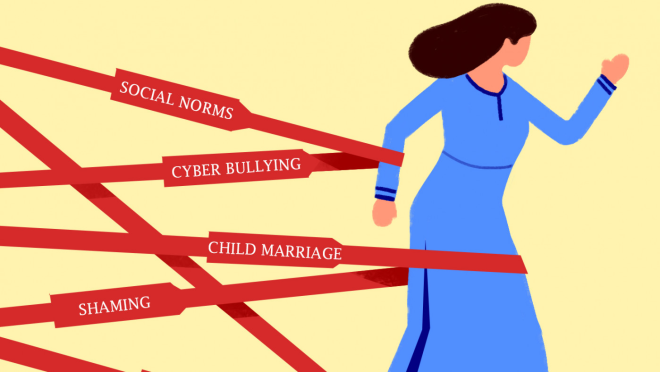
This narrative is often framed around capability, taboo, and stereotype, yet history tells a contrasting story. The primary obstacle has rarely been women’s ability. Rather, it has been the social, economic, and political structures that determined who was allowed to learn, lead, have rights over their own property, or even speak.
For centuries, women were legally and, through societal practice, judged closer to dependency than given a floor for autonomy. Under many legal systems, married women could not own property independently, involve themselves in decision-making, or control their earnings.
Going back to history
In the 19th century in Great Britain, a married woman’s legal identity was often absorbed into that of her husband under the doctrine of coverture. The journey from being treated as an extension of a man to being recognised as a citizen in her own right is one of the most significant social transformations in human history, especially after globalisation, industrialisation, and the narrowing down of countries into three categories.
The struggle for women’s rights has been marked by pivotal historical milestones. The women’s suffrage movement led to voting rights in New Zealand in 1893, the United States in 1920, and many other countries throughout the 19th and 20th centuries. Moreover, the second-wave feminist movements of the 1960s and 1970s challenged discrimination in employment, education, and reproductive rights. These were not merely political victories, but they expanded the social space in which women participated and competed.
Hear from the philosophers and sociologists
Philosopher and activist Simone de Beauvoir said, “One is not born, but rather becomes, a woman.” The statement highlights how gender roles are socially constructed and reinforced through institutions, expectations, and cultural practices.
A particularly influential perspective comes from renowned sociologist Karl Marx.
Marx viewed society through the lens of labour, production, and power relations. Marxist scholars argued that women experience a form of double exploitation. Women contribute labour both in the workplace and within the household, a shadow workplace where most of their work remains unpaid and unappreciated.
This insight was later expanded by Friedrich Engels. He argued that the emergence of private property transformed family structures and contributed to women’s subordination.
“First-class oppression coincides with that of the female sex by the male.”
Modern data shows how historical inequalities continue to shape outcomes. According to reports from the United Nations and the World Economic Forum, women globally perform a disproportionate share of unpaid care and domestic work. In many countries, women spend several more hours per day on household responsibilities than men, which is often overlooked because these are not documented.
Barriers beyond the narrative
The barriers extend beyond economics. Boys are often encouraged to take risks, compete, and assert themselves, while girls are frequently rewarded for compliance, caution, and appearance. These messages accumulate over time and shape aspirations. When certain professions, sports, or leadership positions are overwhelmingly represented by men, young girls receive subtle signals about where they do and do not belong.
Even today, bias remains embedded within institutions. Women who demonstrate positivity may be praised as leaders and criticized for violating gender expectations in another frame, creating a persistent double bind.
The claim that women possess all the advantages in modern society overlooks these structural realities. Scholarships, diversity initiatives, and targeted programmes are often portrayed as special privileges. In reality, they are attempts to address centuries of exclusion and unequal access. They do not erase historical disadvantages overnight.
Therefore, the story of women is not a story of inability. The real question should not be whether women can compete. History has already answered that. Regardless of gender, the world developed a taboo against competing freely and fairly.
When such practices and conditions exist, women merely participate and excel, innovate, or lead. The journey from property to person is still questioned, but it has already transformed the world into where we are today!