Why isn't every bus pink?
The first thing I imagined when I heard about Bangladesh’s women-only Pink Bus was not a woman finally travelling home without fear. I imagined a woman standing at a crowded bus stop, watching the pink bus disappear around the corner. The next ordinary bus arrives. She looks at her watch. She has somewhere to be. She gets on.
Why isn't every bus pink?
The first thing I imagined when I heard about Bangladesh’s women-only Pink Bus was not a woman finally travelling home without fear. I imagined a woman standing at a crowded bus stop, watching the pink bus disappear around the corner. The next ordinary bus arrives. She looks at her watch. She has somewhere to be. She gets on.
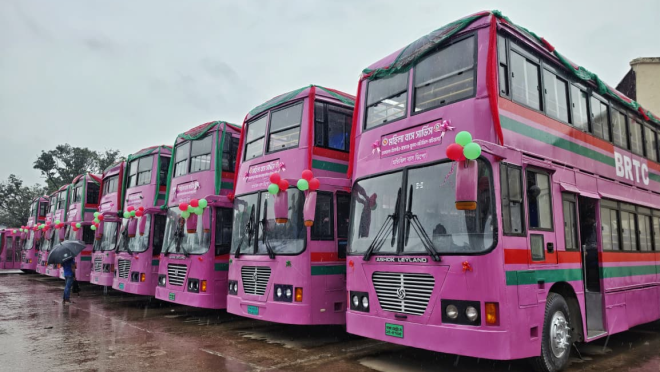
Later, if (WHEN) a man eventually harasses her, I can almost hear the question society might ask her, “Why did you not take the women’s bus?”
That is where my unease begins.
I understand why the government wants to introduce women-only buses. I understand even more why women might welcome them. Anyone who has travelled on Dhaka’s buses knows that getting from one place to another can involve far more than traffic and overcrowding. There is the unwanted touch in a packed bus, the man standing unnecessarily close, the conductor shouting at passengers, the fear of getting off at an unfamiliar stop and the quiet calculation of how early one should return home.
For many women, public transport is not simply inconvenient. It can be frightening.
So when the government promises a space where women can travel with female drivers, conductors and helpers, it is easy to understand the appeal. The new service is being presented as a safer transport option and also as an opportunity for women to work within the transport system.
But I keep returning to one question: ‘Are we making public transport safer for women, or are we creating a separate space because we have failed to make public transport safe?’
There is a difference.
Bangladesh has tried women-only buses before. BRTC introduced such services as early as the 1980s, while several later attempts were made to revive the idea. Research on these initiatives found problems involving routes, frequency, service quality and passenger demand. So this is not exactly a new idea. What is new is the packaging.
The word “pink” immediately gives the project a gendered identity. There is of course nothing wrong with pink. Women can love pink, men can love pink, and colours do not have biological identities. But when the state paints a bus pink specifically to mark it as a women’s space, it inevitably raises a larger question about how we understand women’s place in public life.
For decades, women have fought to enter spaces from which they were excluded. Schools, universities, workplaces, politics and public spaces were once treated as places where women had to negotiate their presence. Now we are telling women that one part of public transport is safer because it is separated from men. Perhaps that is necessary for the moment. But it should never become the destination. The danger is not that women will have a separate bus. The danger is that everyone else will start believing that the problem has been solved because women now have one.
Imagine a woman leaving work late. The Pink Bus does not operate on her route. Or she has just missed it. Perhaps the next one will arrive in 30 minutes, but she cannot wait. She boards an ordinary bus. If she is harassed, who will be blamed? The man who harassed her? Or the woman who chose the “wrong” bus?
I worry about the second possibility because we already know how easily victim-blaming works in our society. Women are asked why they were outside at night, why they travelled alone, why they wore something particular, why they spoke to a stranger and why they did not avoid a certain place.
The Pink Bus could unintentionally add another question to that list: why did you not take the women-only bus? That is a dangerous shift. A woman should never have to choose the correct bus before she earns the right to be safe. This matters because women do not all travel in the same way. There is the university student changing buses twice to reach class. There is the garment worker returning after a long shift. There is the nurse finishing a late duty. There is the domestic worker travelling across the city. There is the mother carrying a child. There is the woman with a disability. There is the elderly passenger. There is the woman who cannot afford to wait for another bus.
For them, public transport is not an experiment in urban planning. It is how they earn, study, care for families and return home. A women-only service that does not fit their routes, timings or realities cannot automatically be called empowerment.
There is another question I would like the authorities to answer before celebrating the buses as safe spaces: what exactly happens when something goes wrong?
If CCTV cameras are installed, that can be useful. Cameras can help investigate harassment and establish what happened. But who controls the footage? Who can access it? How long is it kept? What happens when a woman makes a complaint? Does someone actually investigate it?
A woman should feel protected, not simply watched.
And if the government can create a monitored and controlled environment inside a women-only bus, why should similar standards not apply to ordinary buses? That is the uncomfortable part of this conversation. The problem is not women travelling with men. The problem is men who believe they can harass women without consequences.
A pink bus cannot change that behaviour.
Public transport is never just about transport. It is also about who gets to occupy public space and under what conditions. That is why I do not want to dismiss the Pink Bus. If a woman feels safer on it, that safety matters. If female drivers and conductors gain employment through it, that matters too. If a young woman can travel home without constantly looking over her shoulder, that matters enormously.
But the Pink Bus should be a choice, not a cage.
A woman should be free to ride it because she wants to. She should also be free to ride an ordinary bus without being told that she accepted the risk. And if she is harassed on that ordinary bus, the first question should never be, “Why did you take that bus?” It should be, “Why was she harassed, and what are we going to do about it?”
That is where government accountability comes in.
I have not ridden these buses yet, so I cannot claim to know how women will experience them. Perhaps many will find them comfortable, convenient and empowering.
I hope they do.
But I also worry about what happens afterwards. I worry that one day a woman will report harassment on a regular bus and someone will simply point towards the Pink Bus and say, “You had another option.” I worry that women will gradually be expected to remain within women-only spaces because those are the spaces society has decided are safe for them. I worry that the government will be able to point to a few pink buses and say it has addressed women’s safety while ordinary buses, bus stops, roads and routes remain dangerous.
Most of all, I worry that women will once again be asked to adjust themselves to an unsafe society.
The ultimate goal cannot be to create a small, protected corner where women can travel. The goal should be to make every corner safe enough for them to travel. Women do not need a pink corner of public life. They need public life itself to be safe. So perhaps the real test of the Pink Bus is not how many women board it. It is what happens on the buses that are not pink.
If women become safer everywhere, the experiment has worked. If women are simply moved into one separate space while the rest of the system remains unsafe, then we have not solved the problem.
We have only painted it pink.