The little boy from Rosario made us believe
The little boy from Rosario made us believe
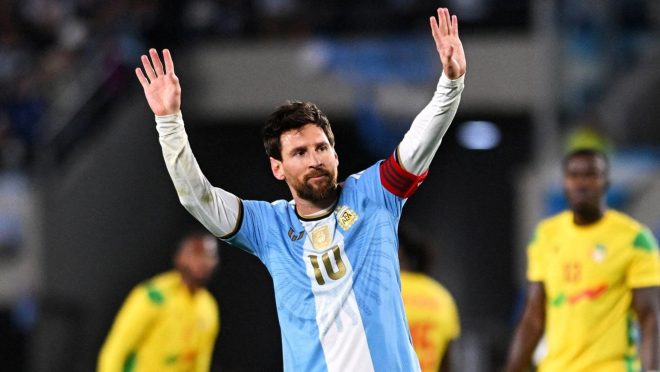
When Peter Drury called the World Cup final of 2022, he reached past the footballer and spoke about a “little boy from Rosario.” It is the line people repeat because it did what Drury does. It took a man of thirty-five on the biggest stage in the sport and returned him to the child he had been.
That child was small. At ten, Lionel Messi was diagnosed with a growth hormone deficiency, and the monthly treatment was more than his family in Rosario could keep paying for. Newell’s Old Boys could not cover it. Barcelona could, and did. At thirteen, he crossed the Atlantic with his father, and the contract that kept him there was, as the story goes, written on a napkin. He made his first-team debut at sixteen. By twenty-two, he had won his first Ballon d’Or.
Then came the years that built the argument against him. He won everything at Barcelona, and in 2012 he scored 91 goals in a calendar year. None of it settled the question in Argentina. The question was whether he was one of them.
Part of the problem was his manner. He rarely spoke. He did not perform for the cameras or pretend to be a leader in the loud way Argentina remembered from Maradona, who had ruled the country’s football with noise. Messi ruled with the ball and said almost nothing. Critics read the silence as indifference. They pointed out that he did not sing the anthem, as if the volume of a man’s voice measured how much the shirt meant to him.
The finals made it worse. In 2014, Argentina lost the World Cup final to Germany in extra time, and Messi walked up to collect the Golden Ball for the best player of a tournament he had not won. The photograph of him passing the trophy is still used as evidence of something. In 2015 and 2016, they lost the Copa América finals to Chile, both on penalties. In 2016, it was his penalty that missed. After the match, he announced he was finished with the national team. He reversed it within weeks, but the sentence had been said.
The exits kept coming. Argentina went out of the 2018 World Cup in the round of 16, 4-3 against France. In 2020, Barcelona lost 8-2 to Bayern Munich, and soon after Messi tried to leave the club that had raised him. In 2021, he did leave, though not the way he wanted. Barcelona could not afford to register his new contract, and he stood at a press conference and cried. The boy who came for treatment at thirteen was leaving at thirty-four because of a spreadsheet.
He joined Paris Saint-Germain, and that summer, before anyone expected it, something changed. At the Maracanã, Argentina beat Brazil 1-0 in the Copa América final. It was the national team’s first senior title in 28 years. Messi dropped to the grass and the squad lifted him.
Then 2022. Argentina lost their opening match to Saudi Arabia, and the old doubt came back at once. They did not lose again. In the final in Lusail, Messi scored from the penalty spot, and Argentina led 2-0. France came back to 2-2, and extra time arrived. Messi scored again in the 108th minute. Kylian Mbappé equalised from the spot in the 118th, completing a hat-trick of his own. The match went to penalties, and Gonzalo Montiel scored the last one.
Drury had the boy from Rosario reach heaven. The line is good, and it will outlast most of what was written about that night. But it describes one evening. The boy who needed treatment at ten reached it at thirty-five, after a missed penalty in New Jersey, a farewell press conference in tears, and an opening loss to Saudi Arabia.
Argentina had spent seventeen years asking him to prove he was theirs. He never obliged. He performed.
I was one of the millions of boys with Messi on the back of his jersey. I cried my heart out when he walked past the World Cup trophy in 2014. Lionel Messi helped me stick with life more times than I can remember. So many things have changed. I have passed the age at which he won his first Ballon d’Or. Football became more than him, and life changed so much over the years.
He has played his last match in the blue and white jersey. Soon he will put his boots away for good, and being who he is, he will never look back. But millions of us will keep looking up to him.
Lionel Messi touching heaven is secondary. He made millions of us hold our heads high and look up at it. He made us believe. How can that ever be forgotten?