Niels Bohr and the case for uncertainty
Niels Bohr and the case for uncertainty
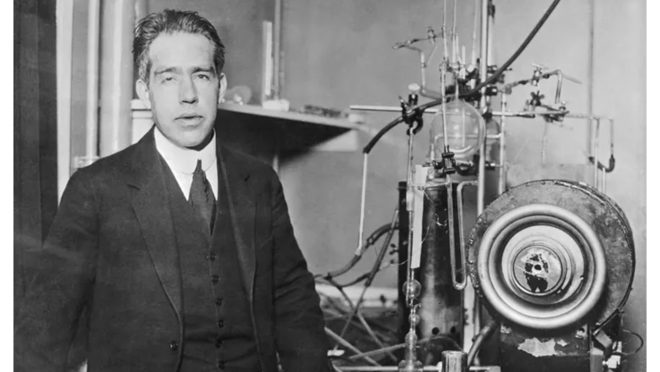
A boy was born in Copenhagen on 7 October 1885, into a family that considered science to be a family business. His father was a physiology professor who was well-respected enough to be nominated for his own Nobel Prize, and there was a lot of conversation in the house that treated difficult questions as amusement rather than assignments.
Niels Bohr grew up good at football, good at mathematics, and, by most accounts, startlingly good at sitting with an idea until it actually made sense to him rather than just sounding right.
That patience ended up mattering more than almost anything else in his career. When Bohr arrived in England to work alongside Ernest Rutherford, physics had a problem it couldn’t quite admit to. Rutherford had shown that an atom had a dense nucleus with electrons somewhere around it, but the existing laws of physics said that arrangement should collapse in an instant. Electrons spiralling inward, atoms crumpling into themselves, the whole physical world technically not supposed to exist.
Bohr’s answer, worked out not long after, was to say that electrons don’t orbit just anywhere; they sit in fixed levels, and they only ever jump between those levels, releasing or absorbing a precise burst of light in the process. It was strange, it broke rules nobody wanted broken, and it also happened to match the data far better than anything that came before it.
The scientific establishment was unconvinced at first, which tends to be the fate of ideas that turn out to matter. Bohr’s model was eventually confirmed, expanded on, and folded into the much larger picture of quantum mechanics that physicists spent the next few decades building. He didn’t build that picture alone. He built a room for it instead, founding an institute in Copenhagen that became less a workplace and more a gathering point, where a generation of young physicists came to argue, doubt each other, and occasionally change their entire understanding of reality over the course of an afternoon.
Bohr is, in a sense, most proud to be remembered for the concept of complementarity that emerged from all of that debate. The idea that something can behave like a particle in one experiment and like a wave in another, and that neither description is false. They are merely two sincere responses to two distinct queries, neither of which is sufficient on its own. Before you realise how frequently the same shape appears outside of physics, it sounds extremely technical. Both happy and painful memories are possible. A decision can be both right and costly. Most interesting things in life resist being reduced to a single, tidy answer, and Bohr built an entire scientific framework around being comfortable with that instead of fighting it.
He didn’t get to keep that comfort forever. When Denmark fell under Nazi occupation, Bohr, with Jewish heritage through his mother, had to be smuggled out by fishing boat in the dead of night, eventually ending up involved in the very weapons research his own discoveries had made possible. He spent much of what remained of his life arguing, quietly and persistently, for international openness around atomic energy rather than secrecy and stockpiling, aware better than almost anyone of exactly what the alternative could cost.
He spent a career demonstrating that uncertainty is frequently the first genuine indication of understanding rather than its opposite. He passed away in 1962. In a world that still finds it extremely awkward to sit inside a question rather than jumping right to the answer, it’s not a bad thing to remember on his birthday.