Govt plans 600 model schools, colleges nationwide
The Commission’s note says the ERD will discuss financing arrangements with potential development partners following the required policy approval.
Govt plans 600 model schools, colleges nationwide
The Commission’s note says the ERD will discuss financing arrangements with potential development partners following the required policy approval.
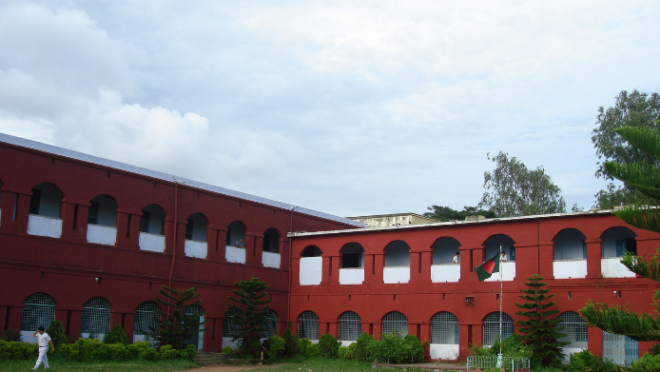
The government has planned to establish 600 modern model schools and colleges across the country, including one boys’ and one girls’ institution in each of the country’s 300 parliamentary constituencies, to expand access to quality education.
The initial cost of the project titled ‘Establishment of 600 Model Schools & Colleges in Selected Areas of Bangladesh’ has been estimated at Tk 68,400 crore, sources said.
The proposed preliminary project aims to ensure equitable access to quality secondary and higher secondary education by developing modern, technology-based and inclusive educational institutions in every constituency, including remote, char, haor and hilly areas.
Under the preliminary proposal, a Planning Commission official told BSS that each of the 300 constituencies will have two separate institutions – one for boys and another for girls – taking the total number of institutions to 600.
According to the preliminary development project proposal (PDPP) submitted by the Secondary and Higher Education Division to the Planning Commission, the proposed project will be implemented by the Directorate of Secondary and Higher Education (DSHE) under the Ministry of Education over five years till 2031.
Of the estimated project cost of Tk 68,400 crore, the government will provide Tk 20,520 crore, representing 30 per cent of the total expenditure, while the remaining Tk 47,880 crore, or 70 per cent, is expected to come from development partners as loans or grants.
The Planning Commission’s preliminary assessment recommends sending the PDPP to the Economic Relations Division (ERD) for necessary action after obtaining policy approval from the minister in charge of the Planning Ministry.
The Commission’s note says the ERD will discuss financing arrangements with potential development partners following the required policy approval.
It also recommends conducting a feasibility study before preparing the detailed development project proposal (DPP) or technical assistance project proposal (TAPP).
World Bank, ADB, JICA among potential financiers
The government has identified the World Bank, Asian Development Bank (ADB), Asian Infrastructure Investment Bank (AIIB), Japan International Cooperation Agency (JICA), Export-Import Bank of Korea (EDCF), Islamic Development Bank and United Nations agencies, including UNESCO and UNICEF, as potential sources of external financing.
The proposed 70 per cent external financing will be arranged through a possible combination of loans and grants. The final financing structure and allocations will depend on negotiations with the development partners.
The project has not yet been included in the list of unapproved new projects under the Annual Development Programme (ADP) for the fiscal year 2026-27.
The Planning Commission has noted that, subject to a positive response from development partners, the government will need to conduct a feasibility study and prepare the DPP or TAPP before including the project in the relevant list of unapproved new projects for securing foreign assistance.
According to the Commission’s assessment, the proposed initiative seeks to address long-standing disparities in educational facilities between urban and rural areas.
Many educational institutions in remote and disadvantaged regions lack modern laboratories, libraries, digital learning facilities and adequate infrastructure, limiting students’ access to quality education.
Rahnuma Nahid, Additional Secretary of the Education Wing of the Socio-Economic Infrastructure Division of the Planning Commission, informed that the Commission received the draft PDPP from the Secondary and Higher Education Division for including it into the ADP of FY27 as a new project.
She said a feasibility study would also be carried out for assessing the viability of the project.
Each institution to accommodate around 1,000 students
The proposed institutions will initially offer education from Grade VI to Grade XII, with an indicative capacity of around 1,000 to 1,100 students each.
At full operational capacity, the 600 institutions are expected to accommodate approximately 600,000 students, including 300,000 girls and 300,000 boys.
Each institution will have a modern academic building, a separate administrative and teachers’ building, science laboratories, STEM, artificial intelligence (AI) and technology facilities, computer and language laboratories, libraries and digital learning centres.
The proposed infrastructure will also include an auditorium, cultural facilities, a mosque, a medical and first-aid unit, a central kitchen and dining hall, playgrounds, sports facilities and swimming pools.
A 100-seat residential hostel will be established at each institution to accommodate students who live far away from their educational institutions, particularly those from remote and disadvantaged households.
The proposal also envisages dedicated spaces for career guidance, science clubs, debate, arts, language learning and other extracurricular activities to develop students’ creativity, analytical abilities and practical skills.
Special emphasis on girls’ education
The project will give particular attention to girls’ education, safety and participation through the establishment of 300 dedicated girls’ institutions.
These institutions will have separate and secure sanitation facilities, common rooms and health and hygiene facilities, including menstrual health provisions, to create a safe and supportive learning environment.
The proposal also includes universal-design facilities, such as ramps, lifts, accessible toilets and barrier-free movement, to ensure that students with disabilities and special needs can access education without discrimination.
The project aims to reduce dropout rates and improve student attendance and retention by providing better educational facilities, residential accommodation and nutritional support.
The project will incorporate green and climate-resilient infrastructure through rooftop solar photovoltaic systems, rainwater harvesting, water recycling, energy-efficient equipment, waste segregation and tree plantation.
Digital monitoring and teacher development
The proposed project will integrate educational institutions with the national Education Identity (Edu-ID) system and a management information system (MIS) to monitor student enrolment, attendance, retention and learning outcomes.
Teacher and staff training will also receive priority.
The project envisages around 45 teachers for each institution, alongside administrative, laboratory, ICT, library, nursing, nutrition, hostel and other support personnel.
The proposed network could engage approximately 27,000 teachers when all 600 institutions become fully operational.
Feasibility study to determine final design and cost
The Planning Commission has emphasised the need for a feasibility study to assess the project’s technical, financial and institutional viability before finalising its design and expenditure.
The study will examine land availability, site selection, construction standards, infrastructure requirements, student capacity, environmental and social safeguards, staffing needs and implementation arrangements.