We joined social media at 11. Why are we drawing the line at 16?
Coming across a recent petition on the fact that, Bangladesh is considering a policy to regulate social media use among children those who are under 16. But before deciding where to draw the age line, my ask is why we allowed an entire generation to grow up online without meaningful safeguards in the first place.
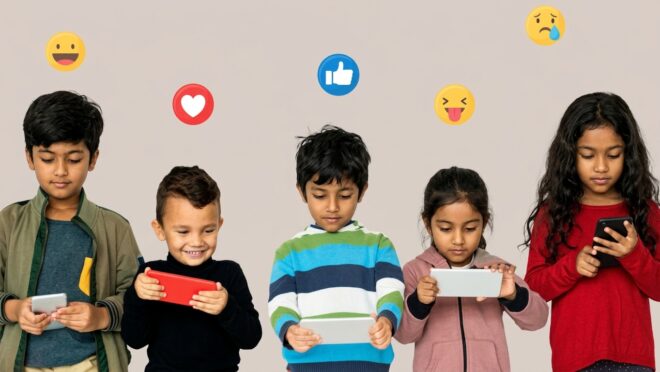
Children now around the age of 11 or 12 uses social media and have practiced that as a regular part of their life. And I suspect that experience is not particularly different from that of many people around that age. Facebook accounts, YouTube videos, online games, Instagram, eventually TikTok. Talking about us, we grew up with these platforms, gradually learning how to navigate the internet long before we understood what it could do to us.
Back then, having a Facebook account felt like matured enough. Being online meant being connected with friends, following trends, sharing photographs and discovering things beyond our immediate surroundings. Nobody particularly questioned whether an “11-year-old” was emotionally prepared for the digital environment they were entering.
Now, years later, the conversation has changed. On 22 November, the BD High Court directed the authorities to formulate a policy regulating social media use by people under 16. It also directed the formation of an expert committee comprising cybersecurity specialists, child psychologists, pediatricians and legal experts to assess the impact of social media on children.
The question is not simply whether children should be allowed on social media before turning 16. It is why 16? And why not 11 or 12 or below 16 any age?
And what exactly changes when someone turns 16 that makes them sufficiently prepared to enter a digital environment that we, as adults, are still struggling to understand?
We were children too. There is something interesting about the current debate. Many of the adults expressing concerns about children’s social media consumption today were themselves introduced to these platforms at relatively young ages.
Some of us started using Facebook at 11 or 12. Others discovered YouTube, online gaming and Instagram around the same time. We did not necessarily have parental supervision, digital literacy lessons or clearly established boundaries. We figured things out as we went along. But the internet we entered was not necessarily the internet children are entering today.
Social media has evolved from relatively simple networking platforms into sophisticated attention driven ecosystems. Algorithms determine what appears on our feeds. Recommendation systems continuously introduce new content. Advertising is personalized, engagement is monetized, and platforms compete for users attention.
A child opening an application today is not simply entering a space where friends share photographs. They are entering an environment designed to keep them engaged. The distinction matters.
The problem is not necessarily that children are using technology at an early age. It is that the digital environment has become considerably more complex while our understanding of how children should navigate it has not evolved at the same pace.
What does the ICCDDRB research tell us? The High Court’s directive has brought renewed attention to research conducted by the International Centre for Diarrheal Disease Research, Bangladesh.
Published in JMIR Human Factors on 4 May 2026, the study titled “High Screen Exposure and Its Association with Physical and Mental Well-Being Among School-Going Children and Adolescents in Bangladesh” examined 420 school-going children aged 6 to 14 from six schools in Dhaka.
The research team included Shahria Hafiz Kakon, Tanjir Rashid Soron, Mohammad Sharif Hossain, Biplob Hossain, Fahmida Tofail and Rashidul Haque. Kakon, an ICCDDRB researcher, served as the lead and corresponding author.
The findings deserve attention. Of the 420 participants, 350, or 83.3%, spent more than two hours daily in front of digital screens. Their average daily screen exposure was 4.6 hours. Around 35.7% reported eye problems, while 80% reported headaches. Perhaps more concerning was the difference in sleep duration: children with higher screen exposure slept an average of 7.3 hours, compared with nine hours among those with lower exposure. The study also found that 31% of participants had at least one identified mental health problem.
These findings should not be dismissed as another discussion about children spending too much time on their phones. They point towards a wider public health concern involving sleep, physical activity, eyesight and psychological well-being.
However, there is an important distinction worth making. The study examined overall digital screen exposure. Nor does its cross-sectional design establish that screen exposure directly caused every health outcome observed. Nevertheless, it provides a significant reason to reconsider how children interact with digital technology.
Why 16? Is this a scientific line?
The age of 16 is increasingly being considered by policymakers as a regulatory threshold for children’s access to social media. But it is important to understand that 16 is not a scientifically established point at which a child’s brain suddenly becomes immune to harmful digital experiences. Child development does not operate according to a birthday.
An 11-year-old, a 13-year-old and a 15-year-old or X, Y, Z can have significantly different levels of emotional maturity, judgement and digital literacy. Even two children of the same age can respond very differently to online environments.
So, why establish an age threshold? Because public policy requires identifiable boundaries. An age based restriction can provide a starting point for determining who needs additional protection and what responsibilities platforms should carry.
The intention should not be to suggest that everyone under 16 is incapable of making decisions. Rather, it should recognize that children are still developing different ability.
At the same time, turning 16 should not be treated as an automatic qualification for navigating every corner of the internet. If the proposed age restriction is to be meaningful, the government must explain the evidence behind the threshold, how it will be implemented and why it is appropriate for Bangladesh. Otherwise, 16 risks becoming just another number in a policy document.
Perhaps we should also look at ourselves. There is another uncomfortable dimension to this discussion. Children do not develop their digital habits in isolation. They observe adults. The ICCDDRB research itself reported that parents spent an average of 3.9 hours daily on screens. In the high-exposure group, the average parental screen time was 4.3 hours.
In an interview with The Daily Star, lead researcher Shahria Hafiz Kakon discussed how the COVID-19 pandemic normalized children’s dependence on digital devices. What initially became necessary for online education and social interaction continued even after schools returned to physical classrooms.
He also highlighted how parents and teachers’ failure to address the growing dependence contributed to the problem. This raises an important question i.e. how can we expect children to develop healthy digital habits when the adults responsible for guiding them?
A child who sees their parents constantly checking notifications, scrolling through Facebook during family conversations and spending hours watching videos is learning something about technology, whether intentionally or otherwise.
Parents have a role. Schools have a role. Technology companies have a role. And the state has a responsibility to ensure that children’s safety is not left entirely to individual families. A restriction cannot replace a solution Regulating social media access might be a reasonable starting point. But it cannot be the entirety of the policy response.
Consider the circumstances in which many Bangladeshi children grow up. Safe playgrounds are limited in many urban neighborhoods. Outdoor recreational opportunities are often inadequate. Academic pressure occupies a considerable portion of children’s daily lives.
When children have limited opportunities to play, explore, socialize and participate in extracurricular activities, digital entertainment becomes an accessible alternative. Removing access to social media without addressing these conditions may simply shift the problem elsewhere. There must also be investment in digital literacy.
Schools could introduce age-appropriate digital citizenship programs. Parents could receive practical guidance on screen-time management. Platforms should be held accountable for age-appropriate design, safer default settings and effective child-protection mechanisms.
And if an age restriction is introduced, its enforcement must not create a new problem involving excessive collection of children’s personal information or intrusive identity verification. A policy intended to protect children should not compromise their privacy in the process. We cannot change how we grew up, but we can change what comes next. I do not think the solution is to romanticize a childhood without technology. That world is largely behind us.
The objective, therefore, should not be to keep children away from technology indefinitely. It should be to ensure that technology does not come at the expense of their childhood. Perhaps the more important question is not whether an 11-year-old should have a social media account or whether 16 is the correct age to introduce one. It is whether we are building an environment in which an 11-year-old can safely explore the digital world, learn from it and benefit from it without being exposed to risks they are not yet equipped to manage.
But if we are serious about protecting children, we must do more than put an age limit on an application. We must take responsibility for the digital environment we have created for them. And then as a whole if it makes sense, then it’s intellectual to sign the law, otherwise re-writing the law.