Bandarban hill school gets electricity through donor support
Children at Paomum Tharkla School in the remote hills of Bandarban are now studying under electric lights and ceiling fans for the first time, following the installation of a solar power system at the community-run school.
Bandarban hill school gets electricity through donor support
Children at Paomum Tharkla School in the remote hills of Bandarban are now studying under electric lights and ceiling fans for the first time, following the installation of a solar power system at the community-run school.
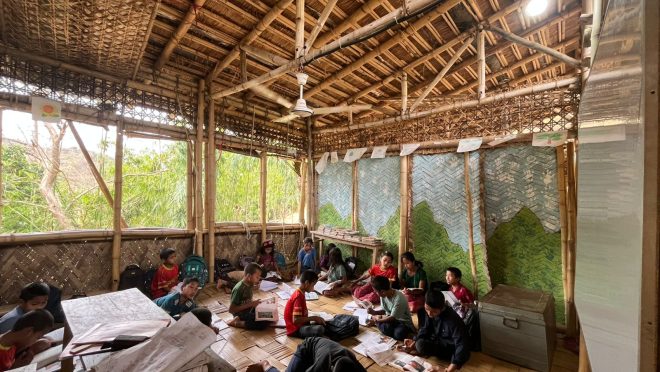
The development marks a major change for a village long cut off from basic services and was made possible through support from several organisations and individual donors.
Pawmum Tharkla, which means “new bud” in the Mro language, began in 2016 as a small community school in a thatched hut for a handful of local children. Over the years, it grew into a three-classroom tin-roofed building through local volunteer efforts and community participation.
Students pay a small monthly fee, parents help maintain the school, and funds raised through the sale of children’s artwork and local produce have helped sustain its operations.
The breakthrough came in February 2026, when the school installed a solar power system supplying electricity to classrooms, the office, veranda and hostel. Thirty lights and nine fans now run on electricity generated by four solar panels connected to batteries and an inverter.
The project was supported by the Azimur Rokeya Rahman Trust in collaboration with Youth Development for Sustainable Bangladesh. Additional contributions came from donors including Anika Karim, Minal Chowdhury, Sadia Tasnim, Lutfar Rahman and Bishakha Tanchangya.
Head teacher Kain Tong Mro said, “We never imagined that lights and fans would run in this school. The solar installation has transformed how children study, especially in the hostel during the summer heat.”

The land for the school was donated by local resident Changkok Mro, while community members continue to support maintenance and fundraising. Organisers said the combined efforts of local residents, donors and partner organisations have created a sustainable model for education in remote areas.
With electricity now in place, the school is planning to introduce online learning. Although mobile network coverage is still unavailable in the village, a supporter has pledged to install a Starlink satellite connection. School organisers said access to the internet, along with equipment such as laptops, cameras, monitors and printers, would allow students to connect to lessons from across the country.
Pawmum Tharkla is part of a wider network of schools initiated by Uthoiyoy Marma, a government primary school teacher from Lama. Other hill schools receiving support from corporate and NGO partners include Chennoy Non-Government Primary School in Lama, Rengyonpara Asha Hoffnung School in Naikhongchhari, and Asha Hoffnung Anandamoyi School in Popa Badlapara.
Organisers said these institutions are helping communities where formal education has long remained out of reach.
Uthoiyoy Marma said education in these areas is not only about learning, but also about dignity and opportunity. His goal is to establish at least one primary school in every hill village in Bandarban, with teaching in indigenous languages alongside Bangla, English and mathematics.
The example of Pawmum Tharkla, organisers said, shows how coordinated support from communities, donors and development partners can bring meaningful change to remote areas.