Youths demand roadmap for 10,000MW solar target
Youths demand roadmap for 10,000MW solar target
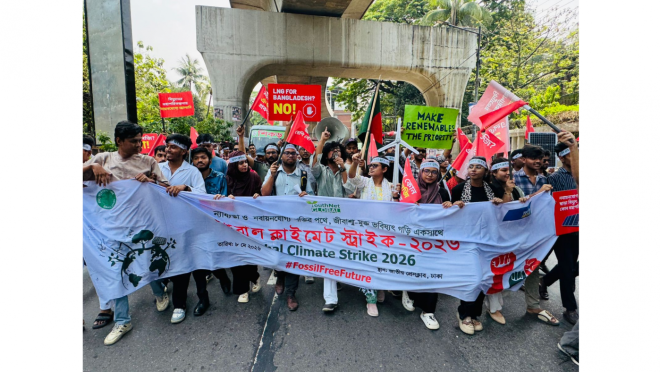
Young climate activists have welcomed the government’s plan to generate 10,000MW of solar power by 2030, but called for a clear, time-bound roadmap to turn the target into reality.
They also demanded a higher share of renewable energy in the upcoming Energy and Power Sector Master Plan and a gradual phase-out of fossil fuel dependence.
The demands were made at a global climate strike held in front of the National Press Club in Dhaka today (8 May).
The programme was organised by YouthNet Global and Youth for NDCs, where more than 200 young people gathered with banners, placards and slogans highlighting the economic and environmental costs of importing oil, gas and coal.
Addressing the programme, YouthNet Global Executive Coordinator Sohanur Rahman said Bangladesh cannot achieve climate justice while remaining dependent on fossil fuels.
“Every new LNG import deal increases pressure on ordinary people and deepens our vulnerability to global instability,” he said.
He said young people are demanding a just transition powered by renewable energy, where energy is affordable, locally generated and sustainable.
“The upcoming EPSMP must include a clear roadmap for at least 10,000MW of solar by 2030 and a significantly higher share of renewables in the national energy mix,” he added.
Chanting slogans demanding 10,000MW solar power, a stronger EPSMP with renewables and an end to future dependence on costly imported LNG, the youths warned that continued dependence on fossil fuels is undermining economic stability, energy security and climate resilience.
Youth4NDC Founder and Executive Director Amanullah Porag said, “We cannot keep paying the price of global instability, unnecessary wars and geopolitical disorder. Our economy is suffering from the rising cost of fuel, electricity and energy, and survival is becoming more expensive every day. We need more affordable energy, and we need an immediate shift towards renewable energy.”
The demonstration took place amid escalating global energy market disruptions triggered by geopolitical tensions, which have destabilised fuel supply chains and driven up global energy costs.
For import-dependent countries such as Bangladesh, this has translated into rising energy insecurity and growing reliance on costly LNG, oil and other fuel options.
Speakers said the country’s growing energy crisis reflects long-standing overdependence on fossil fuels.
“We cannot sell our future to fossil fuels. We do not just need a safe and secure energy future; we need energy sovereignty for our country, and the government should enable that system. There is no alternative to renewable energy for a safe future,” one speaker said.
While acknowledging that the 10,000MW solar target is achievable, youth climate activists also pointed to persistent implementation gaps.
They cited the government’s previous target to generate 3,300MW of rooftop solar power from public buildings by December 2025, which has yet to materialise.
The activists said the electricity crisis is worsening and people are already under pressure from rising energy costs.
They said global fuel price hikes are forcing the government to import LNG at more than double the previous rates, while reliance on imported energy and loans is making electricity more expensive and increasing public debt.
They warned that any further price increase would hit low-income families the hardest.
They also said persistent setbacks in renewable energy expansion are being driven by high taxes on solar equipment, investment bottlenecks and policy uncertainty.
While welcoming the recent government announcement on expanding the public-private partnership model in the energy sector, the youths said policy announcements must be matched with real action.
They demanded urgent removal of tax barriers on solar equipment, faster project approvals and strong inter-agency coordination.
Referring to Bangladesh’s international commitments, the activists said reducing carbon emissions is not optional.
“As a signatory to global climate agreements, Bangladesh must accelerate its transition to renewable energy,” they said.
They also urged developed countries to honour their climate finance commitments and accelerate financial support for renewable energy transition in climate-vulnerable countries such as Bangladesh.
Expressing solidarity with the youth movement, Institute for Energy Economics and Financial Analysis Lead Energy Analyst Shafiqul Alam said renewable energy is essential to building a liveable planet.
In Bangladesh’s case, its importance is even greater because the country remains heavily dependent on fossil fuels, he said.
He welcomed the government’s various plans to expand renewable energy development, but stressed that there must be a clear mechanism for implementing those plans.
At the same time, he said there should be a monitoring system to ensure that the plans are actually carried out.
Waterkeepers Bangladesh Coordinator Sharif Jamil said, “Transitioning away from fossil fuels is no longer merely a demand to respond to the planetary emergency caused by the catastrophic impacts of climate change.”
“With the ongoing reality of global unrest and blockade of the Strait of Hormuz, ensuring energy security through the development of renewables has become an issue of our independence. We must expand solar and wind as quickly as possible,” he said.
He added that large areas of unused land acquired for coal- and gas-based power plants in Bangladesh should be fast-tracked for solar projects.
Organisers said similar climate strike programmes were held simultaneously in 50 districts across the country, drawing participation from school, college and university students.
The rally concluded with a clear message that Bangladesh must urgently shift away from fossil fuel dependence and adopt a comprehensive, actionable masterplan to build a sustainable, renewable energy-driven future for all.