East Delta University hosts discussion on “Policy for Development: Paradox or Priority”
The Department of Public Leadership, Management, and Governance (DPLMG) at East Delta University (EDU) recently hosted a roundtable discussion titled “Policy for Development: Paradox or Priority”, bringing together eminent scholars, policymakers, and experts to exchange insights on sustainable development, the gender gap, policy paradox, and key policy challenges.
East Delta University hosts discussion on “Policy for Development: Paradox or Priority”
The Department of Public Leadership, Management, and Governance (DPLMG) at East Delta University (EDU) recently hosted a roundtable discussion titled “Policy for Development: Paradox or Priority”, bringing together eminent scholars, policymakers, and experts to exchange insights on sustainable development, the gender gap, policy paradox, and key policy challenges.
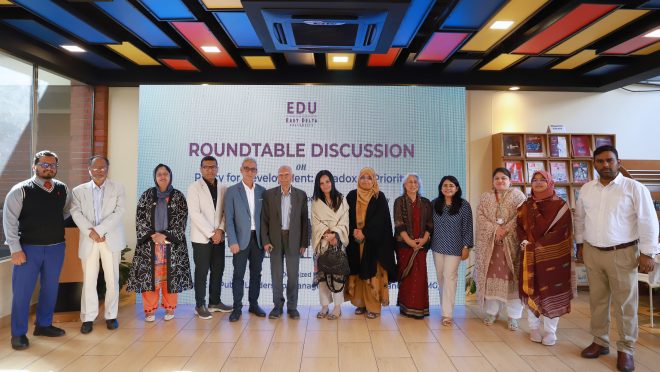
The session was graced by distinguished speakers, including Dr Munia Amin, Managing Director of GenX Health Ltd.; Dr Nahreen I. Khan, Professor at Jahangirnagar University; Dr Ridhwanul Haq, Professor at the Institute of Business Administration, University of Dhaka; Architect Professor Syeda Zarina Hossain; and Advocate Kaniz Kawser Chowdhury. The discussion was moderated by Tasmeem Chowdhury Bonhi, Chairperson of the Department of Public Leadership, Management, and Governance at East Delta University.
The event was also attended by senior EDU officials, including Vice Chancellor Professor Dr Nazim Uddin (PhD); Professor M. Sekandar Khan, Professorial Fellow and Advisor to the Board of Trustees; Professor Shams Ud Doha, Controller of Examinations and Ex-Treasurer; Professor Dr Rashed Al Karim, Associate Dean of the School of Business Administration; and Associate Professor Dr Mohibul Kabir, Associate Dean of the School of Science, Engineering, and Technology.
During the discussion, participants shared perspectives on the multifaceted aspects of multisectoral development, emphasising the need for well-planned policies, skilled manpower, and modern infrastructure. Topics ranged from sustainable urban growth to education reform, healthcare advancement, and the importance of maintaining ecological balance in the city’s green and port areas. The discussion also highlighted the importance of informed citizens in selecting suitable leaders and ensuring accountability.
Speakers noted that Chattogram, as one of Bangladesh’s key economic hubs, holds immense potential if development initiatives are guided by effective policy frameworks and strategic collaboration among government, academia, and the private sector.
The roundtable concluded with a consensus that sustainable development should be treated not as a paradox but as a priority, with every policy decision aligned with the vision of an inclusive, resilient, and future-ready Bangladesh. Participants emphasised that participatory development remains key to achieving the Sustainable Development Goals (SDGs) and should be prioritised by the upcoming government.