IUB hosts seminar on measles prevention and response
IUB hosts seminar on measles prevention and response
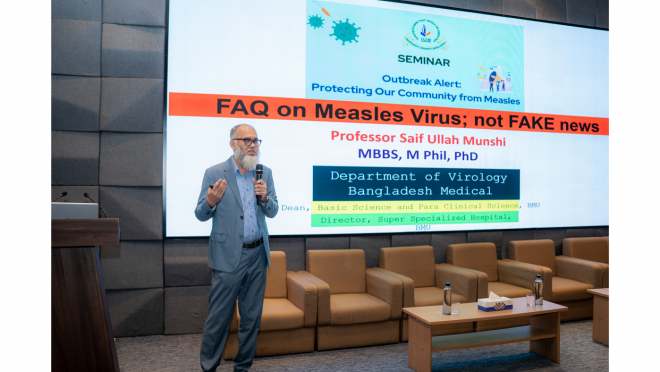
The Department of Public Health at Independent University, Bangladesh (IUB), held a seminar entitled “Outbreak Alert: Protecting Our Community from Measles” on 8 April 2026 at the DMK Lecture Gallery on campus.
The seminar aimed to raise awareness following the ongoing measles outbreak in Bangladesh, which has resulted in the deaths of numerous children and the hospitalisation of thousands nationwide. The event convened health experts, academics, and students to discuss prevention, early detection, and effective response strategies.
Key speakers included Professor Dr Saif Ullah Munshi, Dean of the Faculty of Basic Science and Para Clinical Science and Director of the Super Specialised Hospital at Bangladesh Medical University; Professor Dr Tahmina Shirin, Director of the Institute of Epidemiology, Disease Control and Research (IEDCR) and the National Influenza Centre (NIC); and Prof Dr Muhammad Tawfique, Consultant in Paediatrics at Bangladesh Specialised Hospital.
Professor Dr Saif Ullah Munshi addressed common queries and clarified misconceptions circulating on social media about the measles outbreak. He explained that individuals born after 1990 are generally protected due to vaccination, while those previously infected with measles acquire natural immunity. He added that vaccinated mothers can pass protective antibodies to their children, offering protection up to approximately nine months of age.
He noted that measles poses a heightened risk for children aged one to five, who are more susceptible to severe outcomes, while older children face comparatively fewer fatal complications. The disease spreads through airborne droplets from coughing and sneezing, especially in enclosed spaces such as public transport, classrooms, auditoriums, and airports.
However, he stated that the likelihood of the outbreak escalating into a pandemic this year remains low due to robust vaccination programmes, adding that measles does not persist in the environment like certain other viruses. He urged parents to ensure their children receive two doses of the measles vaccine for maximum immunity.
Professor Dr Tahmina Shirin stated that a suspected measles outbreak is defined by three or more cases in a specific area within a month, while two laboratory-confirmed cases within the same period constitute a confirmed outbreak. She observed that most recent cases have occurred among unvaccinated children.
She further explained that the institutional response to measles outbreaks is led by the Expanded Programme on Immunisation (EPI) under the Directorate General of Health Services (DGHS), with technical support from the World Health Organization (WHO) and additional input from IEDCR as required. She added that the incubation period for measles typically ranges from three to five days, during which symptoms may not be fully apparent, although the virus continues to develop in the body.
Professor Dr Muhammad Tawfique noted that measles may initially resemble a common viral illness, presenting with symptoms such as fever, runny nose, and rash. He clarified that a rash without accompanying fever or runny nose does not necessarily indicate measles. Typically, fever begins at a low level, gradually rises, and persists for three to four days in measles cases.
He added that the characteristic rash typically appears around the third day of illness, beginning along the hairline, around the ears, and at the back of the head, often accompanied by discharge from the eyes and nose before spreading across the body. He also mentioned that tiny sandgrain-like Koplik’s spots inside the mouth, which develop before the rash appears, are a key sign of confirmed measles infection. Irritation and itching can persist for three to four days before subsiding.
Professor Tawfique urged the public not to rely on unverified or misleading information circulating on social media regarding the spread or diagnosis of measles. He emphasised the importance of consulting a registered medical doctor for any suspected symptoms or concerns to ensure accurate diagnosis and appropriate treatment.
IUB Vice-Chancellor Professor M Tamim chaired the seminar. Dr Kamran ul Baset, Dean of IUB’s School of Pharmacy and Public Health, and K Ayaz Rabbani, Dean of the School of Environment and Life Sciences, also addressed the gathering.