NSU seminar explores Asia’s green transformation and opportunities for Bangladesh
North South University’s (NSU) Center for Climate Change and Disaster Resilience (CDR) organised a seminar titled “How Asia is leading the green transformation and how Bangladesh can benefit” on Sunday at the Syndicate Hall of the university.
NSU seminar explores Asia’s green transformation and opportunities for Bangladesh
North South University’s (NSU) Center for Climate Change and Disaster Resilience (CDR) organised a seminar titled “How Asia is leading the green transformation and how Bangladesh can benefit” on Sunday at the Syndicate Hall of the university.
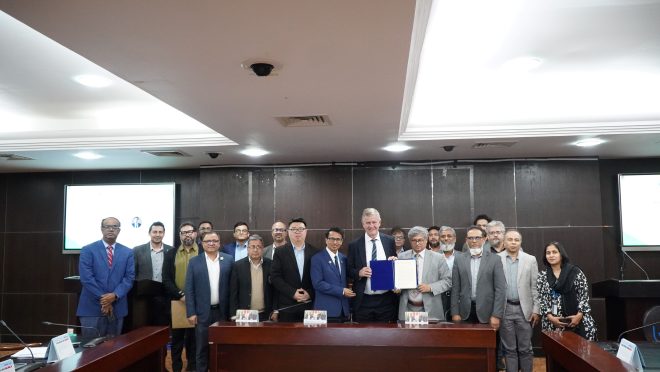
The seminar was graced by Erik Solheim, President of the Belt and Road Green Development Initiative and former Norwegian Minister of Environment and International Development, as the chief speaker.
Professor Abdul Hannan Chowdhury, Vice Chancellor of NSU, chaired the session, while Professor Nasar Uddin Ahmed, Pro Vice-Chancellor of NSU, and Alex Wang, Secretary General of the China–Bangladesh Partnership Forum, were also present. The discussion was moderated by Professor Md Jakariya, Director of the CDR Centre at NSU.
During the programme, North South University conferred the title of Honorary Professor on Erik Solheim in recognition of his contributions to global environmental leadership and sustainable development.
Speaking at the seminar, Solheim highlighted Bangladesh’s strong potential to benefit from Asia’s green transformation. He said there were significant opportunities for the country to invest in solar energy, electric vehicles, recycled-based products, and land protection initiatives. “These sectors present major prospects for the new government, as well as for civil society and businesses, to position Bangladesh as a leading nation in the coming decades,” he said.
Professor Nasar Uddin Ahmed stressed the need for stronger political commitment to environmental policies. He noted that while scientific solutions exist, environmental progress is often hindered by business-driven pressures on policymaking. “The challenge is not a lack of solutions, but a lack of commitment, as business influence can shape political decisions,” he said.
Vice Chancellor Professor Abdul Hannan Chowdhury underscored the environmental costs of rapid industrialisation in Bangladesh. He pointed out that unplanned industrial growth has led to severe pollution of rivers and natural ecosystems. “To address these challenges, we must undertake large-scale, sustainable initiatives and invest in green and efficient energy systems,” he said.
The seminar brought together academics, researchers, and students, creating a platform for in-depth discussion on Asia’s leadership in green development and the pathways through which Bangladesh can advance its sustainable development goals.