Policy to Praxis: DU experts call for institutionalizing women’s rights
A roundtable titled “From Policy to Praxis: Institutionalising Rights, Justice and Action for Women and Girls in Bangladesh” was held at the Social Sciences Faculty conference room of University of Dhaka on Wednesday (11 March).
Policy to Praxis: DU experts call for institutionalizing women’s rights
A roundtable titled “From Policy to Praxis: Institutionalising Rights, Justice and Action for Women and Girls in Bangladesh” was held at the Social Sciences Faculty conference room of University of Dhaka on Wednesday (11 March).
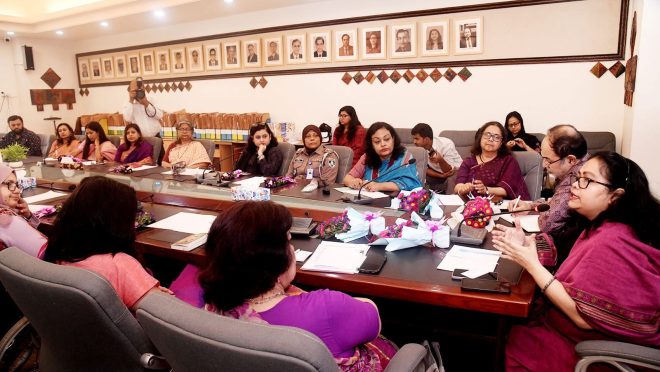
The event was organised by the Centre for Gender and Development Studies, University of Dhaka (CGDS) with support from the Social Sciences Faculty to mark International Women’s Day.
Pro-Vice Chancellor (Administration) of the University of Dhaka, Dr. Sayema Haque Bidisha, attended the programme as the chief guest.
The roundtable was moderated by CGDS Director Dr. Sanzida Akhtar. Dean of the Social Sciences Faculty Dr. Tayebur Rahman spoke as the guest of honour, while Dr. Halida Hanum Akhter, senior faculty member at the Johns Hopkins Bloomberg School of Public Health, joined as the special guest. Professor Dr. Ayesha Banu of the Department of Women and Gender Studies delivered the welcome address.
Speaking at the event, Dr. Sayema Haque Bidisha said that although women have made remarkable progress in education, their participation in quality employment and policymaking remains limited.
She stressed the need to ensure women-friendly work environments to increase women’s participation in the economy. Emphasising the importance of skill development, she said women must be equipped to address emerging challenges such as automation and to improve the quality of their participation in the workforce.
Bidisha also noted the lack of clear, targeted allocations in the national budget for women’s development and employment. She emphasised the need for greater importance to be given to ministries such as the Ministry of Women and Children Affairs and the Ministry of Labour and Expatriates’ Welfare.
She further suggested recognising caregiving as a mid-skill profession, which could create large and dignified employment opportunities for women both at home and abroad.
Highlighting barriers to women’s participation in workplaces, she said childcare support must be expanded beyond elite circles. The state and society should work together to establish community-based daycare centres, particularly for workers in the ready-made garment sector and for low-income women living in urban settlements.
She also proposed introducing incentives in the national budget to encourage private sector involvement in establishing such daycare facilities.
Bidisha added that families and the media must play a stronger role in promoting gender-sensitive attitudes in society. She expressed hope that women’s participation in policymaking in Bangladesh would increase significantly in the next decade, allowing the voices of marginalised women to be better represented.
Representatives from organisations including the Asian Development Bank, Manusher Jonno Foundation, Bangladesh Police, Women With Disabilities Development Foundation, Bangladesh Mahila Parishad and BRAC, along with legal advocacy groups and private universities, participated in the roundtable.