“Sundarbans Across Borders” showcases cultural resilience at British Council auditorium
“Sundarbans Across Borders” showcases cultural resilience at British Council auditorium
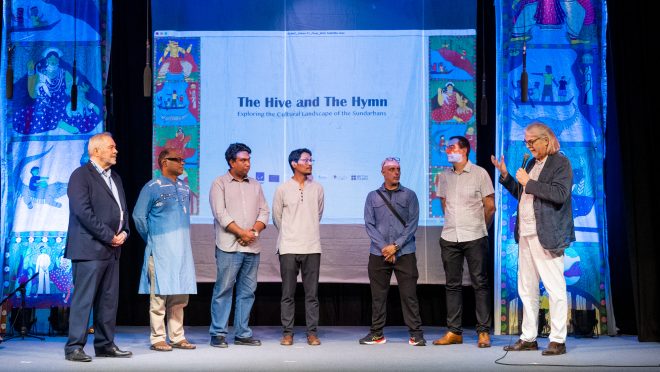
The EUNIC Cluster Bangladesh and the European Union Delegation to Bangladesh, in collaboration with HERITINCE DoABUET, Riverine People and Team Platform, hosted the opening reception and performance event “Sundarbans Across Borders: The Spirit of Cultural Resilience” at the British Council Bangladesh auditorium on 22 February.
The programme highlighted the powerful cultural ties connecting communities across Bangladesh and India, presenting the Sundarbans as a shared ecosystem shaped by intertwined heritage, belief systems and artistic traditions.
A central feature of the event was The Hive and the Hymn, an interdisciplinary exhibition exploring the tangible and intangible cultural practices of Moual (honey collector) communities living along the fringes of the Sundarbans. The exhibition forms part of the broader EUNIC-supported initiative Sundarbans Across Borders: The Spirit of Cultural Resilience, which aims to deepen understanding of the intersection between culture, living heritage and climate resilience on both sides of the border.
Open to the public from 23 to 26 February, daily from 10:00 AM to 8:00 PM, the exhibition features four bodies of Patachitra scroll work — including the traditional Gazir Pat, a contemporary depiction of the honey collection cycle, a vertical retelling of the Bonobibi myth, and a co-created scroll painted by community women and children. These works are presented alongside architectural and cultural research conducted by BUET’s Heritage and Technology Integration Cell and Riverine People, highlighting livelihood practices, settlement patterns, ecological adaptations and spiritual traditions of the region.
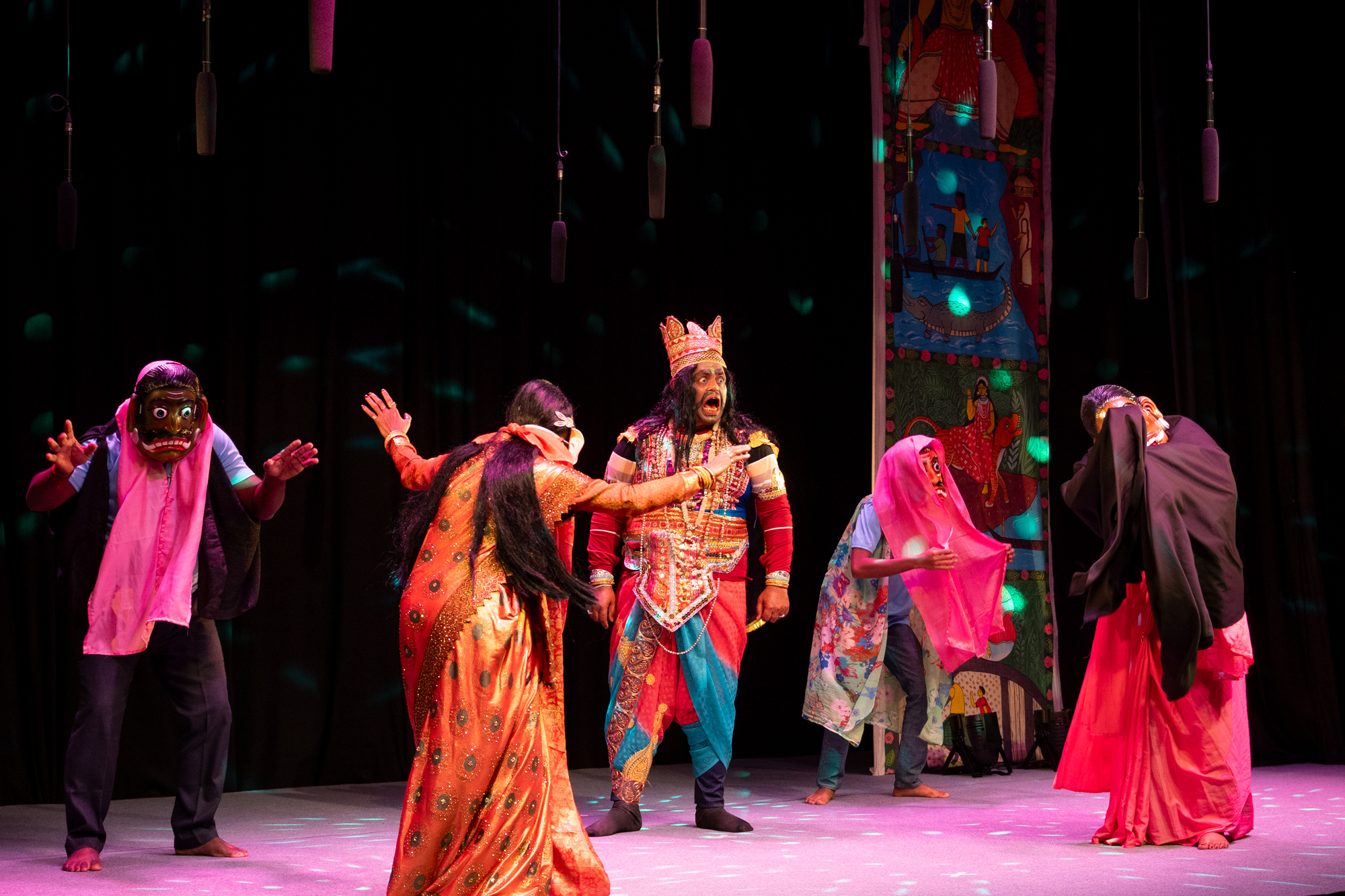
Photo: Courtesy
Visitors also experienced a documentary capturing the project’s research journey, followed by a curator’s tour. A second film spotlighted performers of Bonobibi’r Pala, leading into an 80-minute live staging of Dukhe’r Bonobash by SagorNodi Natyasangstha from Satkhira.
The initiative is co-financed under the EUNIC Cluster Fund 2024, promoting sustainable and culturally grounded collaborations across the region. It brings together partners in Bangladesh and West Bengal, India, engaged in coordinated research, documentation and community engagement.
Stephen Forbes, Country Director of British Council Bangladesh, emphasised the importance of cultural relations in fostering connection and trust between nations, noting that the exhibition celebrates the knowledge, creativity and resilience embedded in Sundarbans heritage.
Frank Werner, President of EUNIC Cluster Bangladesh, described the project as a landmark collaboration — marking the first joint implementation between two EUNIC clusters and offering, for the first time, a comprehensive narrative of the Sundarbans in book form, enabling communities to speak directly to urban audiences through their own artistic voices.
As part of the programme, the official launch of The Saline Quest for Honey will take place on 24 February. Developed under the wider initiative, the publication documents the lives and adaptive knowledge of Mouals and forest-dependent communities of the Sundarbans. Drawing on immersive research in Satkhira’s Shyamnagar region, it combines ethnographic study, field surveys and visual storytelling inspired by the traditional Gazir Pot art form, enriched with field photography and illustrations created in collaboration with local artists.
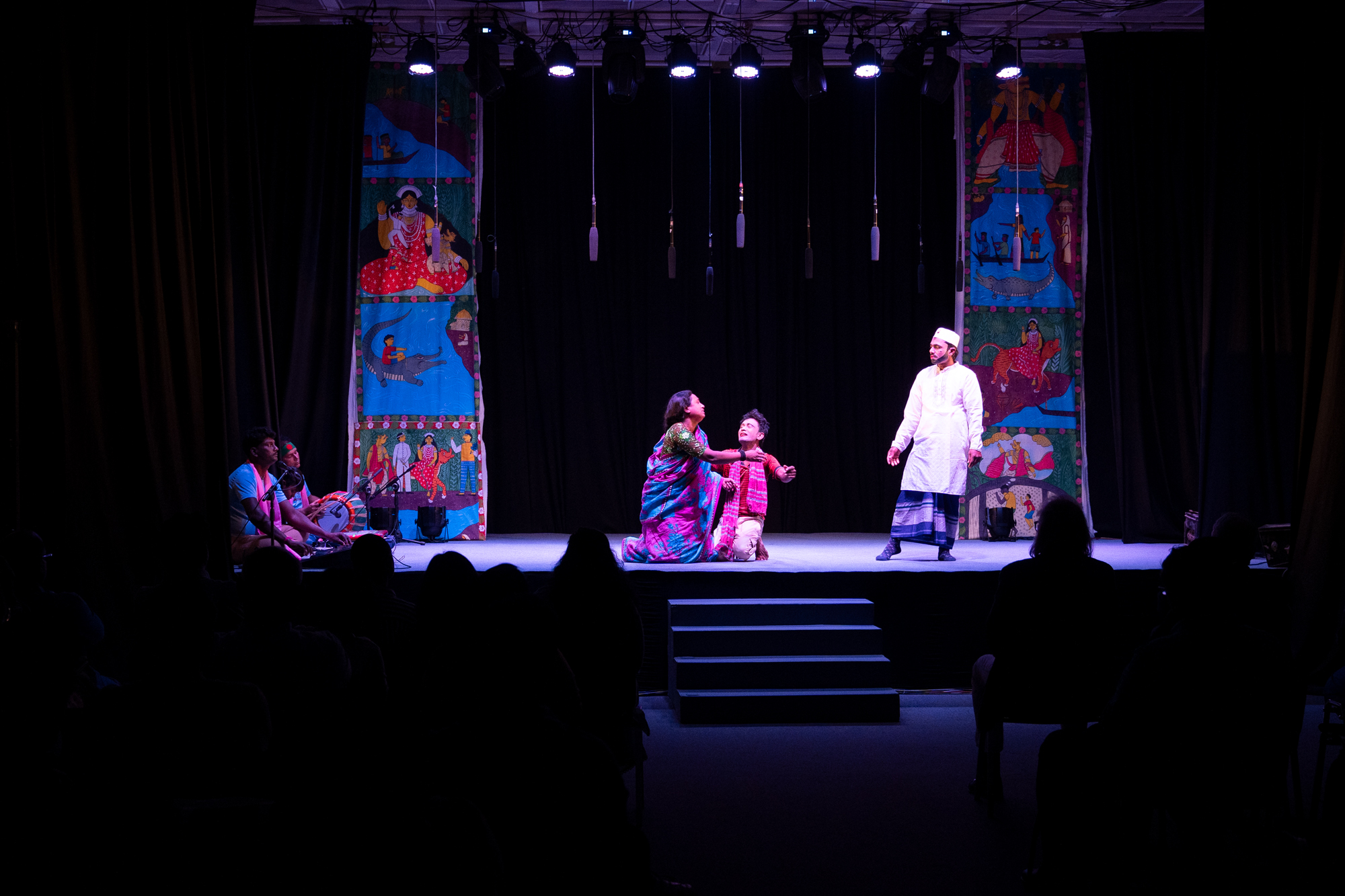
Photo: Courtesy
The launch event included a 15-minute visual presentation capturing the research process — including interviews conducted in Datinakhali and Mirgang, and focus group discussions with members of the Moual and Munda communities — followed by an author panel discussion exploring cross-border collaboration and the ecological and cultural resilience of Sundarbans communities.
Through workshops, field studies, collaborative art production and performances, the project foregrounds the lived experiences of Sundarbans communities — particularly women, who play a vital role in sustaining cultural memory and ecological knowledge.
The event stands as a testament to the power of cultural partnerships in strengthening regional ties, supporting community resilience and bringing global attention to the vibrant cultural ecosystems of the Sundarbans.