Winning business competitions: The JINXED method
Business competitions have seen a sharp rise in terms of popularity, credibility and, most importantly, prize money.
Winning business competitions: The JINXED method
Business competitions have seen a sharp rise in terms of popularity, credibility and, most importantly, prize money.
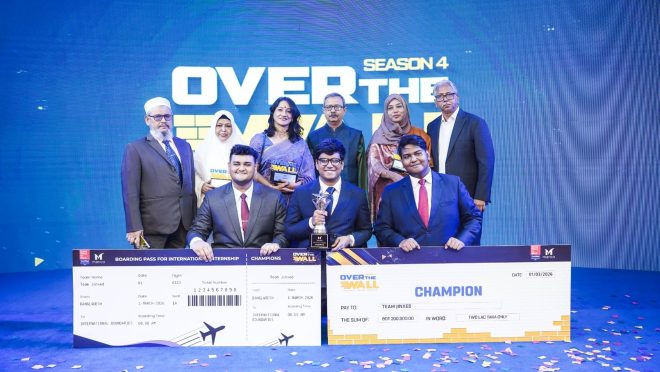
Regardless of why they have gained such prominence, there is no doubt that if you are a business undergrad hoping to land a dream job in a premium MNC, avoiding business competitions is something you cannot afford, quite literally.
In light of such realities, I tracked down the winners of Over The Wall 2025, Team JINXED, to understand what it takes to be the best and what business graduates should know before committing to competitions fully.
The nature of the beast
Business competitions come in all shapes and sizes. Some are hosted by university clubs, while others are designed and run by MNCs themselves. Over The Wall falls into the second category.
The main objective is to introduce a product innovation, either by improving packaging, positioning, or an execution strategy, or by introducing a completely new product.
No matter the nature of the challenge at hand, judges usually look for feasibility and whether the product genuinely addresses a market demand while aligning with the company’s values, long-term vision, and business goals.
Structuring the team
Just like in life, one cannot do everything alone in a business competition. Almost all competitions require the formation of a team. Team selection is therefore extremely crucial, as these are the people who will either support your cause or, inadvertently, work against it.
“Team JINXED is simply three friends from freshman year who wanted to learn together. That comfort allowed us to challenge each other openly and even say harsh things without taking them personally,” shared Rafid, one of the members of JINXED.
According to the team, conflict is not something to be avoided but rather welcomed with a positive outlook. “Healthy conflict is necessary. If you are not arguing with your teammates, then you are not doing it right.”
That said, each individual member of the team must be able to pull their own weight. If not, even a technically sound team may fail easily. However, JINXED believes, quite ironically, that luck also plays a role. “There is always an element of timing, perception and, yes, a role of fate in everything,” they added.
The ammunition for war
Viewing every business competition through the same lens may not be the wisest approach, but similarities do exist. One of the main ones is the task of generating ideas.
As mentioned earlier, an idea can either be entirely unique or one that creates significant impact within an existing model. The ability to identify which ideas are worth pursuing and which should be discarded is the cornerstone of any winning strategy.
Team JINXED clearly shared, “A winning idea fits seamlessly with the company’s existing operations and shows clear potential for profit generation and sustainable growth. An idea may sound exciting, but if it does not integrate well into how the company actually works, it rarely wins.”
The ability to adapt and pivot at a moment’s notice is another highly valued skill. JINXED revealed that they pivoted four times before finalising their idea. “The decision to pivot came from a combination of gut feeling and validation from our mentors. When both intuition and experienced feedback indicate that an idea is not strong enough, it is better to let go early rather than force it forward.”
They also added that judges expect comprehensive research that clearly supports every claim made in the presentation. The research does not need to be excessive, but it must be logical, compact and data-driven. Every slide should be defensible, and every assumption should be supported by reasoning or evidence.
This raises the question of the scope of research and the amount of data required. One thing to remember is that “judges are not looking for perfect or exhaustive datasets,” shared JINXED.
They want to see that the idea is grounded in reality and supported by logical reasoning, consumer insights and relevant market indicators. If the data can clearly explain why the problem exists and why the proposed solution makes sense, it is usually sufficient.
According to them, students can rely on simple and accessible tools such as short surveys, informal consumer interviews, observation, secondary research reports and online data sources. Social media behaviour, online reviews, Google Trends and publicly available industry insights can also provide strong directional understanding.
All in all, a strong team paired with an impactful idea, backed by comprehensive research, can be a showstopper in any business competition. A hint of luck does the rest and turns it into a winning formula.