Grammys 2026: Bad Bunny, Dalai Lama and K-Pop make history on a night of firsts
Records fell and emotions ran high at the 68th Annual Grammy Awards in Los Angeles, where Bad Bunny took the top honour, the Dalai Lama became a surprise winner, and a track from an animated film finally secured K-pop’s first-ever gilded gramophone
Grammys 2026: Bad Bunny, Dalai Lama and K-Pop make history on a night of firsts
Records fell and emotions ran high at the 68th Annual Grammy Awards in Los Angeles, where Bad Bunny took the top honour, the Dalai Lama became a surprise winner, and a track from an animated film finally secured K-pop’s first-ever gilded gramophone
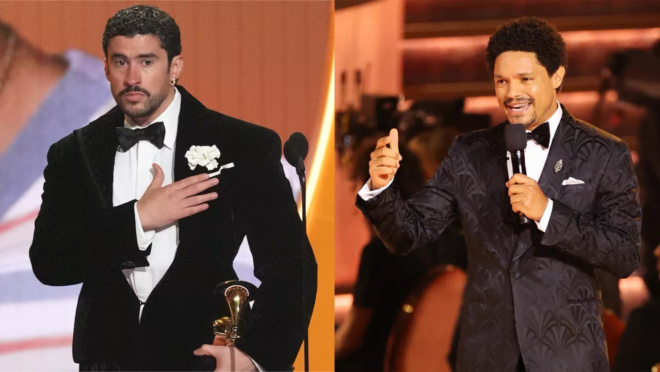
The 68th Annual Grammy Awards will be remembered not just for the music, but for the history books that were rewritten inside the Crypto.com Arena last night. In a ceremony that balanced high-octane performances with moments of profound reflection, the Recording Academy delivered a list of winners that shattered glass ceilings across genres, from Latin trap to K-pop, and even spiritual spoken word.
Hosted for the sixth and final time by the unflappable Trevor Noah, the evening was a celebration of global sounds. Noah, who brought his trademark wit to the proceedings, opened the show by acknowledging the diverse room.
“We have everyone here tonight,” he said during his opening monologue. “We have pop stars, rock legends, and yes, the Dalai Lama is a nominee. If I lose my category to the Dalai Lama, I’m not even going to be mad. I’m just going to seek enlightenment.”
As it turned out, Noah did exactly that.
In one of the night’s most talked-about moments, the 90-year-old Tibetan spiritual leader won the award for Best Audio Book, Narration & Storytelling Recording for his album ‘Meditations: The Reflections Of His Holiness The Dalai Lama.’ The win edged out heavyweights including Noah himself.
Though the Dalai Lama was not present in Los Angeles, the award was accepted on his behalf by musician Rufus Wainwright, a collaborator on the project. “I am obviously not the Dalai Lama,” Wainwright joked, smoothing the tension in the room before reading a statement from His Holiness.
“I receive this recognition with gratitude and humility,” the message read. “I do not see it as something personal, but as a recognition of our shared universal responsibility. I truly believe that peace, compassion, and an understanding of the oneness of humanity are essential for the collective well-being of all eight billion human beings.”
K-Pop finally strikes Gold
While the Dalai Lama brought a moment of zen, the energy shifted dramatically when the winner for Best Song Written for Visual Media was announced. After years of nominations for groups like BTS and BLACKPINK without a win, the barrier was finally broken by ‘Golden’, the smash hit from the Netflix animated film K-Pop Demon Hunters.
The track, a high-energy anthem performed in the film by the fictional group Huntr/x and voiced by real-life talents EJAE and Audrey Nuna, became the first K-pop song in history to win a Grammy. The songwriting team, including hitmaker Teddy and producer 24, took to the stage in visible shock.
“This is not just for us,” said producer 24, switching between English and Korean. “This is for the culture that raised us, the fans who believed in us, and the music that connects us across oceans. K-pop has arrived.” The win sent social media into a frenzy, with “Golden” trending worldwide within minutes.
Bad Bunny takes the crown
The night’s biggest prize, Album of the Year, went to Puerto Rican superstar Bad Bunny for his introspective and critically acclaimed Debi Tirar Más Fotos (I Should Have Taken More Photos). It was a vindication for the artiste, whose previous blockbuster Un Verano Sin Ti had narrowly missed the top award years prior.
Bad Bunny, dressed in a sleek, structured suit that departed from his usual avant-garde streetwear, delivered a passionate speech in Spanish. “Music does not have a language anymore,” he told the cheering crowd. “It has a feeling. Tonight, you felt it. Thank you to the Academy for seeing us, for hearing us.”
And of course, before leaving the stage, he did take a dig at ICE— rightfully so.
Kendrick reigns supreme
While Bad Bunny took the final trophy, it was Kendrick Lamar who dominated the tally sheet. The rap titan walked away with five awards, including Best Rap Album and Best Rap Performance. Lamar, who has often been elusive at awards shows, was present and gracious.
During his acceptance speech for Best Rap Album, Lamar paid tribute to the genre’s longevity. “It is hip-hop as usual, man,” he said, holding his trophy aloft. “I’m not good at talking about myself, but I express it through music. Hip-hop is going to always be right here. We are going to be in these suits looking good, having our folks with us. We are going to be having the culture with us. God is glory.”
Another legend joined an exclusive club last night. Filmmaker Steven Spielberg achieved ‘EGOT’ status (winning an Emmy, Grammy, Oscar, and Tony) after taking home the award for Best Music Film for Music for John Williams, his documentary about the legendary composer. Spielberg’s win was a sentimental favourite, honouring a partnership that has defined cinema for five decades.
Performances that dazzled
The musical lineup was equally impressive. The show kicked off with a nostalgic yet fresh performance by Earth, Wind & Fire, who were joined by rising stars for a rendition of “Shining Star” that brought the entire audience to its feet.
Lady Gaga, returning to the Grammy stage, delivered a theatrical medley from her album Mayhem, reminding everyone of her vocal prowess. She was a central figure at the 2026 Grammys, securing several trophies for her acclaimed album Mayhem and the hit “Abracadabra.” Her haul included Best Pop Vocal Album, Best Dance Pop Recording, and Best Remixed Recording.
Accepting the award for Best Pop Vocal Album, an emotional Gaga thanked her fiancé, Michael Polansky, for standing by her “every single day.” She then delivered a powerful rallying cry to female artists, urging them to “always listen to yourself and always fight for your ideas.” She emphasized that her success was built on “discipline, hard work, and craftsmanship.
However, it was Justin Bieber who stole the mid-show spotlight. Performing at the Grammys for the first time in four years, Bieber delivered a stripped-back, acoustic version of his latest ballad that silenced the arena and earned a standing ovation.
As the ceremony concluded, Trevor Noah bid the audience farewell, marking the end of his six-year run as host. “It has been the honour of a lifetime,” he said, signing off. “Keep listening, keep dancing, and be kind to one another.”
The 2026 Grammys will be recorded as a turning point—a night when the awards finally caught up with the world, recognising that great music comes from everywhere: from the streets of Puerto Rico to the animation studios of Seoul, and even the monasteries of the Himalayas.